Most people who build or buy a new home assume foundation trouble is something that happens to old houses. Then the first crack shows up over a bedroom door, and the question starts: is this new house settling the normal way, or is something wrong underneath it?
It is a question our team hears from owners of newer Tulsa homes, and the answer depends on what the house was built on. Some settling in a new house is just lumber and concrete adjusting. Foundation settlement is a different problem, and the research on how often it shows up in new construction is worth knowing before you build. Below we share what the data says, why new house pads settle, what that movement does to the finishes you paid for, and why the least expensive time to stop it is before the slab is ever poured.
Is It Normal for a New House to Settle?
Yes, a little. A new house is full of materials that are still drying out and adjusting. Framing lumber shrinks as it dries, drywall tape can crack at the corners, nail pops appear, and concrete forms small shrinkage cracks as it cures. Those changes are usually cosmetic, tend to show up in the first year or two, and stop growing once the materials settle in.
Foundation settlement is something else. It happens when the soil under part of the house compresses, shrinks or shifts, and the structure moves with it. Here is a simple way to sort the two.
Usually normal in the first year or two
- Hairline cracks in drywall at the corners of doors and windows that stay hairline
- Small nail pops and tape seams showing through the paint
- Thin shrinkage cracks in a garage floor or patio that do not widen or offset
- A door that needs one small hinge or strike plate adjustment
Worth a closer look
- Cracks that keep getting wider, or cracks where one side sits higher than the other
- Stair step cracks in brick or stone veneer
- Doors that stick, swing on their own or stop latching, especially on one side of the house
- Tile or grout cracking in a line across a room
- Gaps opening between cabinets, countertops, trim or baseboards and the wall
- Floors you can feel sloping, or windows that bind
When several of those show up together, especially in one part of the house, the pattern points to the foundation rather than the framing. Our guides to drywall cracks and sticking doors after a rainy season and the warning signs of foundation problems in Tulsa go through each sign in more detail, and our article on whether exterior wall cracks are cosmetic or structural covers the outside of the house.
How Often Do New Homes Settle? What the Research Shows
No national database tracks every new house that settles, so anyone who quotes you one exact percentage is guessing. What we do have are two solid sources that point in the same direction.
What a national new home warranty company found
2-10 Home Buyers Warranty is a new home warranty company based in Denver. A 2013 Los Angeles Times column by housing writer Lew Sichelman, which called 2-10 the country’s oldest and largest new home warranty company, reported on a review of more than 10,000 structural claims over 32 years by its chief risk manager, Walt Keaveny. Here is what the column reported:
- Structural problems can start on day one, but most claims were reported four to seven years after the owners moved in.
- Only about 20 percent of structural claims involved the framing. The rest concerned foundations.
- The two main causes were active soils that settle, heave or move sideways, and fill material that was not compacted to code requirements.
- Homes where geotechnical engineers were involved in the design were about half as likely to have a structural issue.
- Investigating and repairing a structural claim cost an average of $42,000 at the time.
The same column cited earlier research finding that about 1 in 4 houses will experience some structural distress, and about 1 in 20 will eventually take a major structural hit.
That four to seven year window matters. A typical new home warranty covers workmanship items for one year, plumbing, electrical and mechanical systems for two, and structural defects for ten, as 2-10 explains in its own warranty guide. By the time most structural claims are filed, the one year coverage for drywall, trim and doors has run out.
What geologists found on expansive clay
The Colorado Geological Survey sums up the national picture this way: more than 250,000 new homes are built on expansive soils each year, about 60 percent of them will see minor damage during their useful lives, and about 10 percent will see significant damage, some of it beyond repair. The 250,000 homes and 10 percent figures trace back to a 1973 article in the American Society of Civil Engineers’ Civil Engineering magazine, so treat them as an old estimate rather than a fresh count. The newer warranty data above points the same way.
What that means for a new home in Tulsa
Neither source counted Tulsa homes on their own, so there is no local rate to quote. What we do know is that much of the Tulsa area sits on clay that swells when it gets wet and shrinks when it dries out, which is exactly the soil behavior both of those sources describe. Add hot, dry stretches in summer and heavy spring rains, and a new slab goes through its first full swing from wet to dry within its first year. Our guide to Oklahoma clay soil and foundation damage explains the soil side in depth.
Why New House Pads Settle
The pad is the flat, raised area of soil a new house is built on. On most lots it is a mix of native soil and fill that was brought in or moved around to level the site. A good pad is built in thin layers, with each layer compacted and tested, and the building code expects exactly that. Section R401.2 of the International Residential Code says fill soils that support footings and foundations must be designed, installed and tested in accordance with accepted engineering practice, and Section R403.1 says footings must rest on undisturbed natural soil or engineered fill.
When pads settle anyway, the cause usually comes back to one of these.
Fill that was never compacted properly
Loose fill keeps compressing under the weight of a house for months or years. If it was dumped in thick layers or never tested, the part of the house sitting on the deepest fill tends to drop first. This is the same cause the warranty claims data flagged: fill that was not compacted to code.
Lots that are part cut and part fill
On a sloped lot, the builder often cuts soil from the high side and moves it to the low side to make a level pad. The result is a house that sits partly on firm native ground and partly on new fill. The two halves do not settle at the same rate, and the crack usually shows up right along that line. Engineers call this differential settlement.
Clay that swells and shrinks underneath
Even a perfect pad sits on whatever clay lies below it. When that clay dries out in late summer and swells again in the spring, the slab rides along. The edges of a slab usually move the most, because the soil at the perimeter dries out and soaks up water faster than the soil under the middle of the house. That is why corner cracks and sticking exterior doors are so common. Our article on how Oklahoma clay soil damages foundations shows what that cycle looks like over several seasons.
Water going to the wrong place
New lots have fresh grading, young landscaping and gutters that may or may not have extensions yet. The code calls for the ground to fall at least 6 inches within the first 10 feet away from the foundation (IRC Section R401.3), but that slope gets disturbed by fences, flower beds and backfill that sinks over time. Water that collects against a new slab soaks the clay on one side of the house and not the other. Our foundation drainage systems page and our Tulsa drainage solutions guide cover the fixes.
A foundation built to the minimum
Here is a part of the code many buyers never hear about. The code expects foundations on expansive soil to be designed for it, but it makes an exception: a slab that has performed adequately in similar soil conditions can be approved by the building official (IRC Section R403.1.8). And where expansive or shifting soil is likely, the code leaves it to the building official to decide whether a soil test is required at all (Section R401.4). Plenty of new homes are built under those rules and do fine. Some do not, and those are the homes that end up needing foundation repair a few years later.
What Settlement Does to a New Home’s Finishes
When a new house settles, the foundation is only part of the story. The movement travels up through the framing and shows up in everything that was built to be straight and tight:
- Drywall cracks above doors and windows, and ceiling cracks along the seams
- Cracked tile and grout in kitchens, baths and entries
- Hardwood or vinyl plank floors separating at the seams
- Cabinets pulling away from the wall and countertops cracking
- Interior doors that rub or will not latch, and windows that bind
- Stair step cracks in brick or stone veneer outside
- Trim, baseboards and crown molding opening up at the joints
Foundation repair can stabilize the house, but it does not patch the drywall, regrout the tile or rehang the doors. Those repairs come afterward, and in a new home with expensive finishes they add up quickly.
Insurance rarely helps. The standard ISO HO 00 03 homeowners policy form excludes settling, shrinking, bulging or expansion, including resultant cracking, of footings, foundations, walls, floors, roofs or ceilings. Our article on homeowners insurance and foundation repair in Oklahoma covers the few situations where a claim can work.
A builder warranty may help, but read it closely. The ten year structural coverage only applies when the damage meets the warranty’s own definition of a structural defect, so ask for the performance standards booklet before you close, just as the Times column recommended.
Why Settlement Is Easier to Prevent Before the Slab Is Poured
Most of those problems cost less to prevent than to repair, and the simplest time to deal with the soil is before the concrete goes down. That is the whole idea behind pre-construction helical piers in Tulsa.
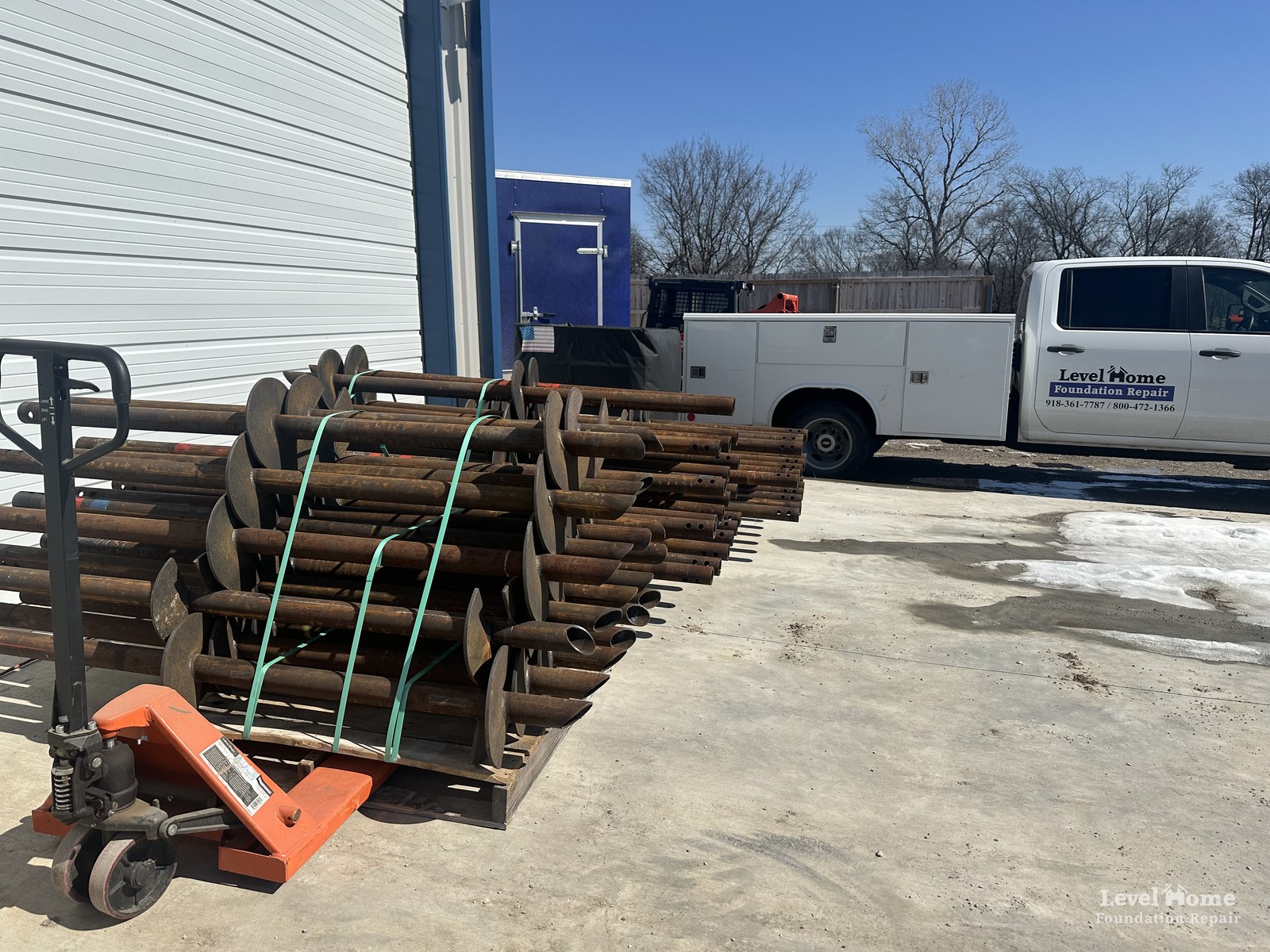
A helical pier is a steel shaft with one or more spiral plates welded near the tip, a lot like a giant screw. On a new build, our crew installs the piers after the pad is graded and before the foundation is poured. The slab or grade beams are then poured onto the pier system, so the weight of the house rides on steel anchored in stable soil instead of resting entirely on the pad.
How the piers carry the house
A hydraulic torque motor turns each pier down through the fill and the active clay until the plates engage firm bearing soil. In the Tulsa area, our residential helical piers typically reach 15 to 25 feet. At that depth, the seasonal wetting and drying near the surface has far less effect, so the house depends far less on whatever the top few feet of clay are doing. Our article on how deep helical piers go explains what sets that depth.
How each pier is checked
Helical piers give you a way to check the work as it goes. The torque needed to turn a pier into the ground rises as the soil gets stronger, and the International Building Code (Section 1810.3.3.1.9) lists well documented correlations with installation torque, along with load tests, among the ways to determine a helical pile’s capacity. Our crew verifies torque on every pier and documents the results, so the builder and engineer have real numbers for each support point instead of an assumption.
Where they make the biggest difference
- Lots with deep or uneven fill, or a cut and fill transition under the house
- Sites where the soil report shows highly expansive clay
- Homes with finishes that crack easily and cost a lot to redo, such as stone veneer, large tile floors and stone countertops
- Additions tied into an existing house, where two foundations need to move as one (see our article on helical piers under a home addition)
- Custom homes where the owners plan to stay for decades
For the engineering side of that decision, our guide to when a Tulsa building project needs helical piles explains how soil reports drive the recommendation, and our complete guide to helical piers covers how they work.
Pay Once Instead of Twice
When a house on an unsupported pad starts to settle, the owner pays twice. First comes the foundation repair, which on a finished home means digging along the outside walls or working through finished floors to reach the slab. Then comes a second bill for the drywall, tile, trim and doors the movement damaged. Piers installed during construction go in before there are finished floors and walls to work around, and they lower the odds of facing both bills later.
That is the same thinking behind every recommendation we make: solve the problem once. A foundation that saves money at the pour and needs repair in year six did not save anything. For a closer look at the numbers, see our comparison of pier costs before and after construction and our breakdown of foundation repair costs in Oklahoma.
We will also tell you when piers are not needed. If the soil report shows stable ground, the pad was built and tested properly, and the engineer’s foundation design fits the site, a conventional foundation may be the right call. Our job is an accurate assessment, not an upsell.
Questions to Ask Before Your Slab Is Poured
Whether you are building in Tulsa, Broken Arrow, Bixby, Jenks or Glenpool, these questions are worth asking your builder before the concrete truck shows up:
- Was a geotechnical report done for this lot? The warranty company’s chief risk manager told the Times that homes designed with geotechnical input are about half as likely to have structural trouble.
- How was the pad built? Ask how deep the fill is, where it is deepest, and whether each layer was compaction tested.
- Is the house on a cut and fill transition? If so, ask how the foundation design accounts for it.
- What is the foundation designed to do on this soil? Ask whether it includes deep support or relies on the pad.
- Where will the water go? Confirm the final grade falls away from the house and the gutters discharge away from the foundation.
- Who verifies the piers? If piers are part of the plan, ask for the torque and depth records for each one.
- What does the warranty actually cover? Ask for the structural defect definition and the performance standards booklet in writing.
We are glad to walk through those answers with you or your engineer. Our processes are approved by engineering firms across Texas and Oklahoma, and we have never failed an engineer reinspection. You can see how we work with Tulsa structural engineering firms on our engineering page.
What to Do If Your New House Is Already Settling
If you are seeing the warning signs above in a newer home, act early. Take dated photos, measure crack widths, note which doors stick and when, and check your builder warranty for deadlines and notice requirements. Then have the foundation evaluated by someone who will explain the cause, not just sell a fix. Our foundation inspection guide explains what a good inspection should cover.
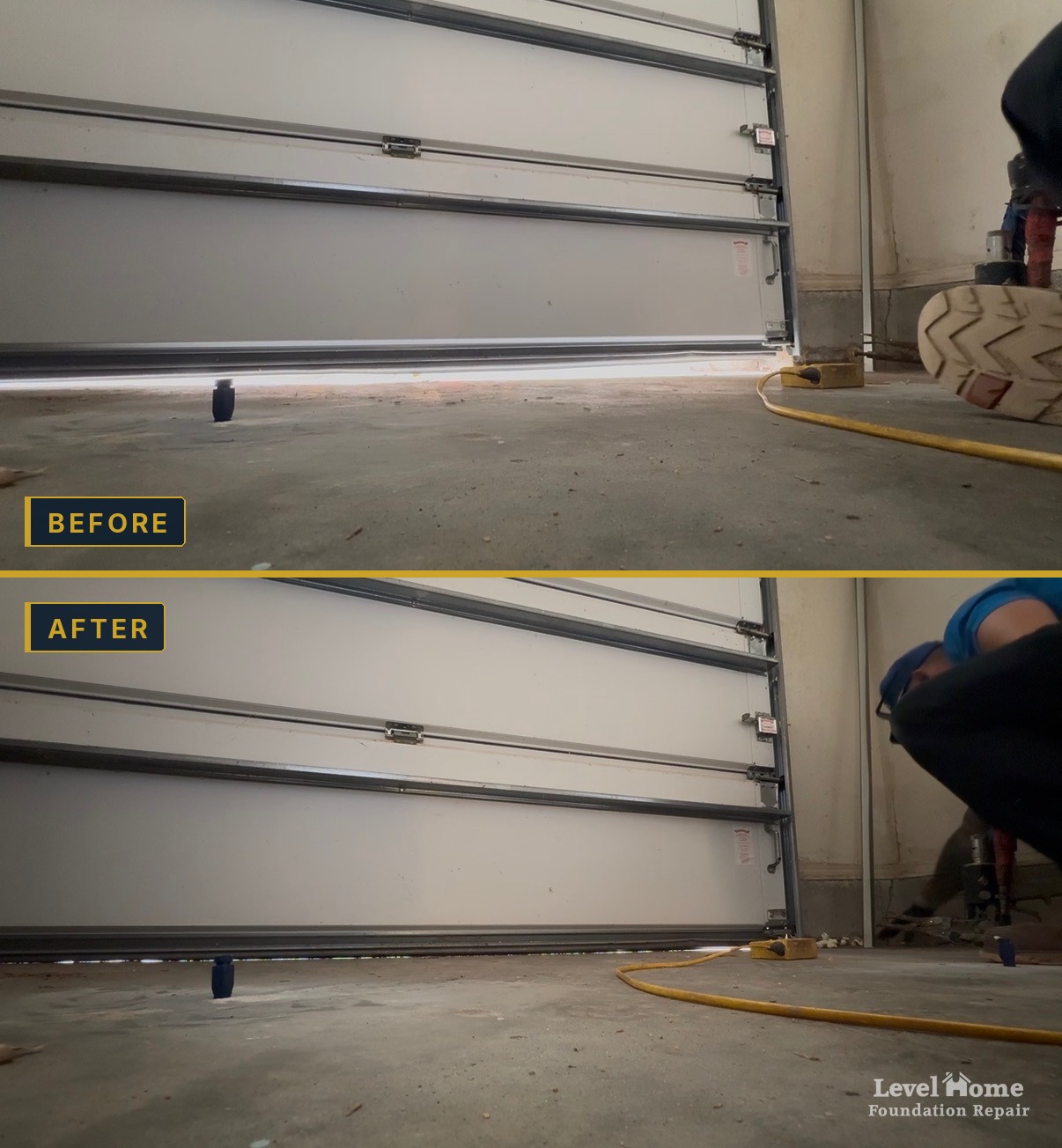
Helical piers are not only for new construction. On an existing home, helical piers or steel piers can stabilize the foundation and, in many cases, lift it back toward level. Our comparison of steel piers versus helical piers explains which fits which situation, and our slab foundation repair page covers the process on a finished home.
Key Takeaways
- Some settling in a new house is normal: hairline drywall cracks, nail pops and small shrinkage cracks from drying lumber and curing concrete.
- Foundation settlement is different. Research cited in a 2013 Los Angeles Times column on new home warranties estimated that about 1 in 4 houses will see some structural distress and about 1 in 20 will eventually see a major structural problem.
- In national 2-10 Home Buyers Warranty claims data reported in 2013, most structural claims came four to seven years after move in, driven mainly by active soils and fill that was not compacted to code.
- Settlement damages finishes that a foundation repair does not fix, and the standard homeowners policy form excludes settling.
- Pre-construction helical piers carry the house to firm soil below the active clay, and installation torque gives a measurable check on every pier.
Frequently Asked Questions
How long does it take for a new house to settle?
The normal drying and curing of a new house happens mostly in the first year or two, which is when hairline drywall cracks and nail pops tend to appear. Foundation settlement runs on a different clock. In the 2-10 Home Buyers Warranty claims data reported by the Los Angeles Times in 2013, most structural claims were filed four to seven years after the owners moved in, so a new house that stays quiet for two years has not necessarily finished moving.
How much settling is normal in a new house?
Hairline cracks that stay hairline, a few nail pops and a door that needs one adjustment are normal. Cracks that keep widening, cracks where one side is higher than the other, stair step cracks in brick, doors that stop latching and tile cracking across a room are not normal settling, and they deserve an inspection.
Are settlement cracks in a new house covered by the builder warranty?
Sometimes. A typical new home warranty covers drywall, trim and similar workmanship items for the first year, and its structural coverage lasts ten years but only for damage that meets the warranty’s definition of a structural defect. Read your performance standards booklet and send written notice as soon as you see a problem.
Does homeowners insurance cover a new house settling?
Usually not. The standard ISO homeowners form excludes settling, shrinking, bulging or expansion, including the resulting cracking of foundations, walls, floors, roofs and ceilings. Some policies cover damage caused by a sudden covered event, such as an accidental plumbing leak, so it is worth asking your agent.
Can helical piers be added after a house is built?
Yes. Helical piers stabilize existing homes all the time. It simply costs more and involves more disruption once the house is finished, because the crew has to dig along the foundation or work through the floor, and the damaged finishes still need repair afterward. That is why installing them before the pour is the better value when the soil calls for it.
Do I need a soil test before building a house in Tulsa?
The International Residential Code leaves that decision to the local building official when soil data show that expansive or otherwise questionable soil is likely. Even when it is not required, a geotechnical report is money well spent on a new build, and it is one of the first things our team asks to see when a builder or homeowner calls about piers.
Building a New Home? Talk to Us Before the Slab Is Poured
Level Home Foundation Repair has worked on foundations across the Tulsa area for over 10 years, and we install new construction piers for builders and homeowners throughout northeast Oklahoma. Most residential pier jobs take one to three days, and your builder can pour as soon as our crew finishes. Our pier installations come with a transferable warranty, with terms that vary by service and scope. For larger commercial builds, our Level Structural division handles the project.
If your newer home is already showing signs of settling, schedule a free inspection and we will tell you what is causing it and what it will take to fix. Call (918) 361-7787 or contact us online.