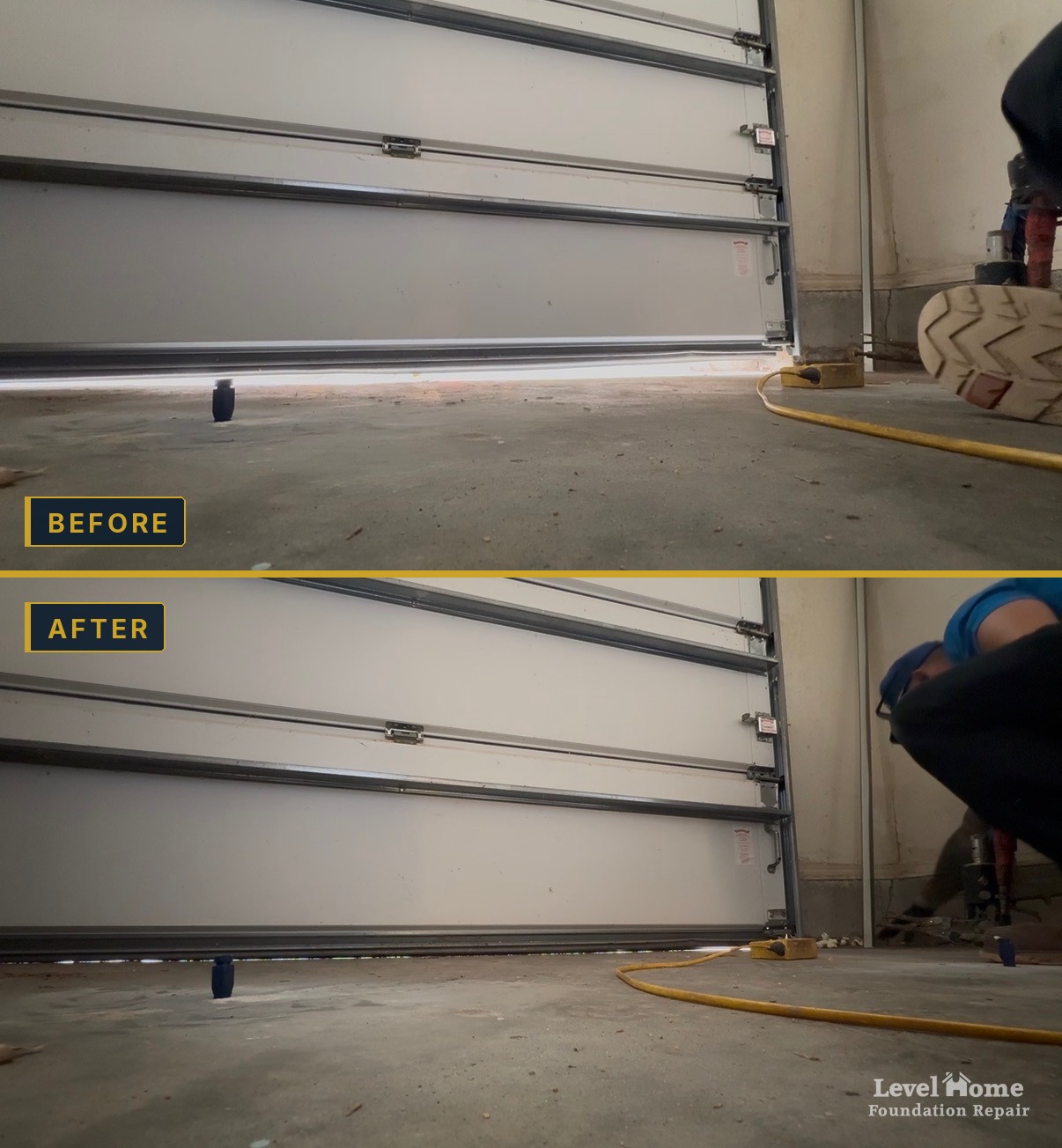
Close your garage door on a sunny afternoon, switch off the lights and look at the bottom edge of the door. If you see a line of daylight where the door meets the concrete, you have a gap under your garage door. Most people assume the door needs adjusting or the rubber seal is worn out, and a lot of the time they are right. Sometimes, though, the door is fine and the floor under it has moved.
That was the situation on a job our team finished recently. The interior garage slab had settled, and the floor at the door opening had dropped far enough that daylight showed along the bottom of the closed door. We lifted the slab back into place, and the gap closed. Below, we walk through the before and after photos, explain how a sinking slab opens a gap, show you how to tell whether your gap is a door problem or a floor problem, and cover what it takes to fix each one.
The Job: A Settled Garage Slab and a Gap Under the Door
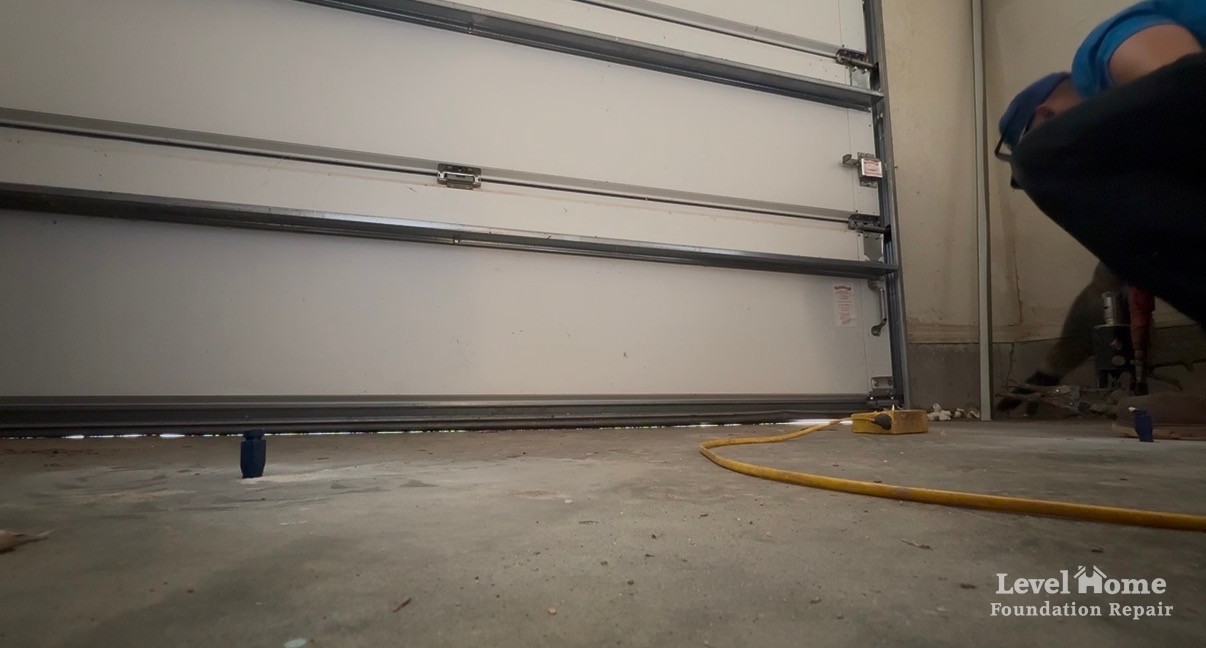
The photo below was taken from floor level inside the garage with the door closed. Look along the bottom of the door and you will see a bright band of daylight running under it. The light was getting in because the slab beneath the door had settled and dropped away from the door seal.
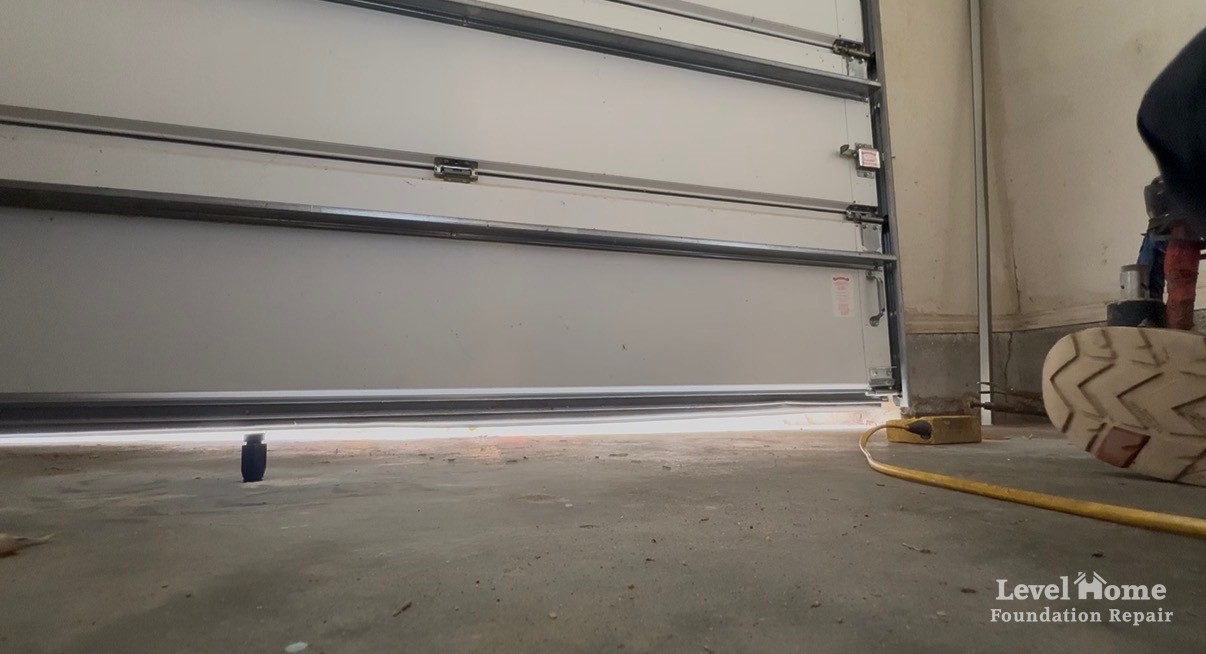
A settled slab rarely announces itself all at once. The floor drops a little at a time, the gap grows slowly, and it is easy to get used to. By the time daylight is visible across the opening, the soil under that part of the slab has usually been giving way for a while. Our post on what happens when sunken concrete is left alone shows how small drops tend to grow.
Our team lifted the slab back to where it was supposed to be. The next photo was taken from the same spot after the lift. The bottom seal of the door rests on the concrete again, and the band of light is gone. The gap closed because the slab was back at its original height, which is exactly what you want to see after a slab lift.
Every slab and every house is different, so we will not pretend that every gap under a garage door can be fixed this way. What this job shows is how closely the concrete and the door are tied together. When the floor moves, the door tells on it.
Why a Sinking Slab Opens a Gap Under the Garage Door
A garage door closes the same way every time. The opener drives it down to a set stopping point, and a rubber or vinyl seal along the bottom edge squeezes against the floor. Clopay’s guide to garage door seals calls the bottom seal “often the first line of defense against water, dirt, and pests” and explains that it compresses when the door closes. That seal only works if the floor is where the door expects it to be.
The door, its tracks and the opener are all fastened to the framing of the house. The garage floor is a different story. In many homes, the garage floor is a separate slab of concrete, poured up against the foundation rather than tied into it. The International Residential Code sets the minimum thickness for a concrete floor on the ground at 3 1/2 inches. That is not much concrete, and a slab like that depends on the soil underneath it for support.
So when the soil under the front edge of the slab compresses, washes out or shrinks, the slab drops with it. The house, the door tracks and the opener stay where they were. The door comes down to the same stopping point it always has, but the floor is no longer there to meet it, and you get a gap.
Why the edge by the door is a common trouble spot
The same code requires the parking area of a garage floor to be sloped toward a drain or toward the main vehicle entry door so liquids can run out. That slope does its job, but it also means water from wet tires, melting ice and rain blowing in under the door all head for the same edge of the slab. Outside, the driveway carries runoff right up to that edge as well.
Water is hard on the soil under a slab. It can carry fine soil away and leave empty pockets, called voids, under the concrete. Here in northeast Oklahoma, a lot of our soil is clay that swells when it gets wet and shrinks as it dries out. The Colorado Geological Survey describes expansive soils as one of the most prevalent causes of damage to buildings and construction in the US, and lists cracked driveways and sidewalks among the damage. Our guide to how Oklahoma’s clay soil damages foundations goes deeper on what that wet and dry cycle does over the years.
Fill soil is the other common culprit. When a house is built, the ground under the garage floor is often built up with fill. If that fill was not compacted well, it can keep settling for years after the concrete is poured. We cover this in more detail in our post on why garage floors are usually the first slab to sink, along with the crack patterns that tend to go with it.
Is It the Door or the Floor? How to Tell
Before anyone drills a hole in your floor, it is worth figuring out which problem you actually have. Plenty of gaps at the bottom of garage doors have nothing to do with the concrete, and if a new seal or a door adjustment is all yours needs, we will tell you that. Paying for a slab lift you do not need helps nobody. Our article on avoiding foundation repair misdiagnosis explains why we take that approach.
Signs the door is the problem
- The bottom seal is torn, flattened, brittle or missing in spots.
- The gap showed up suddenly, for example after the door was bumped or the opener was worked on.
- The door sits crooked in the opening, with uneven spacing along the sides as well as at the bottom.
- The concrete along the door line looks flat, with no new cracks and no lip where the floor meets the driveway.
Signs the slab is the problem
- The gap has grown slowly over months or seasons instead of appearing overnight.
- New cracks have opened in the floor near the door, or an old crack has widened.
- A lip has formed where the garage floor meets the driveway, or where the floor meets the step into the house.
- The floor has pulled away from the walls, leaving a gap along the base of the wall.
- Water collects just inside the door after it rains.
- A long, straight board laid on the floor near the door rocks, or shows daylight under it.
A simple check you can do yourself
On a bright day, close the door, turn off the garage lights and look along the bottom edge. Note where the light comes through. Then lay a straight board or a long level on the floor just inside the door, running the same direction as the door, and look for low spots. If the floor dips where the light shows, the slab has probably moved. If the floor is flat and the light only shows where the seal is worn or the door hangs crooked, start with a garage door technician.
Why Adjusting the Door Is Not a Real Fix for a Sinking Slab
When a gap shows up, the first instinct is to make the door reach the floor again. There are three common ways to do that: put on a thicker bottom seal, glue a threshold strip to the floor, or adjust the opener so the door travels farther down. Each of these can cut down on drafts and keep some water out. None of them does anything about the reason the slab dropped.
Seals and thresholds have their place. Clopay notes that bulb style bottom seals are especially useful on rough or uneven garage floors, and that threshold seals help in garages that sit lower than the driveway or have uneven floors. For a floor that is only slightly out of flat, that may be all you need. For a slab that is still settling, a bigger seal just covers the gap while the soil underneath keeps changing.
Adjusting the opener deserves extra caution. Chamberlain, the company behind Chamberlain and LiftMaster openers, warns in its support guide for doors that will not fully close that incorrect adjustment of the travel limits will interfere with the safety reversal system. It also says the door must reverse when it touches a 1 1/2 inch object, such as a 2×4 laid flat, on the floor. Making the door travel farther to chase a sinking floor is a job for a garage door professional, and it should come after the floor is dealt with, not instead of it.
How a Settled Garage Slab Gets Lifted Back Into Place
Fixing a sunken garage floor starts with finding out why it sank. Our team looks at where the slab dropped and how far, whether water is reaching the soil at the door opening, whether there are signs of a plumbing leak and, just as important, whether the house itself is moving. A garage slab that settled on its own is a concrete leveling job. A garage floor that dropped along with the walls around it points to a foundation problem, and that calls for a different repair.
Lifting the slab with polyurethane foam
For a slab that is still in one piece, concrete leveling is often the answer. Level Home’s concrete leveling method is polyurethane foam injection. Our crew drills small holes, about 5/8 inch across, through the settled slab at planned spots. High density polyurethane foam is injected through those holes. As it expands, it fills the voids under the concrete and raises the slab, and the crew watches the lift as it happens so the slab comes up to where it belongs. The holes are patched when the work is done.
Because the foam is light, it does not load extra weight onto soil that has already shown it is weak. On most jobs, you can walk on the slab about 15 minutes after injection and drive on it the same day. You can read more about the process on our poly foam concrete lifting page, or dig into the engineering behind polyurethane foam injection if you like the technical side.
This is not an experimental idea. The Oregon Department of Transportation used injected polyurethane to raise and stabilize a bridge end panel and an adjacent concrete slab, then monitored the slabs for two years as part of a research project. A garage floor carries far lighter loads than highway traffic, but the principle is the same: fill the empty space under the concrete and give it solid support again.
Mudjacking, the older alternative
Some companies still lift slabs by mudjacking, which pumps a cement and sand slurry under the concrete through larger holes. It can raise a slab, but the material is far heavier, and that extra weight sits on the same soil that let the slab down in the first place. We compare the two side by side in our guide to concrete leveling with foam injection versus mudjacking.
When lifting is not the right repair
Lifting is not the answer for every garage floor. If the slab is broken into several loose pieces or the concrete is crumbling, replacement may make more sense, and our post on when a broken interior slab needs complete replacement explains how we approach that. If the garage floor dropped because the foundation under the house is settling, the house needs support first, usually with steel piers or helical piers installed down to stable soil. Our slab foundation repair page walks through those options, and our post on how slab foundation settlement happens explains when piers and foam work together.
This is why our team has learned so many repair processes instead of leaning on one. We would rather match the repair to the problem than force the problem to fit the repair. Our article on foundation repair methods explains how we make that call.
What the After Photo Really Shows
The closed gap is the part everyone notices, and it matters. A door that seals properly keeps rain, dust, leaves, insects and mice out of the garage, and it keeps out a lot of hot and cold air too.
The bigger change is the one you cannot see. Before the lift, the front of that slab had lost the support it was built on. A slab without full support is more likely to crack as cars roll over it, and cracks let in more water, which can wash out more soil. After the lift, the slab is back at its original height and supported again. The door meeting the floor is simply the easiest way to see it.
How to Keep a Garage Slab From Settling Again
Once a slab is lifted, the goal is to keep water from undoing the work. A few habits make a real difference:
- Make sure gutters and downspouts drain away from the driveway and the garage door opening, not onto them.
- Keep the joint between the driveway and the garage floor sealed so water cannot run straight down along the edge of the slab.
- Watch where water goes during a heavy rain. If the yard or driveway sends it toward the garage, a foundation drainage system can carry it somewhere else.
- Fix plumbing leaks in the garage quickly. A slow leak from a water heater or a laundry line can soften the soil under the slab, and our post on how plumbing leaks cause foundation damage explains why.
- Check the bottom of the door every few months. If light starts showing again, call before the gap gets big.
It also helps to understand how voids form under a slab in the first place, because the same process affects driveways, porches and patios.
When a Gap Under the Garage Door Points to a Bigger Problem
A settled garage slab can be an isolated problem. It can also be a sign that the soil is moving under the house. Pay attention if the gap under your garage door shows up along with any of these:
- Cracks in the brick or siding at the corners of the garage door opening.
- Interior doors that start sticking or will not latch.
- Diagonal drywall cracks near door frames and windows.
- Floors inside the house that feel uneven or sloped.
Any of those deserves a closer look. Our foundation warning signs checklist and our article on what causes uneven floors can help you sort out what you are seeing, and our warning signs photo gallery shows what these problems look like in real homes.
Key Takeaways
- A gap under your garage door can come from the door, the seal, the opener settings or the floor, and the fix depends on which one it is.
- Garage floors are often separate slabs that rely on the soil beneath them, and the edge at the door opening gets the most water.
- A gap that grows slowly, new cracks near the door and a lip at the driveway all point toward a settled slab.
- Bigger seals and opener adjustments can cover a gap but do nothing about the soil under the concrete.
- When the slab is intact, concrete leveling with polyurethane foam can lift it back to its original height so the door seals against it again, as it did on this job.
Frequently Asked Questions
Why is there a gap under my garage door all of a sudden?
A gap that appears overnight usually points to the door rather than the floor. The door may have been knocked out of alignment, a cable or roller may be worn, or the opener settings may have changed. Concrete tends to settle slowly, so a gap that has grown over months is more likely to be the slab. A garage door technician can check the door, and our team can check the slab.
Can a sinking garage floor cause a gap under the garage door?
Yes. The garage door and its opener are attached to the house, but the garage floor is often a separate slab. When the soil under the front of that slab compresses or washes out, the slab drops while the door keeps stopping at the same point, and the space between them is the gap you see. On the job in this post, lifting the slab back into place closed the gap.
Should I adjust my garage door opener to close the gap?
Not as a fix for a sinking slab. An opener adjustment does nothing for the soil under the concrete, and the gap can come back as the slab keeps settling. Chamberlain also warns that incorrect travel limit adjustments interfere with the safety reversal system, so any opener adjustment should be done carefully and followed by a safety reversal test.
Can a sunken garage floor be lifted instead of replaced?
Often, yes. If the slab is still in one piece, concrete leveling with polyurethane foam can raise it back to its original height through small holes, without tearing out the floor. If the slab is broken into loose pieces or the concrete is deteriorating, replacement may be the better choice. An inspection will tell you which one fits.
How long does it take to lift a garage slab?
Most concrete lifting jobs are finished in a few hours. With polyurethane foam, the slab can usually handle foot traffic about 15 minutes after injection, and you can typically park on it the same day. Larger or more complicated garages can take longer. Our guide to foundation repair timelines for every method has more detail.
Does a sinking garage floor mean my house has a foundation problem?
Not necessarily. Because the garage floor is often separate from the foundation that holds up the house, it can settle on its own. It does tell you the soil around your home is moving, though, so it is worth having the rest of the house checked, especially if you see cracks at the garage door corners, sticking doors inside or uneven floors.
See Daylight Under Your Garage Door? Let Us Take a Look
If you are seeing light under your garage door, new cracks in the floor or a lip at the driveway, our team can tell you whether the problem is the door or the slab. Level Home has handled foundation repair in Tulsa and across northeast Oklahoma for over 10 years, and we offer free foundation inspections. If the slab is the issue, we will explain what caused it and how we would lift it. Call (918) 361-7787 or contact us online to schedule a visit.