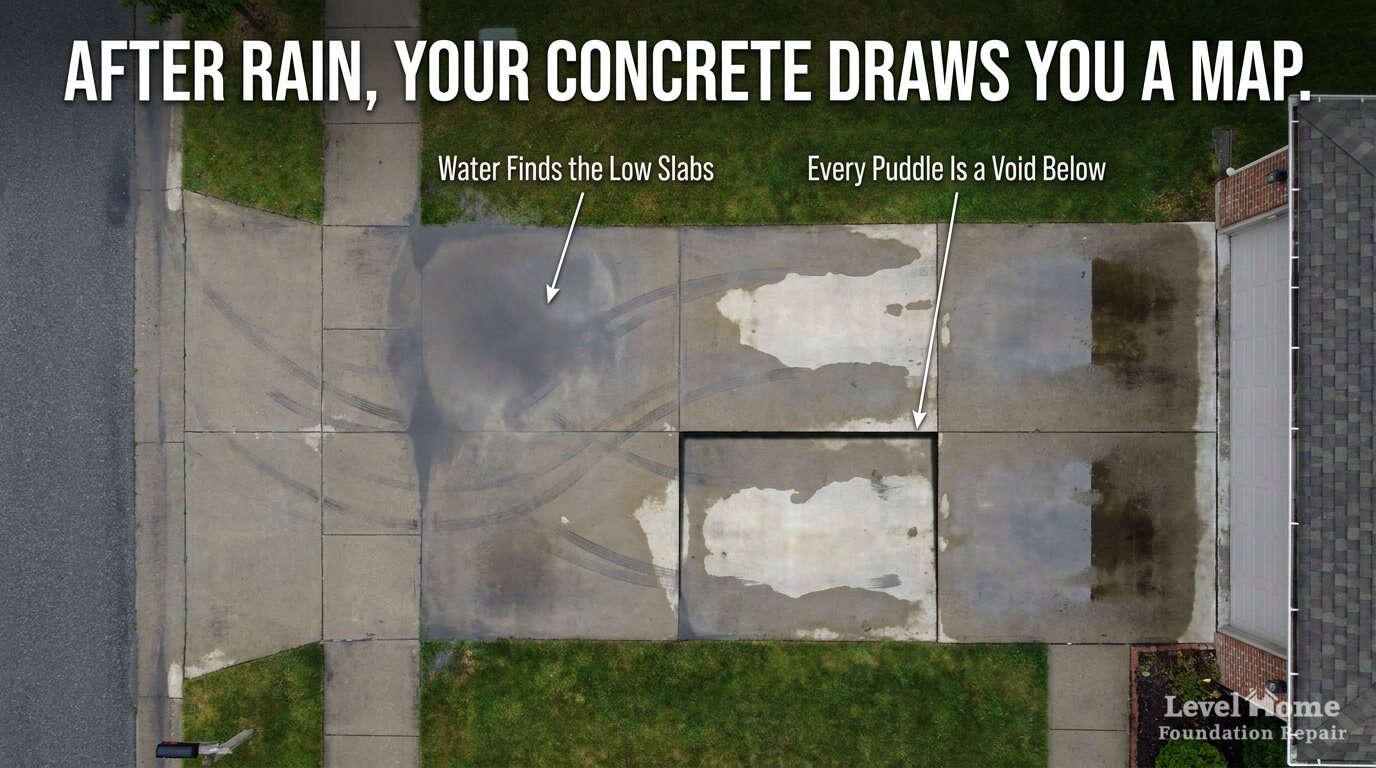
After a hard Tulsa rain, most homeowners walk outside to check for obvious damage — a leaking gutter, a flooded flower bed, maybe a puddle in the yard. Few think to look closely at the driveway or the front porch. But if water is standing there in puddles that take hours to disappear, that pooling water is telling a story about what is happening underneath the concrete. Our team at Level Home sees this pattern constantly across Tulsa neighborhoods, and it almost always points to the same underlying issue: sinking concrete.
This guide walks through why water ponds on settled concrete, what is happening beneath the surface when that happens, and how polyurethane foam injection lifts and stabilizes the slab without the cost or mess of full replacement.
Why Your Driveway or Porch Is Supposed to Shed Water
Concrete flatwork is never poured perfectly flat. Contractors build in a slight slope, typically around 1/8 inch per foot (roughly a 1% grade), so rainwater runs off toward the yard, street, or a drain rather than collecting on the surface. That slope is intentional and it is one of the most important design details in any driveway, walkway, or patio pour.
When that slope is intact, rain sheets off within minutes. When you start seeing puddles that linger for hours, or even overnight, the slope has changed. Concrete does not stretch or bend, so if part of a slab is lower than it was originally, something underneath it has moved.
What Ponding Water Is Actually Telling You
Standing water on a driveway or porch is a diagnostic clue, not just a cosmetic nuisance. Because concrete is rigid, it settles unevenly as the soil beneath it changes. The low spots where water collects are the exact spots where the slab has dropped relative to the rest of the pour. Homeowners who pay attention to where puddles form can essentially watch their concrete draw a map of where it has settled and where voids have likely opened up beneath the surface.
This is different from a drainage problem in the yard. If water is pooling on the hard surface itself rather than running off, the issue is the slab’s position, not just grading around it. Our team recommends getting a free inspection to confirm what is happening below before assuming it is anything else.
Tulsa’s Clay Soil Is the Root Cause
Almost every case of sinking concrete our team investigates in the Tulsa area traces back to expansive clay soil. This soil type absorbs water and swells during wet periods, then shrinks and pulls away from structures as it dries out. That swell-shrink cycle repeats every season, and over years it erodes and redistributes the soil that originally supported the concrete.
Oklahoma’s climate makes this worse. The region sees anywhere from 36 to 56 inches of rain annually depending on location, giving the clay plenty of moisture cycles to work with. Add in freeze-thaw cycles during the winter months, where moisture in the soil freezes, expands, and thaws again, and you have a near-constant process of soil movement working against the concrete sitting on top of it.
How Voids Form Beneath a Slab
As soil shrinks, swells, and erodes, it does not always fill back in evenly under a concrete slab. Water runoff can also wash fine soil particles out from under the edges of a driveway or porch, especially where slabs meet a downspout, a slope, or a gap in landscaping. Over time this creates a void — an empty or loosely packed pocket of space directly beneath the concrete.
A slab with a void beneath it is no longer fully supported. It behaves like a bridge with a missing pier. Every time a vehicle, a person, or even seasonal ground movement puts weight on that unsupported section, the slab flexes downward slightly. Eventually, gravity and repeated loading cause that section to settle into the void, and a low spot forms where water then collects.
The Progression from Small Dip to Bigger Problem
Sinking concrete rarely announces itself all at once. It tends to move through recognizable stages:
- Stage 1: A barely noticeable puddle forms after rain, gone within an hour.
- Stage 2: The puddle lingers longer, and hairline cracks start to appear near the low spot.
- Stage 3: The dip becomes visible to the eye, a trip hazard forms at a joint or edge, and cracks widen.
- Stage 4: Sections of the slab separate or break under load, especially at driveway edges carrying vehicle weight.
Catching the issue at Stage 1 or 2, when ponding is the main symptom, is far less costly and far less disruptive than waiting until concrete is visibly cracked and broken. For a closer look at what happens when this progression is left unaddressed, see our related article on sunken concrete repair before-and-after cases in Tulsa.
Why Ignoring Ponding Water Costs More Later
Water that repeatedly sits on a low spot does not just stay put. It works its way into any hairline crack, refreezes in winter, and widens that crack further through freeze-thaw expansion. It can also seep down at the edges of the slab and continue eroding the soil that is already compromised, effectively growing the void that caused the problem in the first place.
This is a self-reinforcing cycle: a void causes settling, settling causes ponding, ponding accelerates erosion and cracking, and worsening erosion enlarges the void. Addressing the ponding early, while the fix is still a lifting and leveling job rather than a structural repair, is almost always the more economical decision.
How Polyurethane Foam Injection Solves the Problem
Polyurethane foam injection is the modern method our team uses to correct settled concrete without removing or replacing the slab. The process involves drilling small holes through the concrete, injecting a two-part polyurethane foam beneath the surface, and allowing that foam to expand.
As the foam expands, it does three things simultaneously: it fills the void that caused the settling, it compacts and stabilizes any loose soil around that void, and it exerts controlled lifting pressure on the underside of the slab. That combination raises the sunken section back toward its original grade and restores the slope needed for proper drainage. This is the same core method detailed on our poly foam lifting service page, which covers the process end to end, and on our broader concrete leveling service page for Tulsa homeowners.
Why Foam Outperforms Mudjacking for This Type of Repair
Mudjacking, the older method of pumping a cement-based slurry beneath a slab, can also lift concrete, but it comes with real drawbacks for a moisture-driven problem like ponding. Mudjacking slurry weighs over 100 pounds per cubic foot once cured, adding significant new weight on top of soil that is already unstable. Polyurethane foam, by comparison, weighs only 2 to 4 pounds per cubic foot, so it lifts the slab without loading the soil back down.
Foam is also hydrophobic, meaning it does not absorb water, erode, or break down when exposed to moisture. Since ponding water and wet clay soil are exactly the conditions driving the original settlement, a material that will not degrade in wet conditions is a better long-term match than a cement slurry that can wash out or crumble over time. Our detailed comparison of the two methods is available in our foam injection versus mudjacking guide.
Why Injection Holes Are Barely Noticeable
Because polyurethane foam is injected under pressure through a narrow port, the holes drilled into the concrete are only about 5/8 inch in diameter — smaller than a dime. Mudjacking requires holes in the 1 to 2 inch range to accommodate the thicker slurry pump. After a foam injection repair, the small holes are patched and are difficult to spot once cured, preserving the appearance of the driveway or porch.
Speed: Foam Cures in Minutes, Not Days
One of the most practical advantages of polyurethane foam injection is how quickly the area returns to service. The foam reaches structural cure in roughly 15 to 30 minutes, meaning a driveway can typically be driven on the same day the work is completed. Mudjacking slurry, being a cement-based material, needs substantially longer to cure before it can bear regular traffic. For homeowners who rely on their driveway daily, that difference matters.
What a Poly Foam Lifting Project Costs
Homeowners are often surprised to learn how affordable this repair is compared to tearing out and replacing concrete. A typical polyurethane foam lifting project for a driveway runs between $1,000 and $3,000, depending on the size of the area and the extent of settling. A full driveway replacement, by contrast, commonly runs $6,000 to $15,000 or more once demolition, hauling, forming, and new concrete are factored in.
In most cases, foam injection saves homeowners 50 to 70 percent compared to full replacement while addressing the same underlying void and drainage issue. For a broader breakdown of what drives foundation and concrete repair pricing in this market, see our foundation repair cost guide for Tulsa.
When Ponding Points to a Deeper Foundation Issue
In most driveway and porch cases, the settling is isolated to the flatwork itself and does not involve the home’s foundation. However, if ponding on a porch is paired with cracks running into the home’s exterior walls, doors that stick, or gaps around window frames, the settling may extend beyond the slab and into the foundation footings. In those situations, deeper solutions such as steel piers may be needed to stabilize the structure before the surface concrete is releveled. Our team evaluates this during every inspection so the right repair method is matched to the right depth of problem, and we cover the broader category of issues in our guide to slab foundation repair in Tulsa.
The Role of Drainage in Preventing Repeat Settling
Fixing the void and relifting the slab solves the immediate settling, but if water is still being funneled toward the same area — from a downspout, a poor grade in the yard, or a missing gutter extension — the same erosion process can begin again over time. Our team often pairs foam injection repairs with an evaluation of nearby drainage. Solutions such as French drains, downspout extensions, or a full foundation drainage system redirect water away from vulnerable soil so it does not recreate the void that was just filled. For more on how drainage interacts with foundation stability during Tulsa’s heaviest rain events, see our article on perimeter drainage and heavy rain protection.
Patios, Porches, and Other Areas Affected by the Same Issue
While driveways are the most common place homeowners notice ponding, the same settling process affects patios, front porches, sidewalks, and garage floor slabs. Each of these surfaces is built with the same drainage slope principle, and each is vulnerable to the same clay soil movement. If you are noticing pooling water on a patio specifically, our guide to patio leveling in Tulsa covers the nuances of that surface. Garage floors present their own version of this problem since they sit at the transition between the driveway slab and the home’s foundation; our article on garage floor sinking causes and repair explains what to watch for there.
How the Inspection and Repair Process Works
Our team starts every project with a visual and physical assessment of the affected concrete, checking the depth of settling, mapping where water pools, and probing for the extent of any void beneath the surface. From there, we determine injection port locations, calculate how much foam is needed to achieve a level lift, and confirm there are no underlying structural concerns that would require a different repair approach first.
Once the plan is set, small ports are drilled, foam is injected in stages to allow controlled, even lifting, and the slab is monitored throughout the process to bring it back to its proper slope without overcorrecting. Ports are patched, and the area is typically ready for normal use the same day. Every completed project is backed by our warranty and guarantee, giving homeowners confidence the repair will hold.
Why the Underlying Science Matters
The reason foam injection works as well as it does comes down to material behavior at a chemical level — how the two components react, expand, and cure, and how that expansion translates into lifting force distributed evenly across a slab. Homeowners who want to understand the engineering behind the repair in more depth can read our detailed breakdown in the engineering and science of polyurethane foam injection.
Choosing a Contractor for This Type of Repair
Foam injection is a precise process. Too little foam and the slab will not reach a level grade; too much, injected too quickly, and a slab can be overlifted or cracked. Working with a team that has experience reading soil conditions, mapping void locations accurately, and controlling injection pressure is important to getting a durable result. Our team has built its reputation in the Tulsa area on getting this process right the first time; you can read more about our approach and history on our about page and see why homeowners consider Level Home a reliable foundation repair partner in Tulsa.
Frequently Asked Questions
Why does water pond on my driveway after it rains?
Ponding water usually means the concrete in that spot has settled below its original grade, eliminating the slope that normally carries rainwater off the surface. In the Tulsa area, this settling is most often caused by expansive clay soil shrinking, swelling, and eroding beneath the slab.
Is standing water on concrete always a sign of a problem?
Not always instantly, but it should always be checked. A very small amount of standing water that clears within a few minutes may be within normal tolerance. Water that lingers for an hour or more, or that reappears in the same spot after every rain, indicates the slab has settled and is worth having inspected.
How much does polyurethane foam injection cost for a driveway?
Most driveway foam injection projects in the Tulsa area cost between $1,000 and $3,000, depending on the size of the settled area and how much foam is needed to achieve a proper lift.
How does foam injection compare to replacing the driveway?
Full driveway replacement typically costs $6,000 to $15,000 or more once demolition and new concrete are included. Foam injection addresses the same settling issue at roughly 50 to 70 percent less cost, without the downtime of tearing out and repouring concrete.
How long before I can use my driveway after foam injection?
Polyurethane foam cures in about 15 to 30 minutes, so the area is generally ready for normal use, including vehicle traffic, the same day the work is completed.
Will the injection holes be visible afterward?
Injection ports are only about 5/8 inch in diameter, smaller than a dime. They are patched after the lift is complete and are difficult to notice once the patch has cured.
Does polyurethane foam hold up to Oklahoma’s wet weather?
Yes. Polyurethane foam is hydrophobic, meaning it does not absorb water, erode, or break down when exposed to moisture. This makes it well suited to Oklahoma’s rainfall and the wet-dry cycles of local clay soil.
Why does my concrete keep settling in the same spot every year?
Expansive clay soil in the Tulsa area goes through repeated swelling and shrinking as moisture levels change with the seasons, and freeze-thaw cycles in winter add another layer of soil movement. Without repair, the same low spot will typically continue settling further over time.
Can ponding water on my porch mean my foundation is affected too?
Sometimes. If ponding is isolated to the porch slab with no other symptoms, it is usually a surface-level settling issue. If it is accompanied by wall cracks, sticking doors, or gaps around windows, the foundation itself may also be affected and should be inspected separately.
How do I know if I need foam injection or a full inspection first?
If the only symptom is ponding water with no cracking in walls or door and window frames, foam injection is likely the right fix. When in doubt, a free inspection from our team will confirm the extent of the settling and the right repair path before any work begins. Our foundation inspection cost guide also explains what to expect and what an inspection typically costs if a foundation-level concern is suspected.
Get Your Driveway or Porch Inspected
If water is pooling on your driveway, porch, patio, or walkway after every rain, that puddle is showing you exactly where your concrete has settled. Our team at Level Home can confirm what is happening beneath the surface and provide a straightforward plan to lift, level, and stabilize the slab with polyurethane foam injection. Schedule a free inspection today and get an accurate picture of the repair before the problem grows into something more costly.