
Foundation Drainage Systems in Tulsa: Protecting What Holds Your Home Up
Water is the most common cause of foundation failure in Oklahoma. The Level Home team designs and installs drainage systems that redirect it permanently, so your foundation stays dry, stable, and structurally sound.
Water Is the Number One Foundation Threat in Oklahoma
Oklahoma’s expansive clay soil absorbs water like a sponge. When it rains, that clay swells and pushes against your foundation walls. When it dries, it shrinks and pulls away, leaving voids beneath footings and slabs. This constant cycle of pressure and release is what causes foundation cracks, settlement, and structural failure across Tulsa and the surrounding region.
Drainage correction does not just remove standing water. It controls the moisture content of the soil around your foundation, reducing the expansion-contraction cycle that causes the damage in the first place. That is why our team treats drainage as a structural service, not a landscaping upgrade.
Every drainage system our team installs is designed around the specific grade, soil composition, and water flow patterns of your property. Level Home has worked on over 3,000 properties in northeast Oklahoma, and no two drainage plans are identical because no two lots behave the same way in a storm.
Drainage Systems We Install
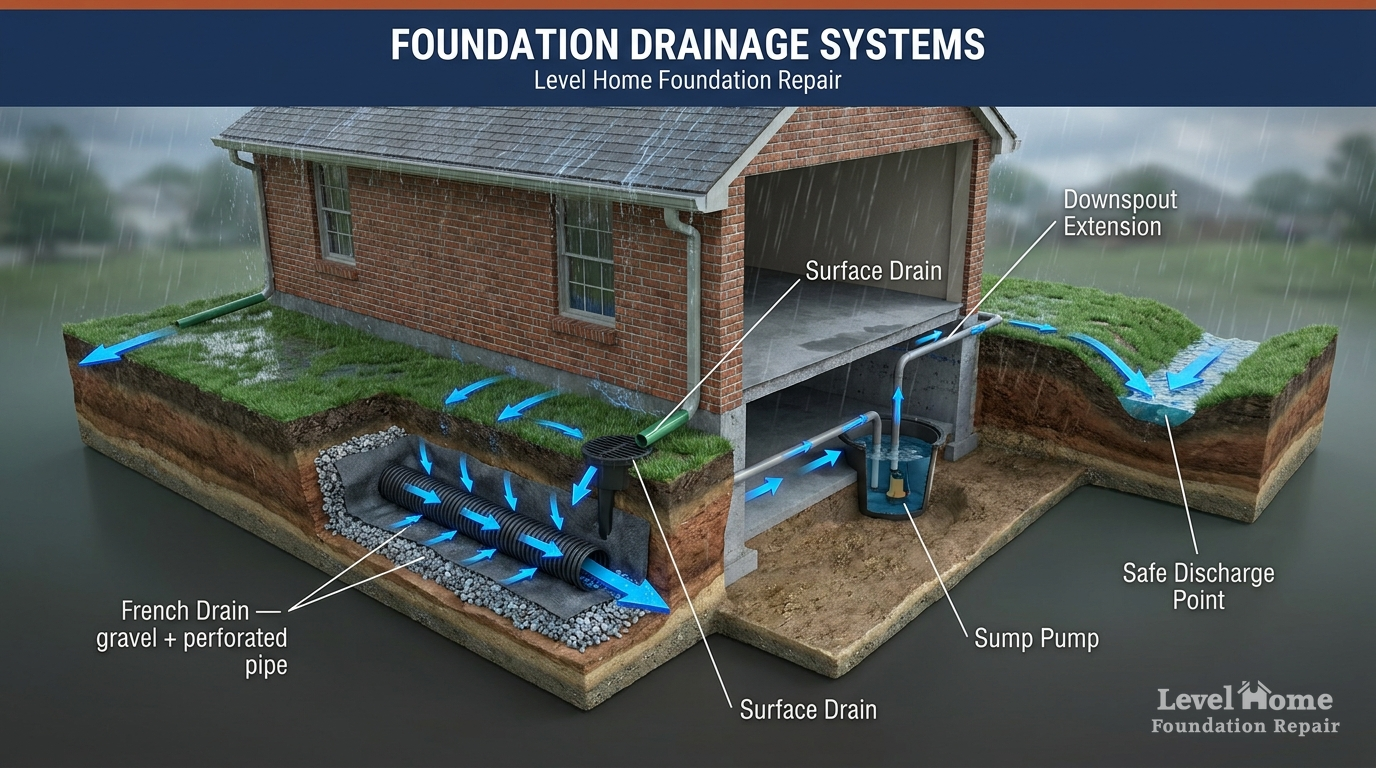
Each system targets a different source of water intrusion. Most properties need a combination of two or more to achieve full protection.
Perimeter French Drains
A trench lined with filter fabric, filled with washed gravel, and fitted with a 4-inch perforated pipe. Installed along the foundation perimeter to intercept groundwater before it reaches the footing. This is the most effective system for homes on Oklahoma clay soil where subsurface water migration is the primary threat.
Surface Drains and Catch Basins
Grated inlet drains placed at low points in your yard to capture standing water and route it through solid pipe to a safe discharge location. Our team uses these in areas where grading alone cannot solve the problem, particularly in backyards where water collects against the slab after heavy rain.
Downspout Extensions
Your roof collects hundreds of gallons per storm. Standard downspouts dump that water directly at the foundation. We extend them underground through solid PVC to discharge points at least 10 feet from the structure. This single correction eliminates a major source of concentrated water at the footing.
Sump Pump Systems
For crawl spaces and below-grade areas where gravity drainage is not possible, our team installs sump pump systems with battery backup. These collect water from interior French drains or crawl space low points and pump it to a safe exterior discharge. Critical for homes with any below-grade living space or storage.
Inside the French Drain: Built to Move Water Permanently
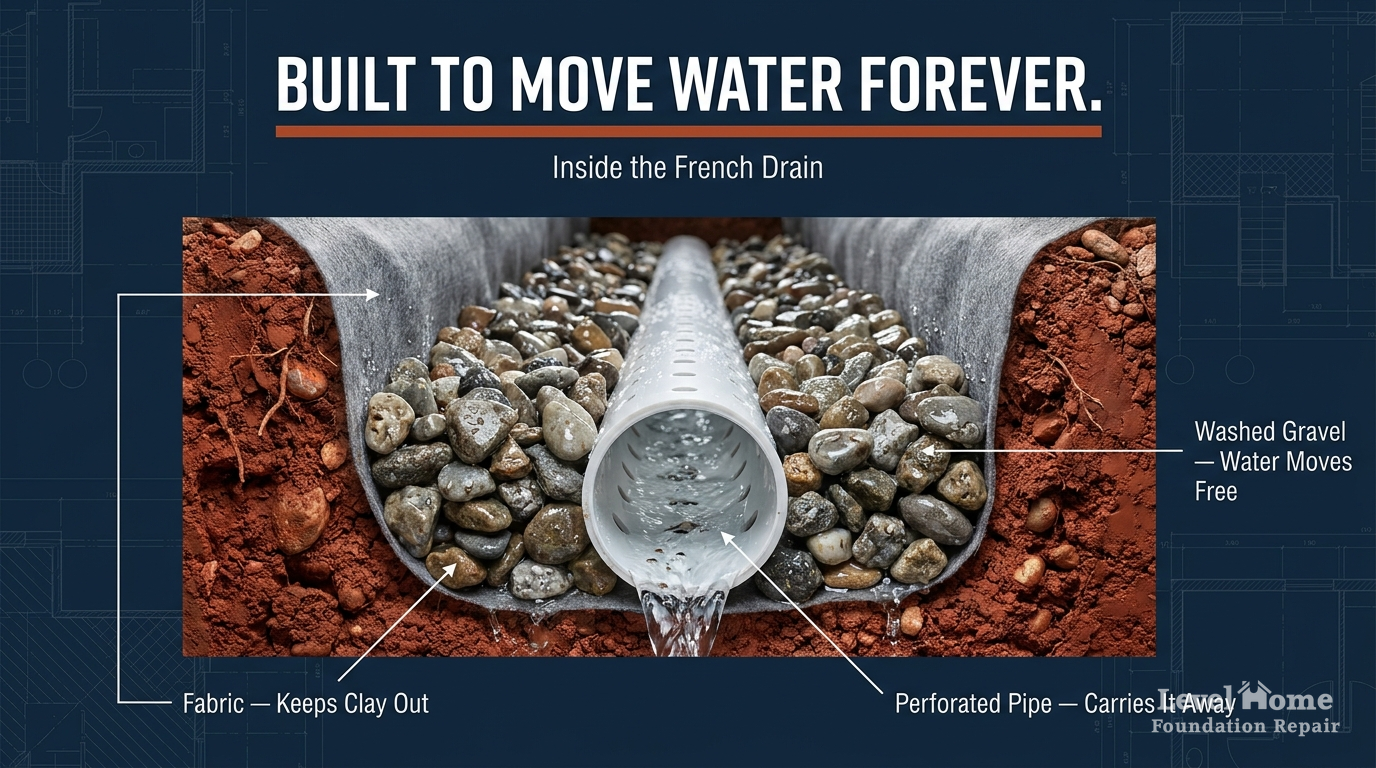
Filter Fabric
Wraps the entire gravel bed to prevent Oklahoma’s fine clay particles from migrating into the drain and clogging the system over time. Without fabric, a French drain in clay soil can fail within two to three years.
Washed Gravel
Clean, angular stone surrounds the pipe on all sides. Water flows freely through the voids between stones, reaching the perforated pipe from every direction. Our team uses washed stone specifically because unwashed aggregate carries silt that reduces flow capacity.
Perforated Pipe
A 4-inch rigid or corrugated pipe with holes along its length collects water from the gravel bed and carries it by gravity to the discharge point. Proper slope is critical: our crew maintains a minimum 1% grade across the full run to ensure reliable flow in every storm.
What Happens Without Proper Drainage
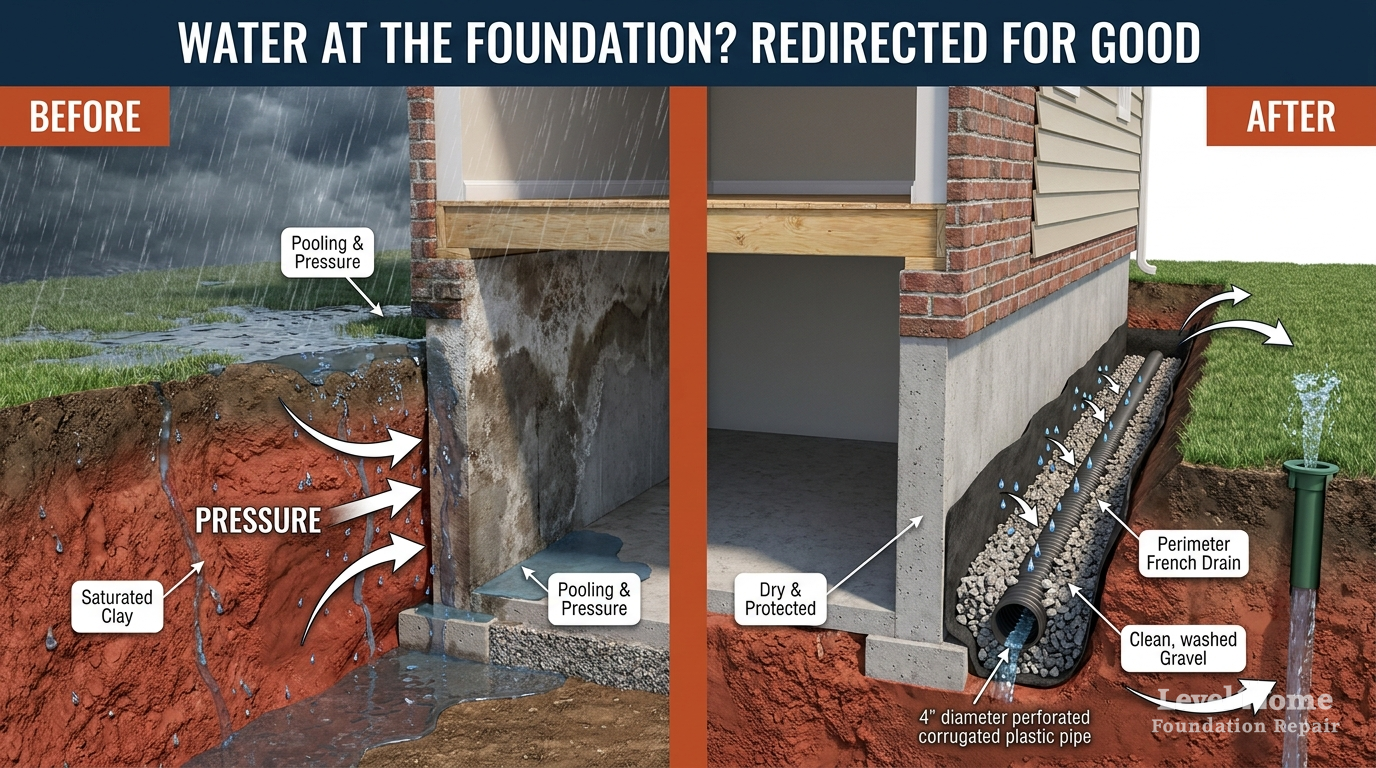
When water saturates the clay around your foundation, hydrostatic pressure builds against the walls and beneath the slab. That pressure does not just cause leaks. It drives lateral movement in basement walls, lifts slab sections unevenly, and accelerates the warning signs that indicate structural compromise.
The progression follows a predictable pattern in Oklahoma:
- Standing water pools against the foundation after rain
- Clay saturation creates lateral soil pressure on walls and footings
- Cracks form in the slab, stem wall, or block foundation
- Water enters through cracks, causing mold, efflorescence, and interior damage
- Soil voids develop as clay dries and contracts, leaving unsupported sections
- Settlement begins, requiring steel pier or helical pier stabilization
Drainage correction at any stage of this progression stops it from advancing further. The earlier it is addressed, the less structural repair is required.
How We Design a Drainage Plan
Every property gets a custom assessment. We do not sell pre-packaged drainage kits. Our team evaluates how water actually moves on your lot and builds a system that matches.
Site Evaluation
Our team walks the full perimeter and grade of the property, identifying low points, pooling areas, downspout discharge locations, and soil conditions. We check for signs of past water intrusion including staining, efflorescence, and soil erosion patterns.
Water Flow Mapping
Using the natural topography of your lot, we map where water enters, where it collects, and where it needs to exit. This determines pipe routing, drain placement, and discharge locations that work with gravity rather than against it.
System Selection
Based on the evaluation, our team recommends the specific combination of French drains, surface drains, downspout extensions, or sump systems that your property requires. We explain exactly why each component is included and what it protects.
Installation
Trenching, pipe laying, gravel bedding, fabric wrapping, and backfill are completed by the Level Home crew. Our team verifies slope with a level at every stage. The discharge point is positioned to move water safely away from the structure and neighboring properties.
Flow Testing and Verification
Before closing any trench, we run water through the full system to confirm flow rate, verify there are no low spots or blockages, and ensure the discharge point is functioning. You see it working before we consider the job complete.
Same Storm, Two Very Different Outcomes
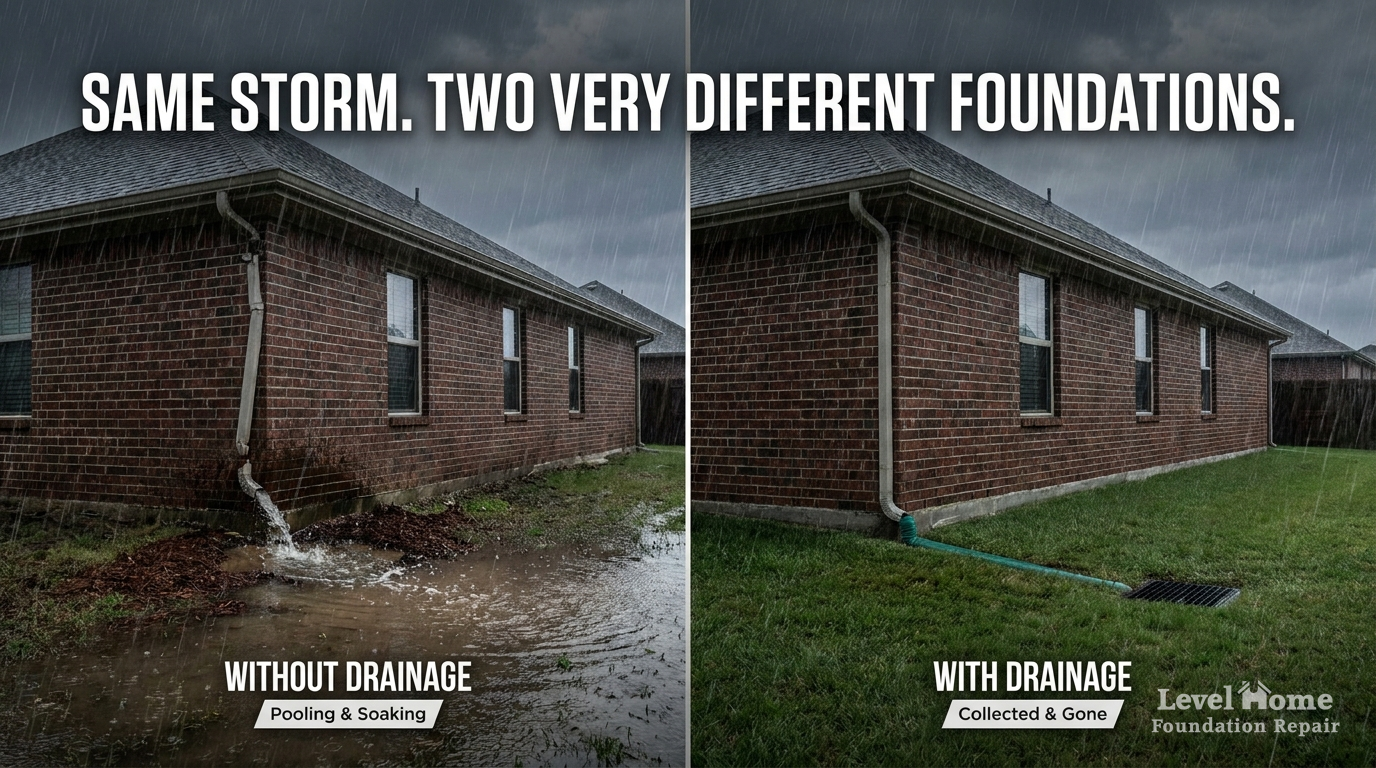
Without drainage, rainwater pools against the foundation and soaks into the clay. With a properly designed system, that same water is collected and routed away before it reaches the footing. The difference is not cosmetic. It is structural.
Warning Signs You Need Drainage Correction
If you notice any of these conditions, water is already affecting your foundation. The longer it continues, the more expensive the eventual repair.
Standing Water After Rain
Water that remains within 3 feet of your foundation for more than 24 hours after a storm is actively saturating the soil around your footings.
Erosion Along the Foundation
Exposed concrete at the base of your home means soil is washing away, removing the lateral support your foundation depends on.
Damp or Musty Crawl Space
Moisture in a crawl space indicates water is migrating through or beneath the foundation. Left unchecked, it damages floor joists, promotes mold, and weakens the substructure.
Stair-Step Cracks in Brick
These cracks follow the mortar joints and indicate differential settlement caused by uneven soil moisture. One side of the foundation is wetter than the other, and it is moving as a result.
Doors and Windows Sticking
When soil moisture causes a foundation to shift, the framing above it racks. Doors and windows that suddenly stick or fail to latch are often the first visible symptom.
White Residue on Basement Walls
Efflorescence, the white powdery deposit on concrete or block, means water is moving through the wall and evaporating on the interior side. The wall is under hydrostatic pressure.
Cost, Value, and Why Drainage Pays for Itself
What Influences the Cost
- Linear footage of French drain required
- Number of surface drains and catch basins
- Depth of trenching (deeper for clay soils with high water tables)
- Number of downspout extensions to route underground
- Whether a sump pump system is needed for below-grade areas
- Access difficulty (fencing, landscaping, hardscape removal)
We provide a detailed written estimate after the on-site evaluation. No surprises. Financing options are available for larger drainage projects.
Why It Pays for Itself
- A full foundation repair with piers can cost 5 to 15 times more than a drainage system
- Interior water damage (flooring, drywall, mold remediation) adds up quickly once water enters
- Proper drainage is a selling point in Oklahoma real estate: home inspectors flag drainage issues on nearly every report
- A transferable warranty on the drainage system adds documented value at resale
When Drainage Correction Pairs with Foundation Repair
If your foundation has already settled or cracked, stabilizing it with steel piers or helical piers addresses the structural damage that has already occurred. But without correcting the drainage that caused the problem, the same forces will continue working against the repair.
That is why our team evaluates drainage on every foundation inspection. If pier work is needed, we design the drainage correction as part of the same scope so the repair has the best chance of lasting permanently. If your foundation is still sound but the drainage is poor, correcting it now is the most cost-effective way to keep it that way.
For commercial properties, drainage design is even more critical. Larger roof areas, parking lot runoff, and impervious surfaces concentrate water at the foundation in volumes that residential systems are not built to handle. our team sizes commercial drainage systems accordingly.
Frequently Asked Questions
How long does a French drain installation take?
Most residential perimeter French drains are completed in one to two days depending on the total linear footage and soil conditions. Surface drain additions and downspout extensions can typically be completed the same day.
Will a French drain work in Oklahoma clay?
Yes, but only when installed correctly. The key is using washed gravel (not fill dirt or unwashed aggregate), wrapping the entire gravel bed in filter fabric, and maintaining proper slope. Without these steps, Oklahoma clay will infiltrate and clog the system within a few years.
Do I need a French drain or a surface drain?
They solve different problems. French drains intercept subsurface water migrating through the soil toward your foundation. Surface drains capture standing water on top of the ground. Most Tulsa properties with significant drainage issues need both. Our team determines the right combination during the site evaluation.
How much does foundation drainage cost in Tulsa?
Costs vary based on the scope of the system. A straightforward perimeter French drain typically costs less than a single pier installation. We provide an itemized written estimate after evaluating your property. Financing is available for larger projects.
Can drainage correction prevent the need for foundation repair?
In many cases, yes. If the foundation has not yet cracked or settled, proper drainage removes the primary force (soil moisture variation) that causes those failures. Our team has seen many properties where timely drainage correction prevented tens of thousands of dollars in future pier work.
What about grading the yard instead?
Regrading can help with surface water, but it does not address subsurface water migration. Oklahoma clay holds water well below the surface, and that moisture reaches your foundation regardless of how the yard is graded. Grading is one part of the solution, not the entire answer.
Do you offer a warranty on drainage work?
Yes. Drainage systems installed by Level Home are covered by a transferable warranty. The warranty covers materials and workmanship, and it transfers to the next homeowner if you sell the property.
How do I know if my existing drainage is failing?
Common signs include standing water that did not used to occur, soggy areas along the foundation, or a visible sinkhole where a previous drain was installed. If your home has an older French drain and you are seeing water issues again, the gravel bed may be clogged with clay. Our team can evaluate the existing system and determine whether it can be repaired or needs to be replaced.
Your Foundation Is Only as Strong as the Ground Beneath It
If water is reaching your foundation, the soil is already changing. The Level Home team can evaluate your property, identify where the water is coming from, and design a system that stops it permanently. The assessment is free, and there is no obligation.