Pre-Construction Helical Pier Installation in Tulsa, Oklahoma
Every foundation problem starts the same way: a structure built on soil that was never stable enough to support it. In Oklahoma, that soil is expansive clay — and it moves. It swells when it rains. It shrinks during drought. And it does this on a cycle that never stops.
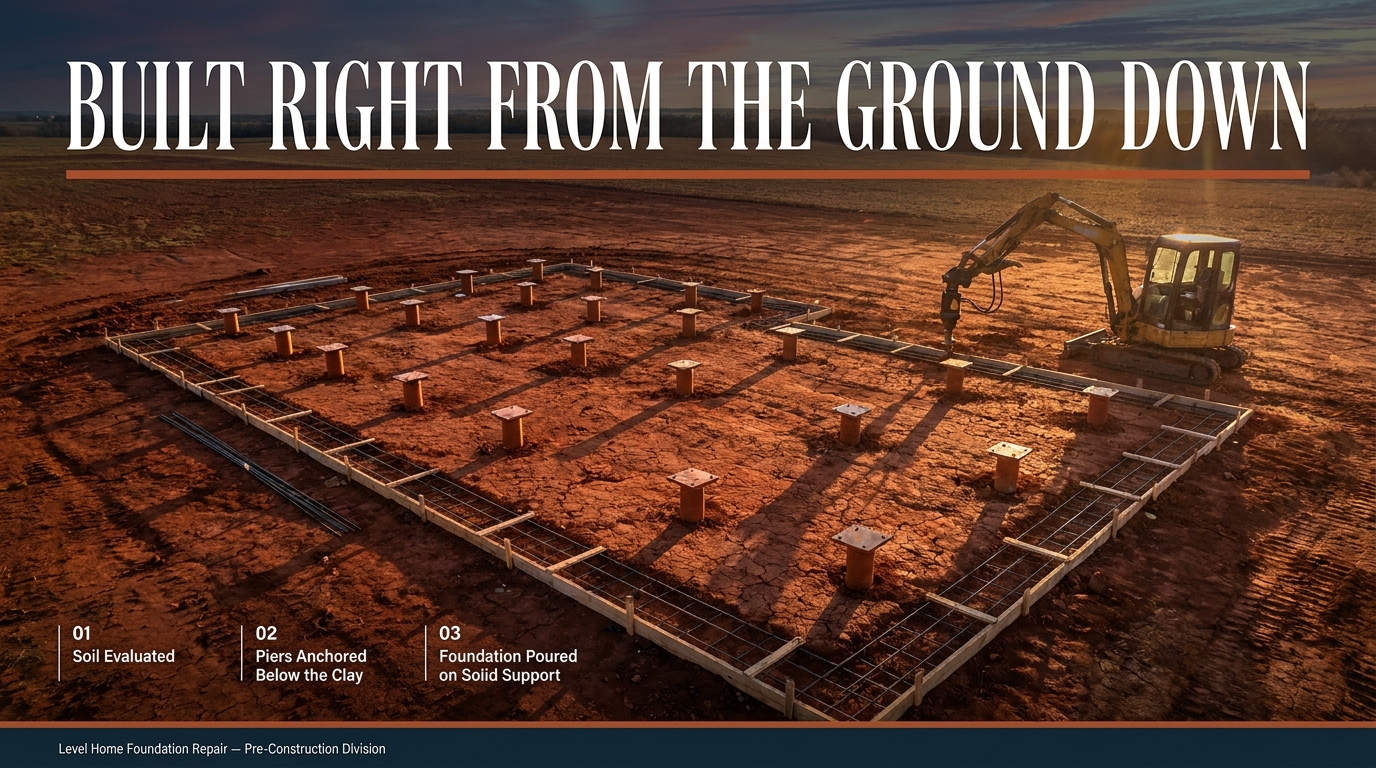
Pre-construction helical piers eliminate the root cause of foundation failure before your building ever goes up. Instead of pouring a slab directly on unpredictable topsoil and hoping for the best, helical piers anchor your structure to load-bearing stratum deep underground — soil and rock that does not move with the seasons. The result is a foundation that stays where you put it.
At Level Home Foundation Repair, we have been installing helical pier systems across the Tulsa metro since 2016. We work with homeowners, general contractors, commercial developers, and pool builders to get the foundation right before the first pour. With more than 162 five-star reviews and a locally owned operation, we treat every project like we are building on our own land.
Planning a new build on Oklahoma soil? Talk to us before you pour.
Schedule a free pre-construction consultation or call (918) 361-7787.
Why Pre-Construction Piers Cost Less Than Post-Construction Repairs
This is the single most important thing to understand about foundation support: it is dramatically cheaper to install helical piers before construction than to repair a damaged foundation after the building is finished.
When a foundation settles after construction, the repair process is invasive, disruptive, and expensive. Crews have to excavate around or beneath an occupied structure. Interior floors may need to be cut. Landscaping, driveways, and porches get torn up. The homeowner or business owner lives through weeks of disruption — and the bill reflects all of it.
Pre-construction helical pier installation avoids every one of those costs. The piers go in on open ground before the slab is poured. There is no structure to work around, no landscaping to protect, no occupied space to navigate. Installation is faster, cleaner, and far less expensive per pier.
| Factor | Pre-Construction Piers | Post-Construction Repair |
|---|---|---|
| Average cost per pier | $300–$800 | $1,500–$4,000+ |
| Excavation required | Minimal — open ground access | Extensive — around/beneath structure |
| Site disruption | None — construction has not started | Significant — landscaping, interior, utilities |
| Installation timeline | 1–3 days for most residential projects | 1–2 weeks including excavation and restoration |
| Interior damage risk | Zero | Possible floor cuts, drywall cracks, cosmetic repairs |
| Structure occupancy impact | None — building does not exist yet | Residents/tenants may need to vacate areas |
| Long-term warranty value | Transferable — adds resale value from day one | Often limited to remedial scope |
The math is straightforward. A typical residential pre-construction helical pier system for a 2,000-square-foot home in the Tulsa area might run $8,000 to $15,000 total. Repairing settlement damage on that same home after the fact can easily exceed $25,000 to $50,000 — and that does not include the cosmetic repairs, the stress, or the lost property value during the process.
Pre-construction piers are not an added expense. They are insurance against a far larger one.
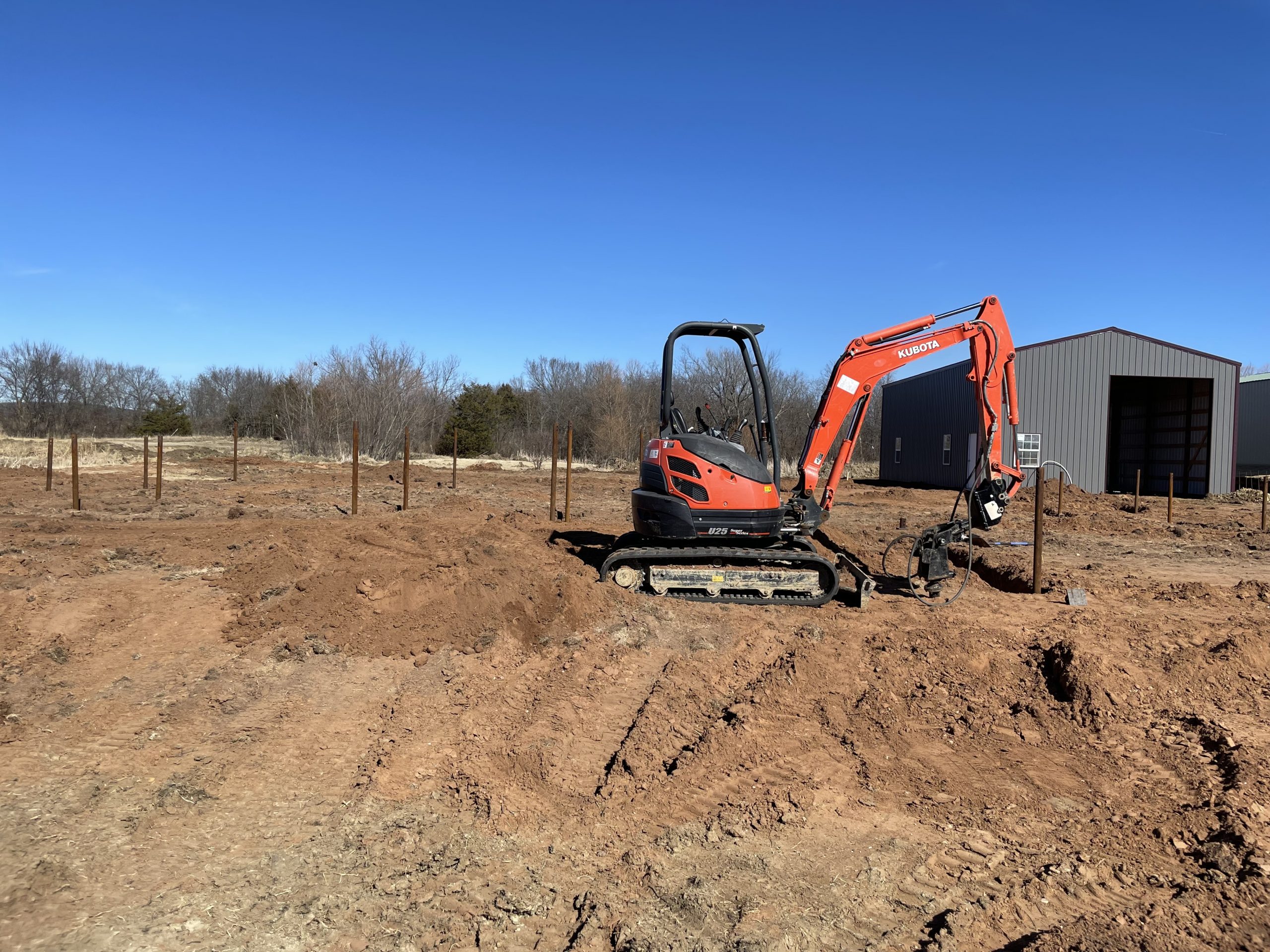
Helical pier installation in progress — hydraulic torque motor driving steel piers into load-bearing stratum on a Tulsa-area job site.
How Helical Piers Work in Pre-Construction
A helical pier is a steel shaft with one or more helical (spiral-shaped) plates welded along its length. During installation, a hydraulic motor attached to an excavator rotates the pier into the ground — similar to a large screw advancing through wood. The helical plates pull the shaft downward through unstable surface soil until it reaches a competent load-bearing layer: bedrock, dense shale, or compacted strata that will not shift with moisture changes.
Each pier is torque-monitored during installation. The torque reading directly correlates to the bearing capacity of the soil at that depth. When the specified torque threshold is reached, the installer knows the pier has engaged stable ground and can support the designed load. This is not guesswork — it is verified, measurable, and documented for every single pier.
The Pre-Construction Installation Sequence
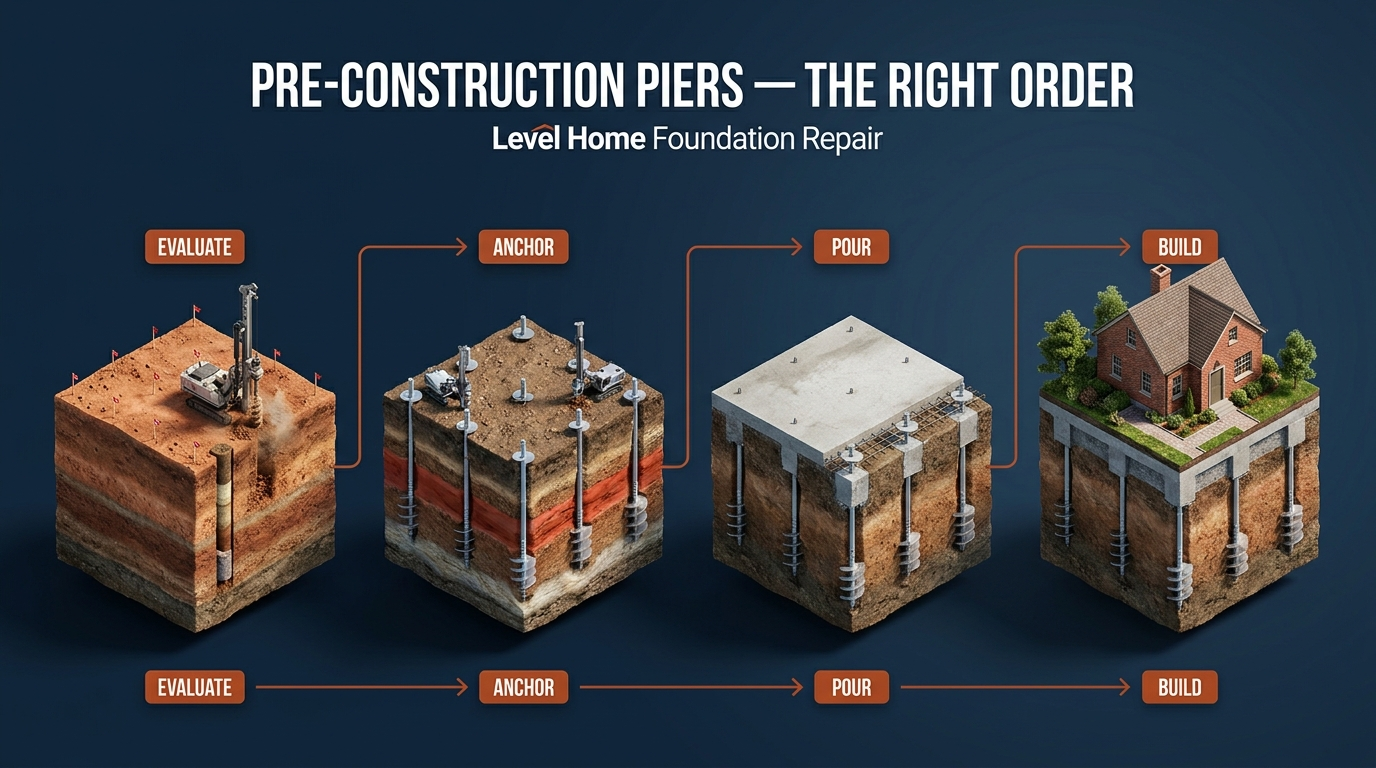
- Site evaluation and soil assessment — We review geotechnical data, assess soil conditions, and coordinate with your builder or engineer to determine pier spacing, depth targets, and load requirements.
- Pier layout — Piers are positioned at every load-bearing point: corners, beneath load-bearing walls, along the perimeter, and at interior support points per the structural plan.
- Hydraulic installation — Each helical pier is hydraulically rotated into the ground using a compact excavator. In Oklahoma clay soils, residential piers typically reach 15 to 25 feet. Commercial piers may go 30 to 50+ feet depending on the load requirements and stratum depth.
- Torque verification — Every pier is torque-tested to confirm it has engaged load-bearing soil at the specified capacity.
- Pier cap and bracket attachment — A steel plate cap or bracket is welded or bolted to the top of each pier, providing the connection point for your foundation.
- Foundation pour — Your builder pours the footing or slab directly over the pier brackets, integrating the deep foundation into the structure from day one.
The entire process for a typical residential build takes one to three days. Your builder can pour the foundation immediately after — no curing time, no waiting for concrete piers to set.
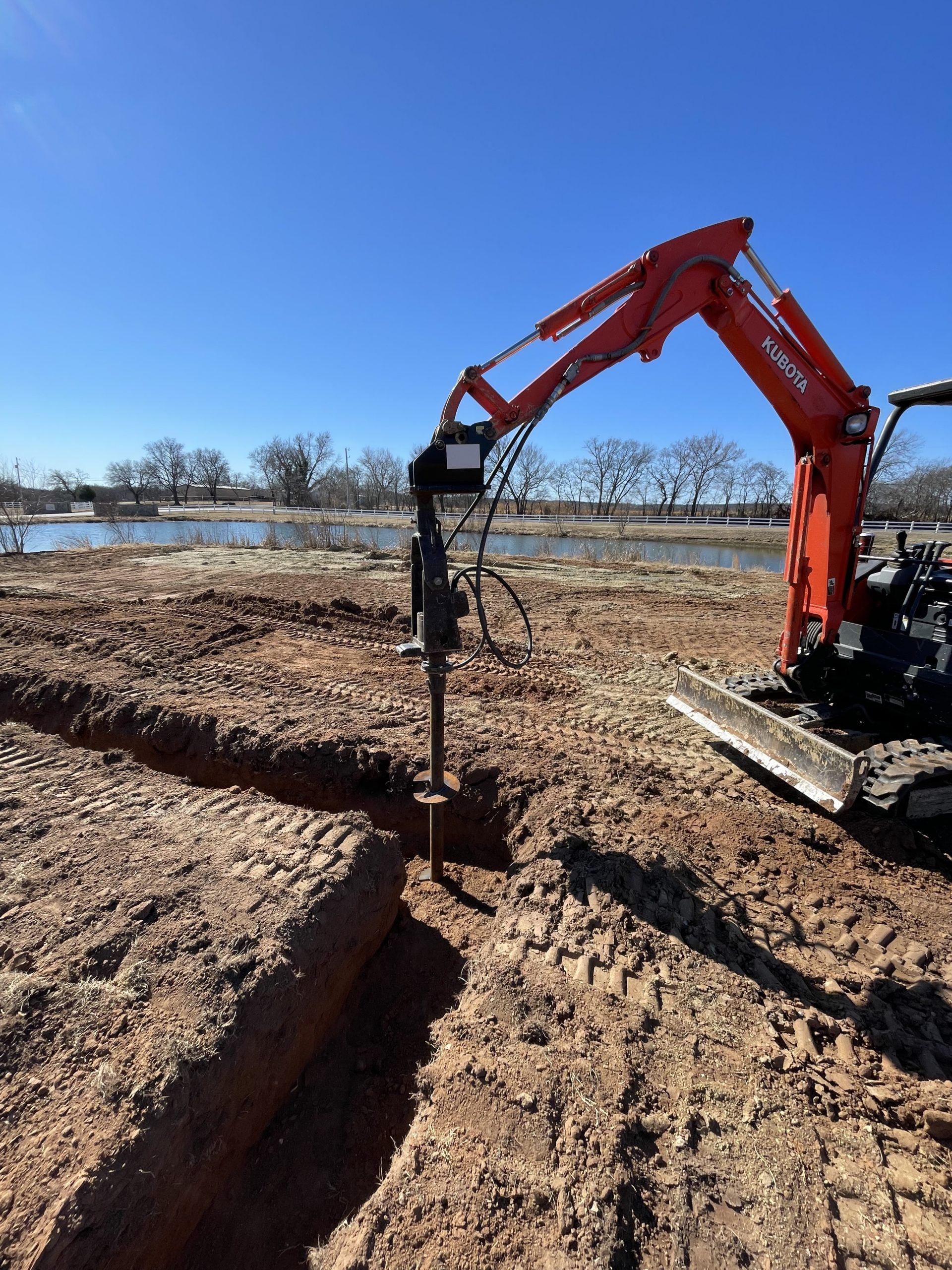
Watch the helical pier shaft advance through Oklahoma red clay. Each rotation pulls the helix plates deeper toward stable bearing stratum below the active soil zone.
Pre-Construction Helical Piers for Residential Homes
Residential new construction is where pre-construction helical piers deliver the most value per dollar in Oklahoma. The Beaumont and Permian clay formations beneath most of the Tulsa metro are among the most expansive soils in the country. Every new home built on a standard shallow footing in this soil is at risk of settlement from its first full weather cycle.
What Residential Pre-Construction Piers Prevent
- Differential settlement — One side of the home sinks while the other stays in place, cracking drywall, jamming doors, and separating brick veneer.
- Slab heave — Moisture migrating beneath the slab causes the clay to swell, pushing portions of the foundation upward and creating interior floor humps.
- Perimeter cracking — The foundation perimeter settles faster than the center, creating the characteristic stair-step cracks in brick and CMU walls.
- Plumbing damage — Foundation movement stresses and cracks underground plumbing lines, leading to leaks that accelerate further soil erosion.
Helical piers bypass all of this by transferring the home’s load through the active zone — the top 10 to 15 feet of soil where moisture fluctuation is most severe — down to soil that stays put. Whether you are building a 1,500-square-foot starter home in Bixby or a 4,000-square-foot custom home in Jenks, helical piers give the foundation a permanent anchor.
Best Applications for Residential Helical Piers
- Custom homes on acreage or rural lots with unverified soil
- Spec homes in subdivisions built on known expansive clay
- Room additions and second-story expansions
- Attached garages and outbuildings
- Sunrooms, covered patios, and outdoor living structures
Pre-Construction Helical Piers for Commercial Buildings
Commercial construction carries higher stakes. The loads are heavier, the footprints are larger, and foundation failure disrupts business operations and creates liability exposure. Pre-construction helical piers are engineered for these exact conditions.
Commercial helical piers use larger shaft diameters and multi-helix configurations to handle the concentrated loads of steel-frame buildings, tilt-up walls, and heavy equipment pads. In Oklahoma, commercial piers are frequently specified by structural engineers for projects on clay-dominant sites where driven concrete piles or drilled shafts would be slower and more expensive.
Commercial Applications
- Retail and office buildings — Strip malls, standalone retail, and multi-story office buildings on expansive clay.
- Warehouse and industrial facilities — Heavy slab-on-grade and equipment pad support where uniform settlement tolerance is tight.
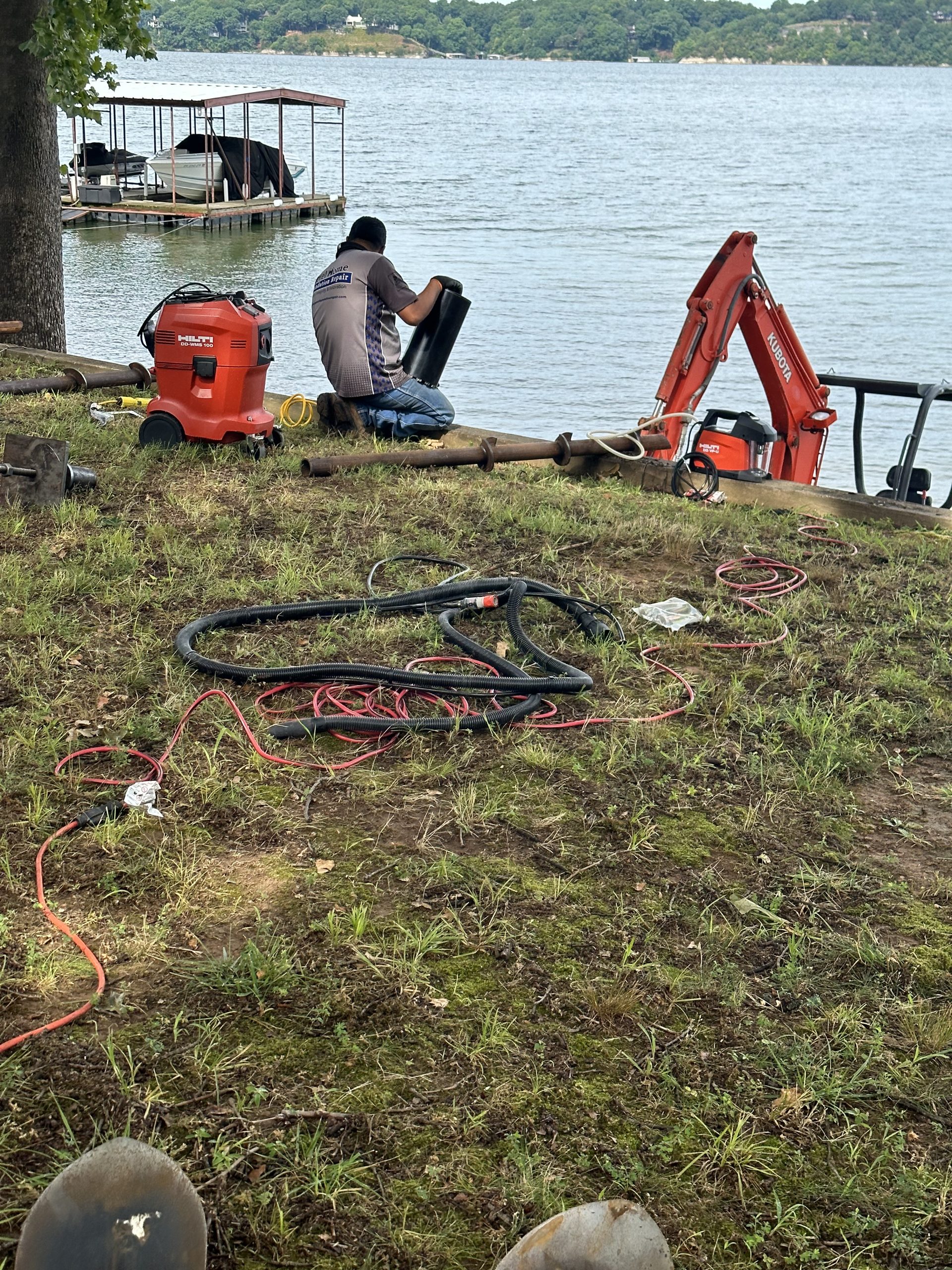
- Metal buildings and pre-engineered structures — The steel piers visible in our job photos above are supporting exactly this type of commercial construction.
- Schools and institutional buildings — Long-span structures with critical settlement limits and codes that demand engineered deep foundations.
- Multi-family residential — Apartment complexes, townhome developments, and senior living facilities with repetitive pier layouts for cost efficiency.
Commercial helical pier installation offers a major scheduling advantage: there is no concrete cure time. Your above-grade construction can begin immediately after the piers are installed and capped. On multi-building developments, our crew can be installing piers on Building B while your GC is framing Building A.
Pre-Construction Helical Piers for Swimming Pools
Pools built on Oklahoma clay soil without deep foundation support are a settlement problem waiting to happen. A filled in-ground pool can weigh 80,000 to 120,000 pounds or more. That load sitting on expansive clay — soil that swells and shrinks with every rain cycle — creates enormous differential pressure on the pool shell. The result is cracking, leaking, and deck separation that costs thousands to repair and may not be fully reversible.
Pre-construction helical piers installed beneath the pool shell and surrounding deck transfer that load to stable soil before the gunite or concrete is ever poured. The pool sits on anchors that do not move, regardless of what the surface clay does around it.
Why Pool Builders Should Specify Helical Piers
- Oklahoma clay is the worst soil for pools — Expansive clay exerts lateral pressure on pool walls and causes uneven settlement beneath the floor. Helical piers eliminate the settlement component entirely.
- Pool decks settle independently — Even if the pool shell survives, the surrounding deck often settles and separates. Piers under both the shell and deck keep everything at grade.
- Waterfront and hillside pools — Pools built on slopes, near lakes, or on fill material benefit enormously from helical pier support. The piers reach past the fill or unstable slope material to competent soil below.
- Cost of pool foundation failure — Repairing a cracked and settled pool shell can cost $15,000 to $40,000+. Pre-construction piers for a residential pool typically run $5,000 to $12,000 — a fraction of the repair cost.
If you are a pool builder working in the Tulsa metro, or a homeowner planning a new pool, talk to us before excavation begins. A pre-construction pier layout takes one to two days and protects an investment that is meant to last decades.
Helical Piers in Marine and Landmark Structures: A Proven History
Helical piers are not a new technology. They have been supporting structures in challenging soil and water conditions for nearly 200 years — and their track record in marine environments is what established them as one of the most reliable deep foundation systems ever engineered.
The Lighthouse Legacy
The first documented use of helical piers (then called screw piles) was in the 1830s, when Irish engineer Alexander Mitchell developed them to stabilize the Maplin Sands Lighthouse on the soft mud of the Thames estuary in England. Traditional foundations could not hold in the saturated, shifting ground. Mitchell’s screw piles — steel shafts with helical plates — were rotated into the seabed until they reached stable strata, and the lighthouse stood firm.
The technology crossed the Atlantic in 1838 with the construction of the Brandywine Shoal Lighthouse in Delaware Bay. From there, the U.S. Lighthouse Board adopted helical pier construction as the standard for lighthouses in tidal basins and inland waterways. Between 1850 and 1900, more than 100 lighthouses were built on helical pier foundations across the Chesapeake Bay, the Gulf Coast, and the Florida Keys.
The Carysfort Reef Light, built in 1852 on helical pier foundations six nautical miles east of Key Largo, Florida, still stands today — more than 170 years later. That is the kind of longevity this technology delivers when properly engineered and installed.
Modern Marine and Waterfront Applications
Today, helical piers remain the foundation of choice for structures built in or near water:
- Boat docks and marinas — Helical piers can be installed in saturated soils and shallow water without concrete forms or cofferdams.
- Seawalls and retaining structures — Screw piles anchor seawalls against lateral soil and water pressure.
- Boardwalks and pedestrian bridges — Minimal environmental disturbance during installation makes helical piers the preferred method in environmentally sensitive waterfront areas.
- Lakefront homes and cabins — Properties built on soft, organic soil near water benefit from the same technology that has held lighthouses for centuries.
Why Oklahoma Soil Demands Deep Foundation Support
Oklahoma does not have mild soil. The Tulsa metro sits on Beaumont and Permian clay formations — highly expansive soils that undergo dramatic volume changes with moisture fluctuation. During wet seasons, this clay can swell 10 to 15 percent or more. During drought, it shrinks and cracks, leaving voids beneath foundations.
This cycle is not occasional. It happens every year. And it is the single biggest cause of foundation damage in the Tulsa area.
Shallow footings — the standard for most residential construction — sit entirely within the “active zone” where these moisture changes are most severe. That means even a well-built home on standard footings is vulnerable to movement from its very first weather cycle.
Helical piers bypass the active zone entirely. In most Tulsa-area installations, our piers advance 15 to 25 feet below grade for residential projects, reaching soil that is unaffected by surface moisture. For commercial projects, that depth can exceed 50 feet. The structure’s weight is transferred from unstable clay to stable, load-bearing stratum — and it stays there permanently.
Areas We Serve for Pre-Construction Helical Pier Installation
We install pre-construction helical pier systems throughout Northeast Oklahoma, including:
- Broken Arrow
- Owasso
- Jenks
- Bixby
- Sand Springs
- Sapulpa
- Claremore
- Catoosa
- Glenpool
- Collinsville
- Skiatook
- Bartlesville
Helical Piers vs. Other Pre-Construction Foundation Methods
Helical piers are not the only deep foundation option — but they are the best fit for the majority of residential and light commercial projects in Oklahoma. Here is how they compare to the alternatives.
| Method | Best For | Limitations |
|---|---|---|
| Helical Piers | Residential, light commercial, pools, additions, marine/waterfront | Very heavy commercial loads may require larger shaft sizes |
| Steel Push Piers | Heavy commercial loads, structures where bedrock is reachable | Require reaction weight — not suitable for pre-construction on unbuilt structures |
| Drilled Shafts (Caissons) | Large commercial, bridges, high-rise | Expensive, slow, requires concrete cure time, significant excavation |
| Driven Concrete Piles | Deep commercial foundations | High noise, heavy vibration, potential damage to adjacent structures |
| Shallow Footings (Standard) | Stable, non-expansive soils only | Vulnerable to settlement in Oklahoma clay — the primary cause of foundation failure here |
A critical advantage of helical piers over steel push piers for pre-construction work: push piers need the weight of an existing structure as reaction force to be driven. Helical piers generate their own advancing force through the screw action, so they can be installed on a bare site with nothing built yet. This makes them the only pier type that is truly designed for pre-construction use.
What Builders and Developers Need to Know
If you are a general contractor, developer, or architect working in the Tulsa metro, here is what makes pre-construction helical piers practical for your projects:
- No concrete cure delays — Steel pier caps are ready for your pour immediately after installation. Your above-grade timeline does not slip.
- Minimal site disturbance — Our compact excavator fleet works in tight lot lines without tearing up the rest of the site.
- Torque-verified capacity — Every pier is documented with torque readings that correlate directly to load-bearing capacity. Your engineer gets verifiable data, not assumptions.
- All-weather installation — Rain, cold, heat — helical piers install in any condition. No weather delays.
- Transferable warranty — The warranty (terms vary by service) on our pier installations transfers with the property, adding marketable value for spec homes and commercial sales.
- Coordination with your team — We work directly with your structural engineer, architect, and GC to integrate pier layout into the foundation plan before a single machine touches the ground.
Builders: protect your builds and your reputation.
Contact us to discuss your next project or call (918) 361-7787.
Frequently Asked Questions
How much do pre-construction helical piers cost?
Pre-construction helical piers typically cost $300 to $800 per pier, depending on depth, shaft size, and soil conditions. A full residential system for a 2,000-square-foot home usually runs $8,000 to $15,000 — significantly less than the $25,000 to $50,000+ it can cost to repair foundation settlement after the home is built.
How deep do helical piers go in Oklahoma?
Residential helical piers in the Tulsa area typically reach 15 to 25 feet, where they engage stable soil below the active zone of moisture fluctuation. Commercial installations may exceed 50 feet depending on the load requirements and stratum depth. Every pier is torque-verified to confirm it has reached adequate bearing capacity.
Can helical piers be installed for any type of building?
Yes. Helical piers support residential homes, commercial buildings, swimming pools, additions, outbuildings, marine structures, and more. They are the only pier type that does not require an existing structure’s weight for installation, making them uniquely suited for pre-construction work.
How long does pre-construction pier installation take?
Most residential projects are completed in one to three days. Commercial projects with larger footprints and deeper piers may take three to five days. Installation does not delay your construction timeline — your builder can pour the foundation as soon as our crew finishes.
Do pre-construction piers come with a warranty?
Yes. Our pier installations include a transferable warranty (terms vary by service type and scope). This warranty adds value to the property from day one and transfers to future owners, which is especially valuable for spec homes and commercial sales.
Are helical piers better than drilled concrete piers for new construction?
For most residential and light commercial projects in Oklahoma, yes. Helical piers install faster, cost less, require no concrete cure time, produce less site disturbance, and deliver torque-verified capacity data. Drilled shafts are still appropriate for very large commercial projects with extreme load requirements.
What if I already poured my foundation and now have settlement?
We can still help. Our helical pier repair and steel push pier systems are designed specifically for stabilizing and lifting existing foundations. But the cost will be significantly higher than it would have been with pre-construction piers — which is exactly why we advocate for getting it right the first time.
Related Foundation Resources
- Helical Piers for Foundation Repair in Tulsa
- Steel Piers for Foundation Stabilization
- Foundation Repair Cost in Tulsa
- Complete Guide to Foundation Repair in Oklahoma
- Commercial Foundation Repair in Tulsa
- Foundation Repair Financing Options
- Concrete Leveling and Slab Repair
- Crawl Space Repair in Tulsa
Building on Oklahoma soil? Do it once. Do it right.
Schedule your free pre-construction consultation or call (918) 361-7787.