Most homeowners know that foam injection can lift sunken concrete. What most people don’t know is why it works so well, how long the material actually lasts, or what engineering data backs up the claims contractors make. I get asked these questions on almost every job, and they deserve real answers — not sales pitches.
This post is the technical deep-dive I wish every homeowner had access to before making a decision. I’m going to walk through the actual material science, the structural engineering behind the process, and the real-world performance data that separates polyurethane foam injection from older methods like mudjacking.
What Polyurethane Foam Actually Is (and Isn’t)
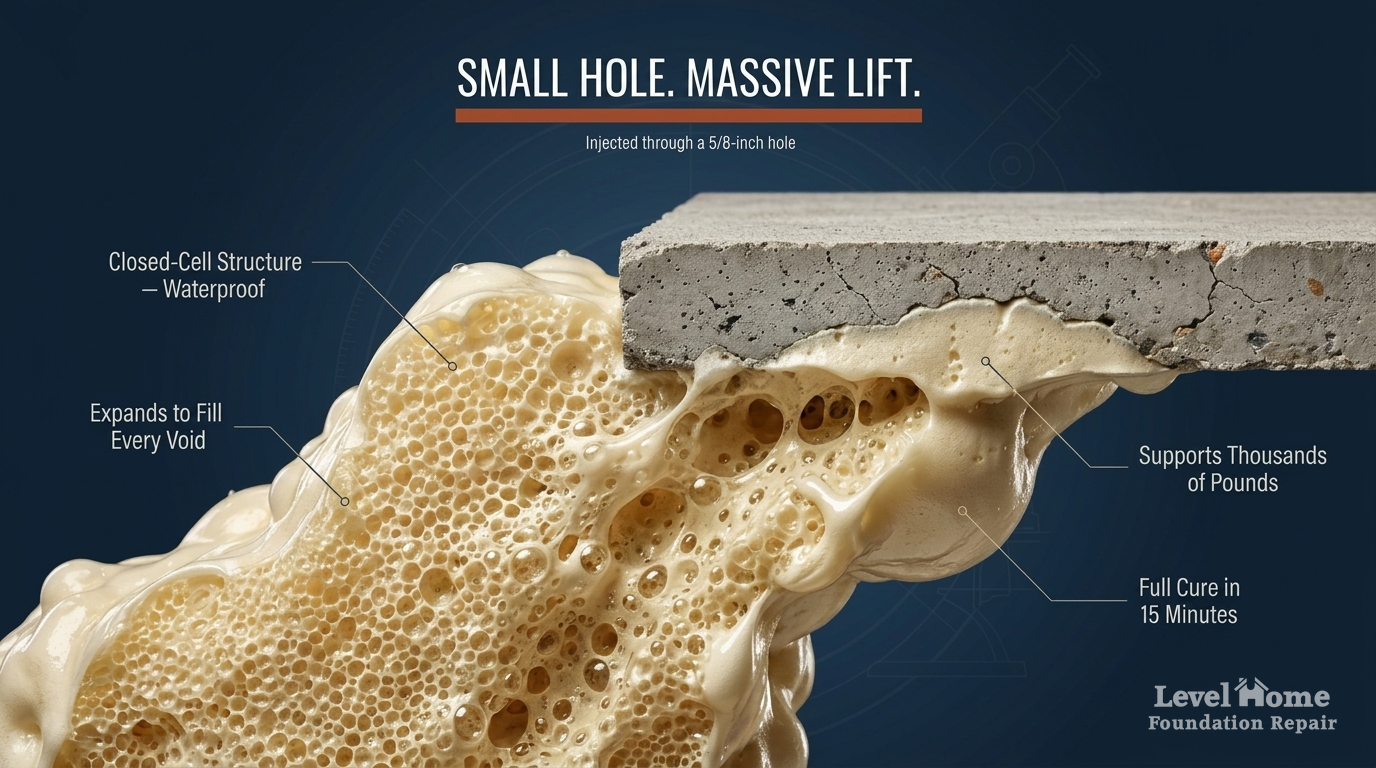
The foam I use for concrete leveling is a two-component, closed-cell polyurethane resin — not the same material as spray foam insulation or the expandable foam you buy at a hardware store. The two liquid components (an isocyanate and a polyol resin) are injected through small ports drilled in the concrete. When the components mix underground, an exothermic chemical reaction creates a rigid, closed-cell foam structure.
Here’s why that chemistry matters for your concrete:
- Closed-cell structure: Each cell is fully encapsulated, meaning the foam does not absorb water. Open-cell foams (like spray insulation) absorb moisture and lose structural integrity over time. Closed-cell does not.
- Controlled expansion: The reaction produces CO₂ gas that expands the material to 15–20 times its liquid volume, depending on the formulation density. This expansion is what generates the lifting force.
- Rapid cure time: The foam reaches approximately 90% of its full compressive strength within 15 minutes of injection. Full cure occurs within 24 hours.
Compressive Strength and Load-Bearing Data
This is where most contractors get vague. Here are the actual numbers.
Structural-grade polyurethane foams used in concrete leveling typically fall into three density classifications, each with different compressive strength ratings per ASTM D1621 (Standard Test Method for Compressive Properties of Rigid Cellular Plastics):
| Foam Density (pcf) | Compressive Strength (PSI) | Typical Application |
|---|---|---|
| 2.0 – 2.5 lb/ft³ | 20 – 30 PSI | Void fill under sidewalks, patios |
| 3.5 – 4.0 lb/ft³ | 40 – 60 PSI | Driveways, garage floors, pool decks |
| 6.0 – 8.0 lb/ft³ | 80 – 120+ PSI | Highways, warehouse floors, heavy commercial |
For context: a standard 4-inch residential concrete slab exerts approximately 50 pounds per square foot (0.35 PSI) of dead load on the soil beneath it. Even the lightest structural foam provides compressive strength roughly 57 times greater than the dead load of the slab it’s supporting. The limiting factor in residential concrete leveling is almost never the foam — it’s the bearing capacity of the soil beneath the foam.
How the Injection Process Works Below Grade
Understanding what happens underground explains why this method produces more consistent results than mudjacking or traditional slab replacement.
Step 1: Void Identification
Before any injection, I assess the slab to identify where voids have formed beneath the concrete. Settlement rarely happens uniformly — one section may have a 2-inch void while the adjacent section sits directly on compacted soil. Understanding the void geometry determines where injection ports are placed and how much material is needed.
Step 2: Port Drilling
I drill ⅝-inch holes through the slab at strategic points. These holes are roughly the diameter of a dime — significantly smaller than the 1½ to 2-inch holes required for mudjacking. Smaller penetrations mean less stress concentration on the concrete and less visible patching when the job is complete.
Step 3: Injection and Expansion
The two-component resin is injected through a specialized gun at controlled pressure. Once below the slab, the chemical reaction begins immediately. The expanding foam flows laterally to fill voids and generates vertical pressure against the underside of the concrete. I monitor lift in real time using a laser level or digital inclinometer placed on the slab surface, stopping injection the moment the slab reaches the target elevation.
The precision here is critical. Unlike mudjacking — where a heavy slurry is pumped until the slab moves and the operator estimates when to stop — foam injection allows lift adjustments as fine as 1/16 of an inch.
Step 4: Port Patching and Cleanup
Each port is sealed with a non-shrink grout or concrete patch. Because the holes are small, the patches are nearly invisible once cured. Most homeowners can walk on the repaired slab within 30 minutes.
Why Soil Type Matters: Tulsa’s Clay Problem
Tulsa sits on expansive clay soil — primarily a mix of the Verdigris and Dennis soil series — that shrinks and swells dramatically with moisture changes. This shrink-swell cycle is the number one reason concrete settles in northeast Oklahoma. During extended dry periods (common from June through September here), the clay contracts and pulls away from the underside of slabs, creating voids. When rain returns, the soil expands unevenly, but it rarely pushes the concrete back to its original elevation.
Polyurethane foam is uniquely suited to this environment because of three properties:
- Hydrophobic: The closed-cell structure does not absorb water. Materials like mudjacking slurry (a cement-sand-water mix) are porous and can erode or wash out when water flows beneath the slab. Foam does not degrade in wet conditions.
- Lightweight: At 2–4 lb/ft³, polyurethane foam weighs roughly 2–3% of what an equivalent volume of mudjacking slurry weighs (approximately 100–150 lb/ft³). This matters because Oklahoma’s clay soils have relatively low bearing capacity when saturated. Adding 100+ pounds per cubic foot of heavy slurry on top of weak soil can cause re-settlement. Adding 3 pounds per cubic foot of foam does not.
- Dimensionally stable: Once cured, the foam does not shrink, expand, or break down. Independent testing per ASTM D2126 (dimensional stability under accelerated aging) shows less than 2% volume change after 1,000 hours of exposure at elevated temperature and humidity conditions.
I wrote a deeper piece on how Oklahoma’s clay soil destroys foundations if you want to understand the soil mechanics in more detail.
Longevity: How Long Does Polyurethane Foam Last Under Concrete?
This is the question I hear most often, and it deserves an honest answer grounded in data rather than marketing claims.
Closed-cell polyurethane foam is chemically inert once cured. It does not rot, dissolve, or provide a food source for insects or microbial growth. The U.S. Department of Transportation has used polyurethane foam for highway and bridge approach slab stabilization since the early 2000s, and field performance studies published by state DOTs (notably Iowa DOT Report TR-674 and the Missouri DOT’s evaluation of foam injection for pavement stabilization) have documented service life exceeding 20 years with no measurable degradation in compressive properties.
The material’s primary vulnerability is UV exposure — ultraviolet light breaks down polyurethane polymers. But because the foam is injected beneath a concrete slab, it has zero UV exposure. In a below-grade, UV-shielded environment, the expected service life of structural polyurethane foam exceeds the expected service life of the concrete slab above it.
Foam Injection vs. Full Slab Replacement: When Each Makes Sense
Foam injection is not the right solution for every situation. Here’s an honest breakdown:
Foam Injection Is the Right Choice When:
- The concrete is structurally intact but has settled, tilted, or developed voids beneath it
- Settlement is less than approximately 4 inches in most cases
- The slab is a driveway, sidewalk, patio, pool deck, garage floor, or interior slab section
- You need minimal disruption — the area can be used within 30 minutes
- Cost matters — foam injection typically runs 50–70% less than full replacement
Full Replacement Makes More Sense When:
- The concrete is severely crumbling, spalling, or structurally compromised
- Multiple large cracks have created unstable sections that shift independently
- The slab has experienced extensive rebar corrosion or delamination
- Aesthetic concerns require a completely new surface (decorative stamping, exposed aggregate, etc.)
If you’re not sure which category your concrete falls into, a free inspection will give you a straight answer with no pressure.
Common Questions About Polyurethane Foam Injection
Does the foam contain harmful chemicals?
Once fully cured (within 24 hours of injection), polyurethane foam is chemically inert and classified as non-toxic. The raw components — MDI isocyanate and polyol resin — require proper handling during application (I wear appropriate PPE during injection), but the cured foam poses no health risk to humans, pets, or soil biology. It does not leach chemicals into groundwater. The material meets EPA requirements for subsurface use.
Can foam injection fix a foundation problem, or is it only for flatwork?
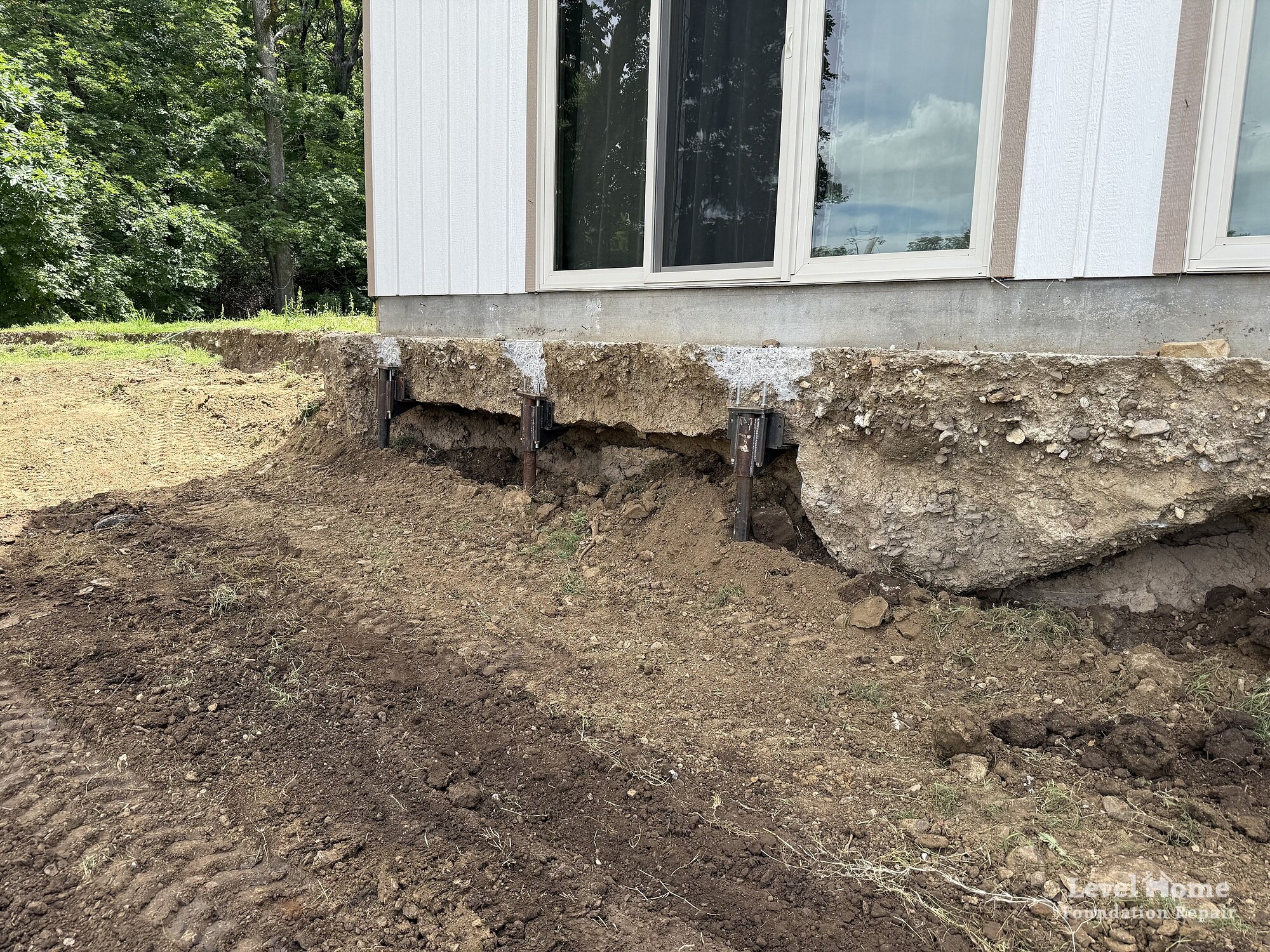
Foam injection is primarily a concrete leveling solution — driveways, sidewalks, patios, garage floors, pool decks, and interior slab sections. For actual structural foundation settlement, the appropriate repair method is typically steel push piers or helical piers that transfer the load to stable bearing strata deep below the surface. Foam can be used as a supplemental void fill beneath a pier-supported slab, but it is not a substitute for structural pier installation when the foundation itself has shifted.
How much weight can the foam support?
Standard residential-grade foam (3.5–4.0 lb/ft³ density) supports 40–60 PSI of compressive load. To put that in perspective: a fully loaded semi-truck distributes approximately 80 PSI through its tire contact patches, and DOT-grade foams (6+ lb/ft³) are rated above 100 PSI to handle that. For residential applications — vehicles, foot traffic, patio furniture, hot tubs — the foam provides an enormous margin of safety above the actual loads it will experience.
What happens if the soil continues to move after injection?
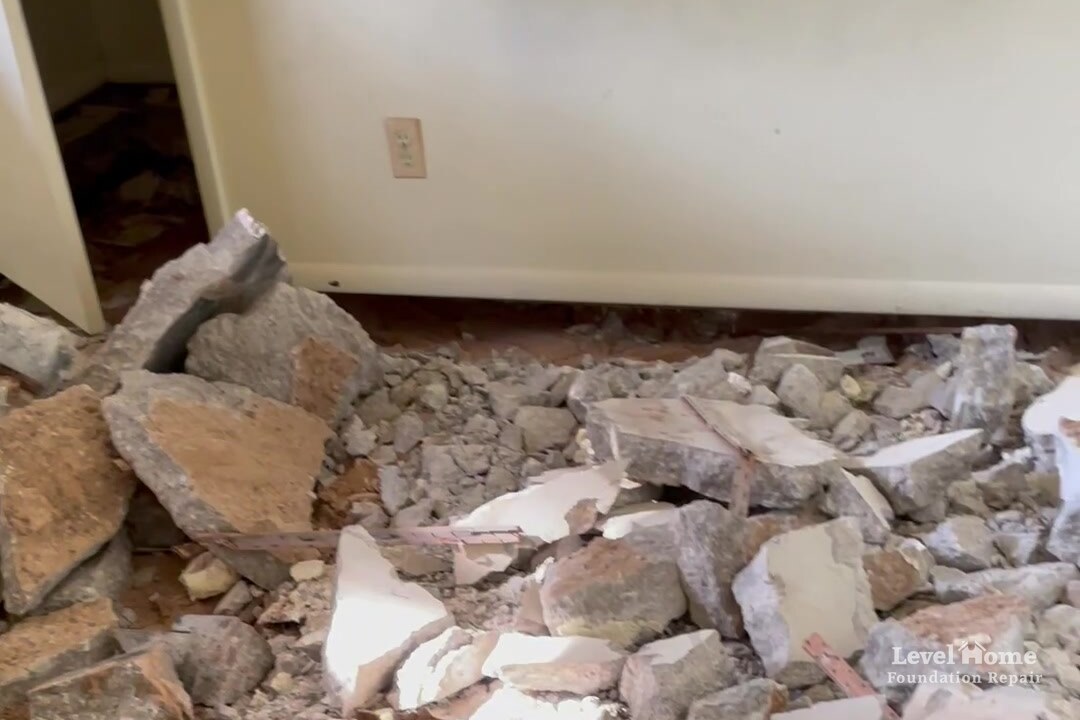
If the underlying clay soil continues to shrink or erode, new voids can form beneath the foam layer over time. The foam itself will not break down or settle, but if the soil beneath it washes out, the foam (and the slab it supports) can drop with it. This is why addressing drainage issues is often part of a complete concrete leveling project. I evaluate drainage conditions on every inspection and will recommend drainage corrections when they’re needed to protect the repair long-term.
Is polyurethane foam environmentally safe for use near gardens or water lines?
Yes. Cured polyurethane foam is inert and does not leach chemicals into surrounding soil or water. It will not contaminate garden beds, wells, or municipal water lines. The material has been approved for use in direct contact with potable water infrastructure in certain applications, and multiple state departments of transportation have approved it for use in environmentally sensitive areas adjacent to waterways.
How does temperature affect the foam’s performance?
Polyurethane foam performs reliably across a wide temperature range. Most manufacturers rate their structural foams for continuous service between -40°F and +200°F. In Tulsa, where ground temperatures at slab depth remain between roughly 45°F and 85°F year-round, the foam operates well within its rated envelope. However, installation in extremely cold weather (below 40°F ambient) requires heated equipment to maintain proper resin viscosity and reaction speed. I adjust my application parameters seasonally to ensure consistent cure quality regardless of when the work is performed.
What’s the R-value of polyurethane foam, and does it affect my slab’s thermal performance?
Closed-cell polyurethane foam has an R-value of approximately 6.0–7.0 per inch of thickness. While this is not the reason it’s used for concrete leveling, it does create a secondary benefit: a layer of foam beneath a garage floor or interior slab adds a measurable thermal barrier between the conditioned space above and the ground below. Homeowners occasionally report slightly warmer garage floors after foam injection, which is a real — if minor — side effect of the material’s insulating properties.
Industry Standards and Testing Protocols
Reputable polyurethane foam suppliers test their products against several ASTM International standards. When evaluating a contractor’s material claims, ask which of these tests their foam has passed:
- ASTM D1621 — Compressive Properties of Rigid Cellular Plastics (compressive strength rating)
- ASTM D2126 — Dimensional Stability of Rigid Cellular Plastics (long-term volume change)
- ASTM D2842 — Water Absorption of Rigid Cellular Plastics (moisture resistance)
- ASTM E84 — Surface Burning Characteristics (flame spread and smoke development — relevant for interior applications)
- ASTM D1622 — Apparent Density of Rigid Cellular Plastics (density classification)
Any contractor who cannot tell you which ASTM standards their foam meets is using a product that hasn’t been independently verified. That’s a red flag worth paying attention to.
Cost Comparison: Foam Injection vs. Alternatives
Here’s an honest cost comparison based on current Tulsa-area market rates for a typical 200 sq ft driveway section:
| Method | Typical Cost (200 sq ft) | Time to Usable | Expected Lifespan |
|---|---|---|---|
| Polyurethane Foam Injection | $800 – $1,600 | 30 minutes | 25+ years (below grade) |
| Mudjacking | $600 – $1,200 | 24–48 hours | 5–10 years (susceptible to washout) |
| Full Slab Replacement | $2,400 – $4,800 | 3–7 days | 20–30 years (new pour) |
Mudjacking carries a lower upfront cost, but the failure rate in clay-heavy Oklahoma soil is significantly higher. The heavy slurry adds substantial weight to already-weak soil, and the porous material degrades when exposed to water infiltration. Many of the concrete leveling jobs I do are re-leveling slabs that were mudjacked 3–5 years ago and have settled again. Over a 15-year window, foam injection is almost always the more cost-effective choice. I go deeper into this comparison in my concrete leveling service page.
What to Look for in a Concrete Leveling Contractor
If you’re evaluating contractors for a foam injection project, here are the questions that will quickly separate the experienced operators from the ones who are learning on your property:
- What density foam do you use, and what’s its compressive strength rating? — A knowledgeable contractor will answer immediately with specific PSI numbers.
- Which ASTM standards does your foam meet? — If they can’t answer, move on.
- How do you monitor lift during injection? — The answer should involve laser levels, string lines, or digital inclinometers — not “I can feel it.”
- Do you carry liability insurance and offer a warranty? — A contractor confident in the material and their workmanship will warranty the repair.
- Will you assess my drainage before lifting the slab? — Lifting concrete without addressing the reason it settled is a temporary fix, not a permanent solution.
The Bottom Line
Polyurethane foam injection is not magic. It’s a well-documented, extensively tested engineering solution that solves a specific problem: concrete that has settled due to soil movement or void formation beneath the slab. The material science is sound, the field performance data spans decades, and the method produces measurably better long-term results than mudjacking in expansive clay environments like Tulsa’s.
If you have a concrete slab that’s settled, cracked at a joint, or created a trip hazard, I’m happy to take a look. I offer free inspections with no obligation — I’ll tell you what I see, what I’d recommend, and what it would cost. If foam injection isn’t the right solution, I’ll tell you that too.
You can reach me at (918) 361-7787 or schedule online here.