When our team gets a call from a builder or developer planning new construction in the Tulsa metro, one of the first questions we ask is simple: has the site had a geotechnical evaluation yet? The answer to that question often determines whether pre-construction helical piles belong in the foundation plan at all — and if so, how many, how deep, and at what load capacity.
Not every new build on Oklahoma soil needs deep foundation support. But given how much of the Tulsa metro sits on expansive clay, a surprising number of projects do. This guide walks through how our team helps builders, developers, and homeowners make that call before the concrete gets poured — because a decision made on paper today is a lot cheaper than a decision made with a jackhammer five years from now.
Reading Your Soil Report: What Actually Triggers a Helical Pile Recommendation
Most new construction projects in the Tulsa area start with a geotechnical (soil) report from a licensed engineer. That report is where the helical pile conversation usually begins, and it’s worth understanding what the engineer is actually looking for.
Plasticity Index and Expansion Potential
The single biggest red flag in a Tulsa-area soil report is a high plasticity index (PI). Soils here — particularly Oklahoma’s expansive clay soil — can swell and shrink dramatically with seasonal moisture changes. A PI above roughly 20-25 combined with a documented “active zone” depth of several feet is usually enough for an engineer to recommend a deep foundation system rather than conventional spread footings.
Bearing Capacity and Fill Conditions
If the report shows low bearing capacity in the upper soil layers, or if the site has uncontrolled or undocumented fill (common on infill lots and older subdivisions being redeveloped), footings sized for native, undisturbed soil won’t perform reliably. That’s a second common trigger for specifying piles.
Groundwater and Seasonal Moisture Swings
Sites with a shallow water table, poor drainage, or a history of ponding are more likely to see the moisture swings that drive clay expansion. Our team often recommends pairing any deep foundation plan with proper foundation drainage to reduce the moisture cycling that stresses both piles and slabs over time.
Load Capacity Thresholds: When the Numbers Say “Go Deep”
Beyond the soil chemistry, the structural load itself matters. Helical piles are rated by torque-correlated capacity, and the engineer of record will typically specify a required capacity per pile based on the anticipated dead load, live load, and any lateral or uplift forces.
- Light residential structures (single-story additions, porches, garages) often fall in the 10,000–20,000 lb per-pile capacity range.
- Standard new home construction on problem soils frequently requires piles rated 20,000–35,000 lbs, depending on spacing and grade beam design.
- Commercial and multi-story structures can require individual pile capacities well above 40,000–60,000 lbs, sometimes with larger-diameter shafts and multiple helix plates.
When required capacities climb into that upper range, or when the structural engineer needs verified, real-time installation torque data for sign-off, that’s usually the point where commercial foundation projects lean toward helical piles over lighter-duty alternatives.
“Helical Piles” vs. “Helical Piers”: Same Hardware, Different Context
We get this question a lot, so it’s worth clearing up: helical piles and helical pier systems are, mechanically, the same product — a steel shaft with one or more helical plates that’s screwed into the ground to a load-bearing stratum.
The terminology split comes down to context and audience:
- “Helical piles” is the term engineers, architects, and commercial contractors use on plans, specs, and geotech reports. It’s the language of new construction and structural design.
- “Helical piers” is the term homeowners and residential repair contractors typically use, especially in the context of fixing an existing foundation that has already settled.
If you’d like the full technical and residential picture, our team has put together a complete guide to helical piers that covers both applications in depth.
Helical Piles vs. Drilled Shafts vs. Driven Piles
Helical piles aren’t the only deep foundation option, and they’re not always the right one. Here’s how the three most common systems compare for Tulsa-area projects.
| Factor | Helical Piles | Drilled Shafts (Caissons) | Driven Piles |
|---|---|---|---|
| Installation time | Fast — often same-day for residential and small commercial jobs | Slow — requires drilling rig, spoils removal, and often concrete curing time | Moderate — depends on pile length and driving equipment |
| Site disturbance | Minimal — no spoils, low vibration | Significant — soil cuttings, larger equipment footprint | High vibration and noise; not ideal near existing structures |
| Verified capacity at installation | Yes — real-time installation torque correlates directly to load capacity | Requires separate load testing to confirm capacity | Confirmed via driving resistance, but less precise for variable soils |
| Best suited for | Residential, light commercial, retrofit, and sites with access constraints | Heavy commercial and high-rise loads where very large capacities are required | Large commercial and industrial sites with predictable, deep bearing strata |
| Typical cost profile | Lower for small-to-mid loads; scales efficiently | Higher due to equipment, spoils disposal, and curing time | Efficient at scale, but mobilization costs are high for small jobs |
| Works in expansive clay | Yes — designed to bypass the active (shrink-swell) zone entirely | Yes, but requires careful sleeve/isolation detailing in expansive soils | Possible, but vibration can be problematic in tight urban lots |
For most single-family homes, additions, and light commercial buildings in the Tulsa area, this table is exactly why helical piles tend to win: the site conditions rarely require the sheer capacity of large-diameter drilled shafts, and the access and speed advantages of helical piles more than make up the difference. Drilled shafts and driven piles still have their place — mainly larger commercial and industrial structures with loads that exceed what a helical pile array can reasonably deliver.
Real Project Scenarios We See Around Tulsa
Scenario 1: New Home on Known Expansive Clay
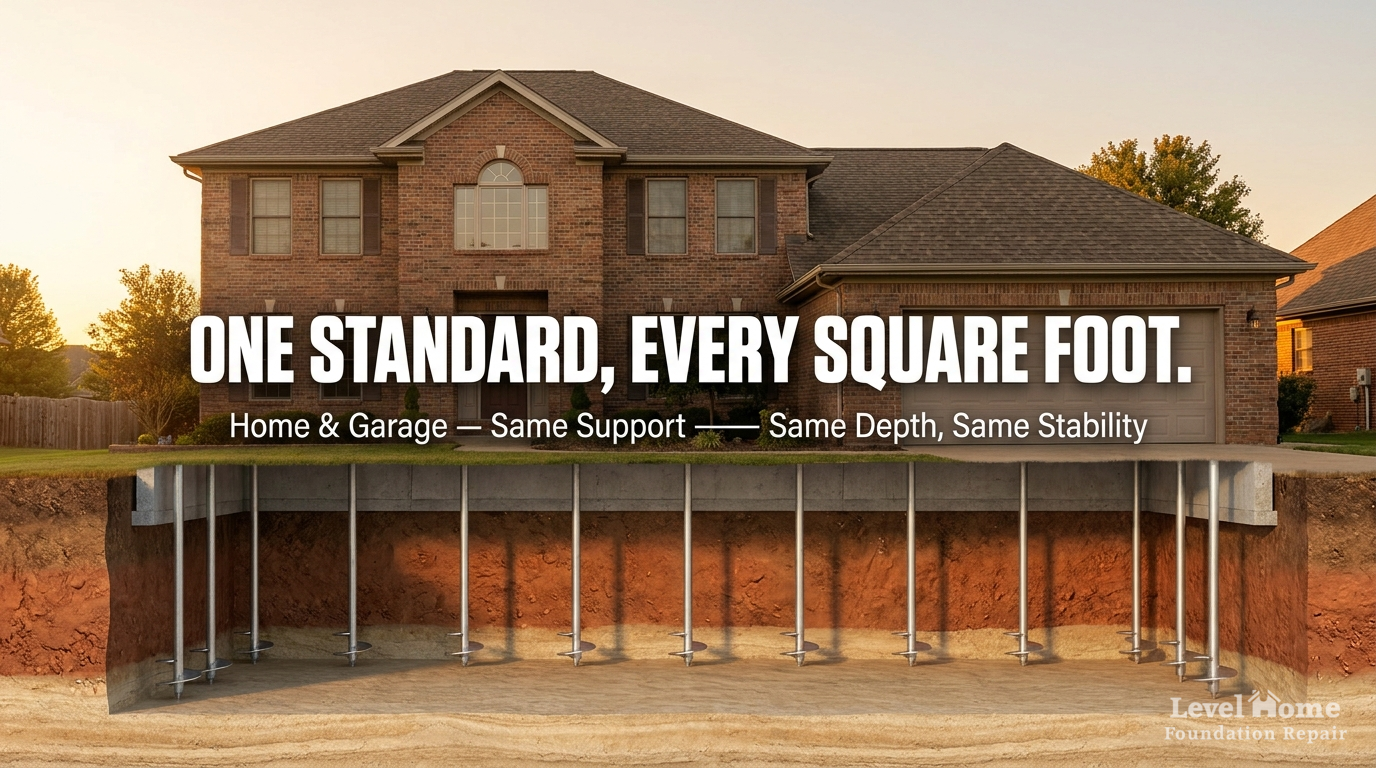
A builder is platting a new subdivision in an area with documented high-PI clay. The geotech report recommends bypassing the active zone entirely. Rather than waiting for post-construction settlement and remedial repair, the builder specs helical piles under the grade beam before the slab is ever poured. This is exactly the logic we cover in our companion piece on why smart builders stabilize before pouring.
Scenario 2: Commercial Building on Undocumented Fill
A commercial developer picks up an infill lot with a history of grading and undocumented fill. Test borings show inconsistent bearing capacity across the site. Helical piles let the engineer design to bedrock or a competent bearing stratum without the excavation and dewatering headaches that a drilled shaft program would introduce on a tight urban lot.
Scenario 3: Pool or Structure on a Sloped Lot
A homeowner planning a pool, outdoor kitchen, or accessory structure on a sloped lot with fill soils needs a foundation that resists both settlement and lateral movement. Helical piles with appropriately rated brackets handle both compression and, when designed for it, uplift and lateral loads — without the heavy equipment access that a drilled shaft installation would require on a slope.
Cost Comparison: Pre-Construction Helical Piles vs. Remedial Pier Installation
This is the number that tends to change minds in the planning meeting. Installing helical piles before the slab is poured is almost always dramatically less expensive, on a per-pile basis, than installing the same piles as a remedial repair years later.
Pre-construction installation happens on open ground with full equipment access, no finished landscaping to protect, no interior floors or slabs to core through, and no need to shore up a structure that’s already showing distress. Remedial installation — the kind our team does every week as part of standard foundation repair costs in the Tulsa area — requires working around an occupied or finished structure, often with additional excavation, slab cutting, and drainage corrections layered on top of the pile installation itself.
When you also factor in the cost of cosmetic repairs (drywall cracks, door and window realignment, tile and flooring damage) that typically accompany a remedial job, pre-construction piling is rarely the expensive option it first appears to be. It’s simply a cost that shows up earlier, on a much smaller bill.
Working With Your Engineer and Contractor to Spec Helical Piles
Getting this right is a team effort between the structural engineer, the geotechnical engineer, and the foundation contractor installing the piles. A few things our team recommends builders bring to that conversation:
- A current, site-specific geotech report — not a report from a neighboring lot or an older phase of the development.
- Clear documentation of anticipated structural loads, including any special loading from decks, pools, or heavy equipment.
- An installer who can provide real-time torque logs for every pile, so the engineer has verified, as-built data rather than assumptions.
- A plan for how the pile system interfaces with the grade beam, footing, or slab design — this detail is easy to overlook and expensive to fix later.
Our team works alongside engineers and general contractors throughout the Tulsa metro on exactly this kind of pre-construction planning, and we’re glad to review a geotech report and talk through helical piers vs push piers, steel push pier systems, or full pre-construction pier installation options before a single yard of concrete gets ordered.
If you’re not sure whether your project needs deep foundation support at all, that’s a great reason to start with a free consultation. Our team can walk the site, review your soil report if you have one, and give you a straight answer — not a sales pitch.
Frequently Asked Questions
How deep do helical piles need to go for new construction in Tulsa?
It depends on the site, but our team typically sees piles installed well below the documented active (shrink-swell) zone, which in the Tulsa area often means digging into stable soil several feet beyond what a standard footing would reach. For a detailed breakdown, see our page on helical pier depth requirements.
Are helical piles more expensive than standard footings?
Upfront, yes — helical piles cost more than a conventional spread footing on stable soil. But on sites with expansive clay, poor bearing capacity, or undocumented fill, standard footings are likely to fail, and the cost of remedial repair later far exceeds the upfront investment in piles.
Can helical piles be used for both residential and commercial new construction?
Yes. The same core technology supports everything from a single-family home addition to large commercial foundations — the difference is in pile diameter, helix configuration, and required torque-correlated capacity, all of which the structural engineer specifies based on the project’s loads.
When are drilled shafts a better choice than helical piles?
Drilled shafts tend to make more sense for very high-capacity commercial or high-rise loads, or where subsurface conditions (large boulders, extremely dense strata) make helical pile installation impractical. For the loads most residential and light commercial Tulsa projects generate, helical piles are usually the more efficient choice.
Do I need a soil report before I can get a helical pile recommendation?
A geotechnical report is the best starting point because it gives an engineer real data on soil plasticity, bearing capacity, and moisture conditions. If you don’t have one yet, our team can help you understand what to request from a geotechnical engineer and how those results translate into a foundation plan.
Does Level Home Foundation Repair install helical piles for new construction, or only repairs?
Both. Our team installs helical piles for pre-construction new-build projects as well as helical piers for remedial residential and commercial foundation repair. All of our installations are backed by our warranty — terms vary by service, so ask us about the specifics for your project type.