That gap between your sidewalk panels did not appear overnight. Neither did the slope in your driveway or the rocking motion your patio furniture picked up last summer. Sunken concrete is a slow-motion problem, and in Tulsa, it has a specific cause: the clay soil beneath nearly every slab in the metro is constantly expanding and contracting with the seasons.
The real issue is not the sinking itself. It is what happens when homeowners assume the problem will stop on its own.
Why Concrete Keeps Sinking Once It Starts
Oklahoma’s clay soil swells when it absorbs moisture and shrinks when it dries out. Every wet spring followed by a hot, dry July creates a new cycle of expansion and contraction beneath your slab. Over time, this process washes out the compacted fill material that originally supported the concrete.
The result is a void: an empty pocket of space between the bottom of the slab and the ground. Once that void forms, the concrete has nothing holding it up. It settles into the gap, and the uneven surface channels water right back into the opening, accelerating the erosion underneath.
A half-inch gap in April can become two inches by October. By the following spring, the slab may crack under its own weight.
The Real Cost of Waiting
Homeowners delay concrete leveling for a few common reasons: the damage looks cosmetic, they assume replacement is the only option, or they plan to deal with it next year. Each of those assumptions carries a cost.
- Trip hazards and liability. A raised or sunken panel on a walkway or driveway is a liability. If a guest, delivery driver, or mail carrier trips on your property, homeowner’s insurance may cover the claim, but the premium increase and hassle are yours to absorb.
- Water intrusion. Sunken slabs next to your home’s foundation direct water toward the structure instead of away from it. That moisture can migrate into crawl spaces, basements, and slab-on-grade foundations, creating a secondary structural problem.
- Cracking and replacement. A slab that has only settled can usually be lifted back into position. A slab that has settled and cracked from the stress often needs partial or full replacement, at three to five times the cost of leveling.
- Property value. Visible concrete damage signals deferred maintenance to buyers and appraisers. A $500 to $1,500 leveling job can prevent a $5,000 to $10,000 hit during a home sale.
How Poly Foam Leveling Works
Modern concrete leveling uses high-density polyurethane foam injection. The process is straightforward: small holes (about the size of a penny) are drilled through the sunken slab, two-part polyurethane foam is injected into the void beneath, and the expanding foam lifts the concrete back to its original grade.
The entire process typically takes one to two hours. The foam cures within 15 minutes, and the surface is ready for foot and vehicle traffic the same day. Unlike the old mudjacking method, poly foam is waterproof, lightweight (about two pounds per cubic foot versus the 100-plus pounds of mudjacking slurry), and will not wash out or compress over time. For a detailed comparison of the two methods, see our guide to foam injection vs. mudjacking in Tulsa.
What a Real Before and After Looks Like
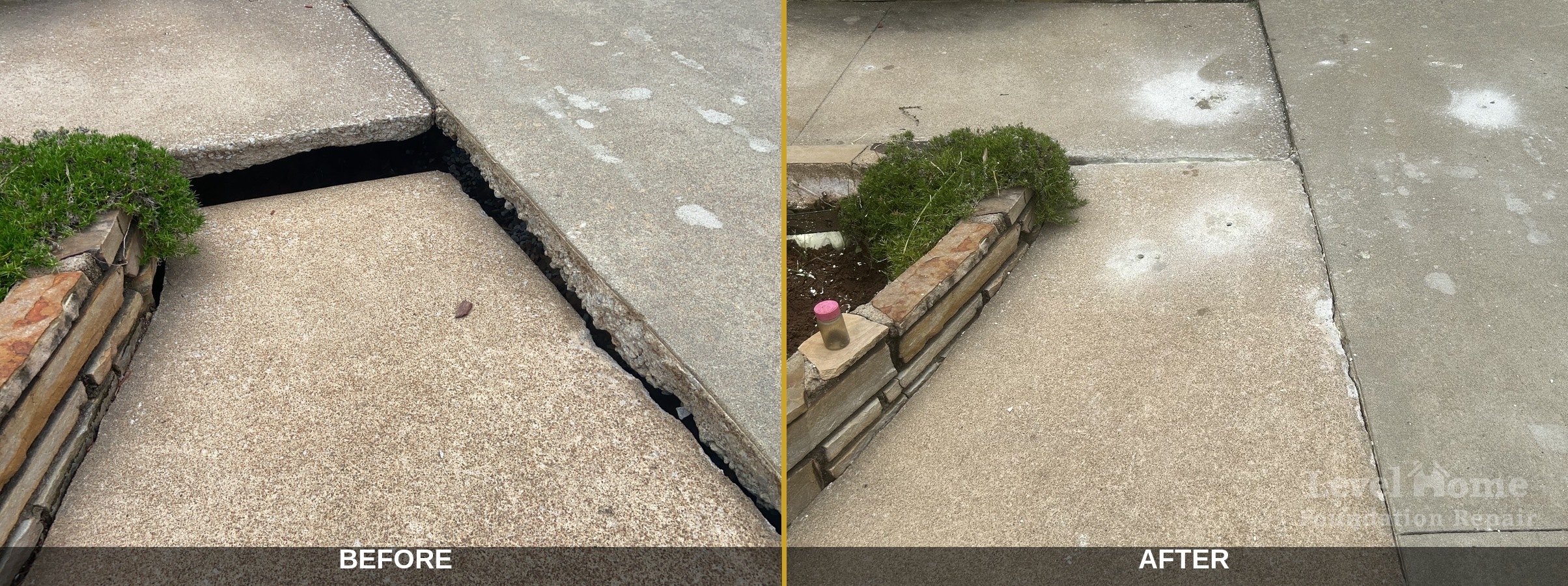
The photo at the top of this post is from an actual job in the Tulsa area. On the left, you can see the slab separation and settlement that had developed over time, a clear gap where the concrete had pulled away and dropped. On the right, the same slabs after poly foam injection: joints tight, surfaces flush, and no visible trace of the original problem.
That kind of result is typical for slabs that have settled but have not yet cracked through. The earlier you address the sinking, the cleaner the outcome.
Where Tulsa Homeowners See It Most
Concrete settlement in the Tulsa metro tends to show up in a few predictable spots.
- Driveways — especially at the seam where the driveway meets the garage slab or where the apron connects to the street.
- Patios — slabs that have pulled away from the house, creating a gap where water pools against the foundation. Our patio leveling guide covers this scenario in detail.
- Sidewalks and walkways — panels that have tipped or dropped relative to their neighbors, creating a visible step and a tripping risk.
- Garage floors — interior slabs that slope toward one wall or away from the door, sometimes accompanied by cracking at the control joints. We wrote a dedicated post on why Tulsa garage floors sink first.
- Pool decks and stoops — areas with heavy foot traffic and direct sun exposure that dry out the subgrade faster than surrounding soil.
When Leveling Works (and When It Does Not)
Poly foam leveling is effective when the slab is structurally intact but has settled due to void formation beneath. That covers the majority of cases we see in the Tulsa metro.
It is not the right solution when the concrete has shattered into multiple pieces, when the subgrade has an active plumbing leak feeding continuous erosion, or when the settlement is caused by a deeper structural foundation problem that requires pier support. In those cases, the underlying issue needs to be resolved before the surface slab can be addressed.
If you are unsure which category your situation falls into, a foundation inspection will clarify it. We evaluate the slab, the subgrade, and the surrounding drainage before recommending any work.
What Leveling Costs in Tulsa
Most residential concrete leveling jobs in the Tulsa area fall between $500 and $2,500, depending on the number of slabs, the total square footage, and the depth of the voids. That is typically 50 to 75 percent less than tearing out and replacing the same concrete. For broader pricing context, our foundation repair cost guide breaks down what different types of work run in this market.
Stop the Settling Before It Cracks
Sunken concrete is one of the few home repair problems where acting early saves real money. The longer a slab sits in a settled position, the more stress builds at the control joints and edges, and once it cracks, the repair options get more expensive.
If you have concrete that has started to sink, shift, or separate in the Tulsa area, reach out for a free assessment. We will tell you whether leveling will solve it or whether something deeper is going on.