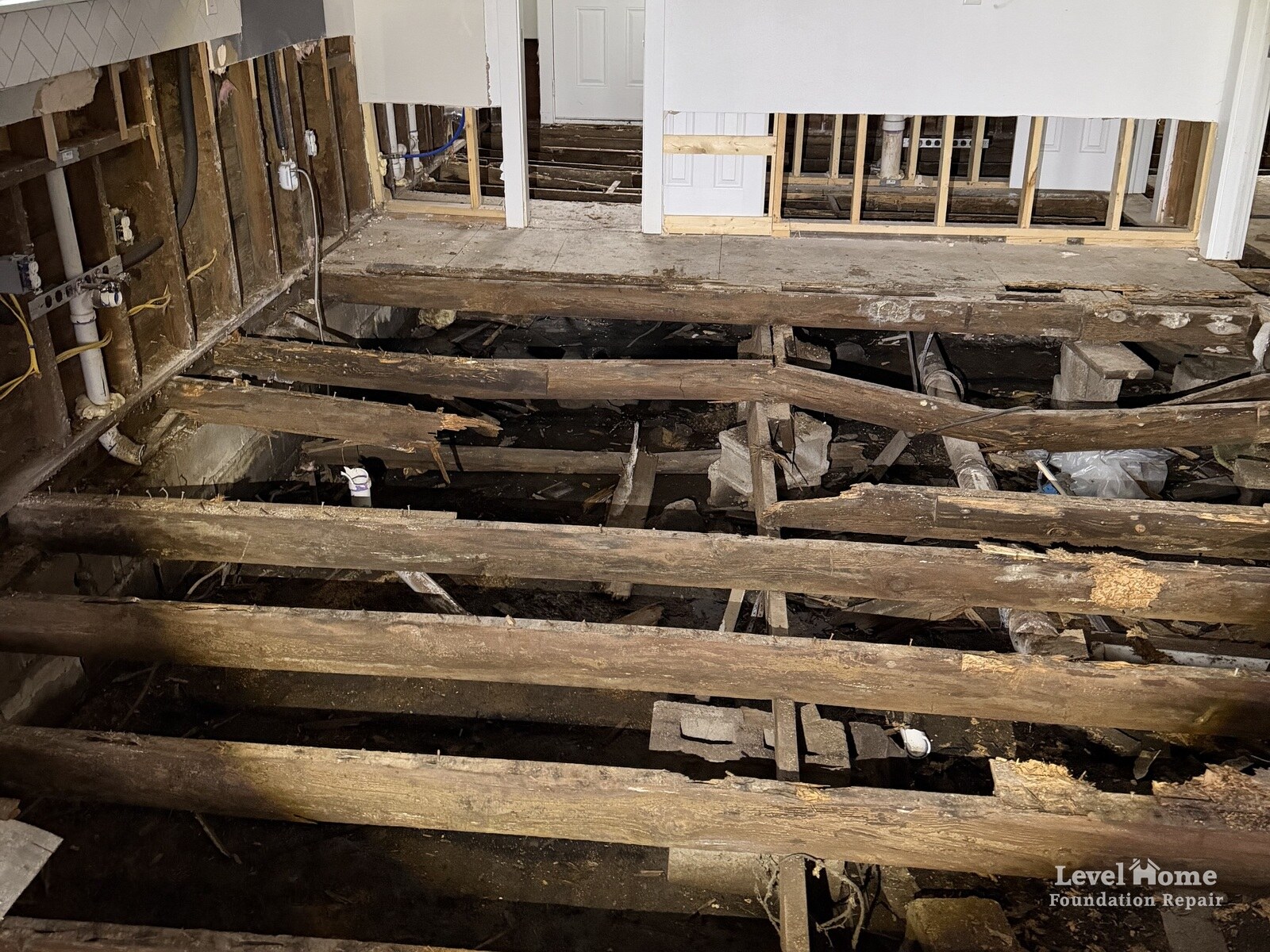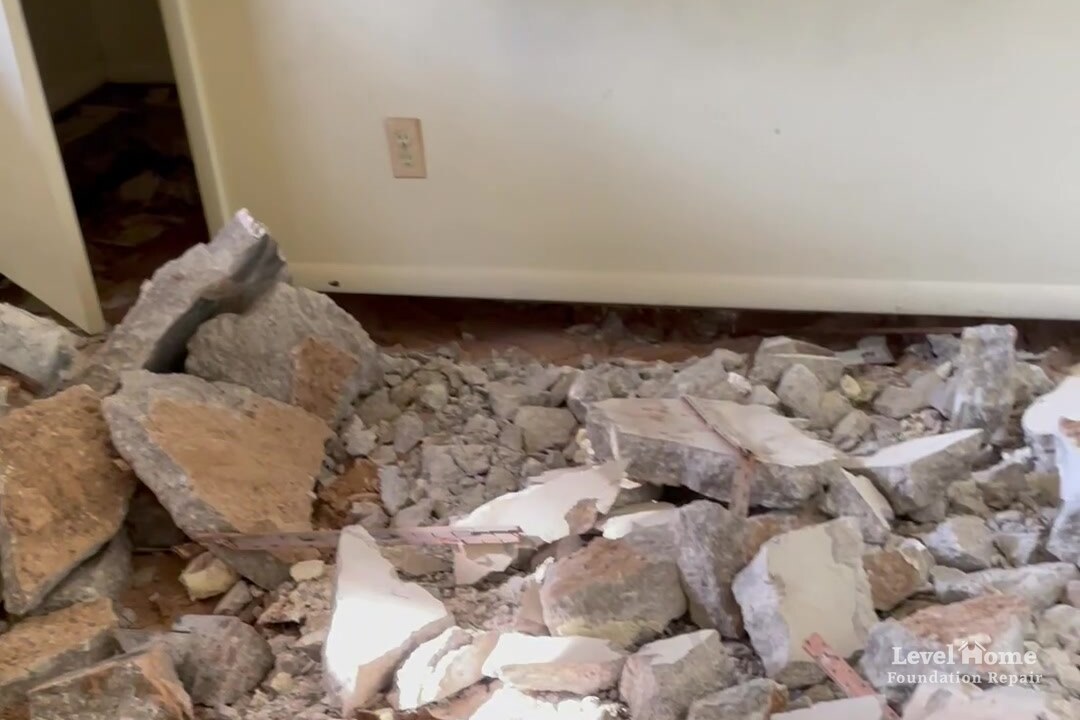

Most people know Level Home Foundation Repair for the work we do under houses: steel piers, crawl space rebuilds, cracked slabs and sinking driveways. This October our team took on a very different kind of job. We repaired a leaking retention pond at one of the City of Tulsa’s water treatment facilities, and we did it by combining polyurethane deep injection with chemical grouting.
A pond at a treatment plant and a sinking garage floor do not look like they have much in common. Both usually come back to the same two things, though: water, and the soil it moves through. This post covers what chemical grouting and polyurethane deep injection are, why the two methods work so well together on a leak, the warning signs that a pond or basin is losing water, and why our team has put so much into learning so many different repair processes.
The Project: A Leaking Retention Pond for the City of Tulsa
Water treatment facilities rely on ponds and basins that are built to hold water. When one of them starts to leak, the cost is more than the water that gets away. Water escaping through a structure, or through the ground around it, can carry soil along with it. Over time that opens voids and weakens the same ground that is supposed to keep the water contained.
That was the situation at one of the City of Tulsa’s retention ponds. Our crew resolved the leak with a combination of polyurethane deep injection and chemical grouting techniques. Because water treatment plants are critical public infrastructure, we are keeping the details of the site itself general in this post.
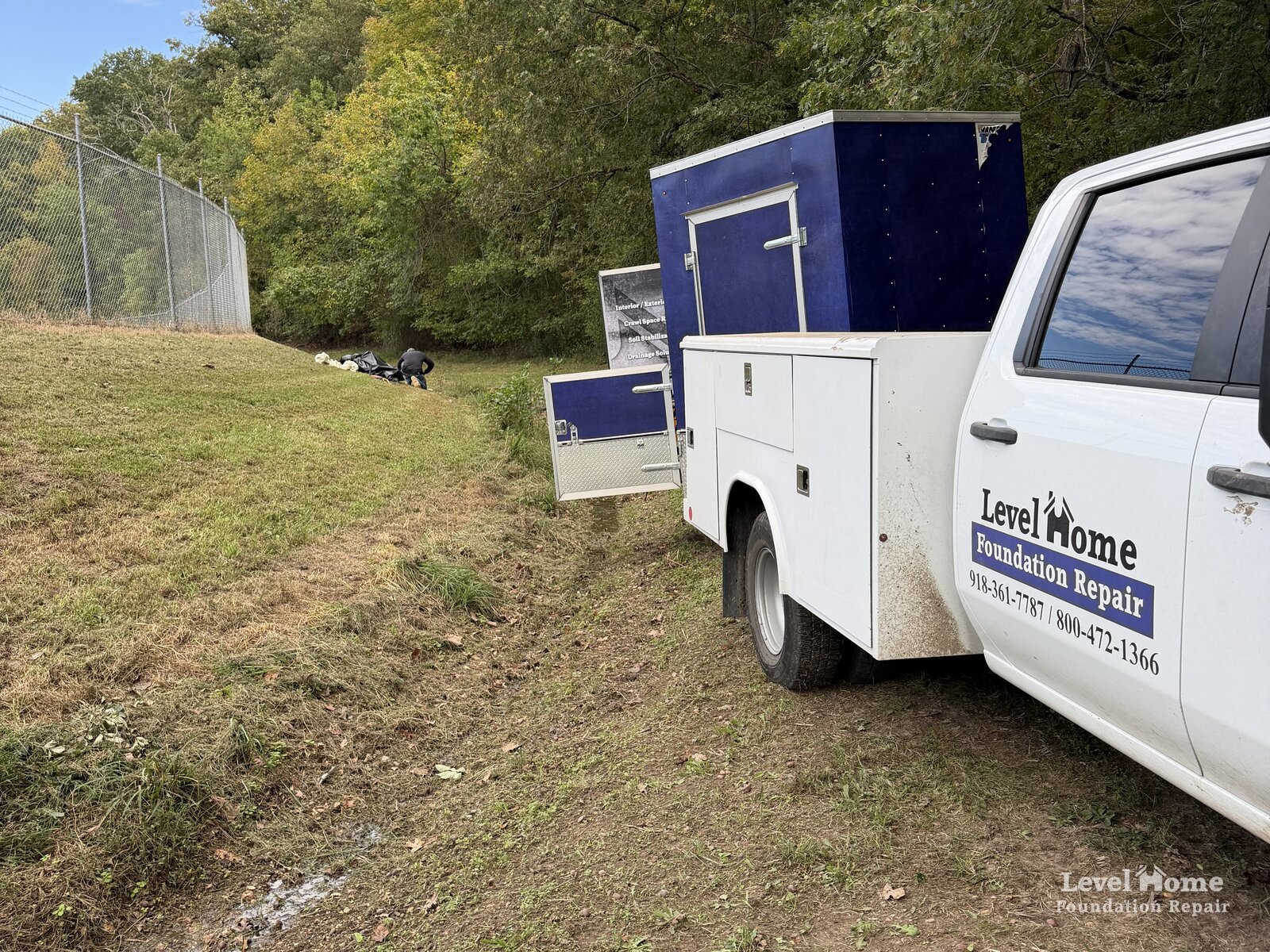
The photo at the top of this post shows City of Tulsa trucks on the facility grounds while the work was underway. The photo above shows our service truck and equipment trailer parked along the slope during the repair.
What Is Chemical Grouting?
Chemical grouting is the injection of a liquid grout with no solid particles into soil, cracks or joints, where it reacts and sets to block the path water is taking or to bind loose soil together.
The difference from ordinary cement grout matters. Cement grout is made of fine particles suspended in water, and those particles can only travel into openings large enough to let them through. The Federal Highway Administration’s ground modification manual defines chemical grouts as pure solutions with no suspended particles, ranging from sodium silicate to polyurethanes, acrylates and other resins. Because they are true liquids, chemical grouts can reach much finer pores. The manual notes that it is normal to fill the larger openings with a particle based grout first and then reach the finer pores with chemical grout.
According to the same manual, chemical grouting is used to seal off water intrusion in tunnels and deep excavations and to reduce water movement through the soil under foundations. Permeation grouting in general, which includes chemical grouts, is used for seepage control, slope stabilization and soil strengthening. It is a specialized tool, which is exactly why a repair contractor needs to know when it is the right call and when it is not.
Hydrophilic and hydrophobic polyurethane grouts
Polyurethane is one of the most widely used chemical grouts for leaks. The Bureau of Reclamation studied polyurethane grouts for sealing leaking cracks in concrete and describes many of them as single component resins that are activated by water. They come in two broad types:
- Hydrophilic grouts react with large amounts of water and cure softer.
- Hydrophobic grouts react with much less water and cure more rigid.
Depending on the product, the cured grout can be a foam, a gel or a solid. The Army Corps of Engineers grouting manual adds that polyurethane grout set times can be adjusted from seconds to minutes, and that the material expands when it is not confined, with some reports of expansion up to 30 times the injected volume. That fast, adjustable reaction is a big reason polyurethane is used to shut off water that is actively moving.
What Is Polyurethane Deep Injection?
Polyurethane deep injection places an expanding, two component polyurethane resin down in the soil at the depths that need treatment, where it fills voids and compacts the loose ground around it.
It is related to the poly foam concrete lifting many Tulsa homeowners already know, but the target is different. Foam leveling works mostly in the thin layer right under a slab. Deep injection works farther down, in the soil itself, which is why it is often described as polyurethane soil stabilization.
A 2021 review of soil injection research in the journal Polymers lays out the basic process:
- Small holes, roughly half an inch to just over an inch across, are drilled.
- Injection tubes are set into the soil zones that need treatment. Those zones are chosen based on the soil type, the groundwater level and the depth of the foundation.
- The two resin components are mixed and injected through the tubes in stages.
- The injection is monitored until the target result is reached.
The reaction starts the moment the two components mix. The review reports that the resin begins to harden within about 30 seconds and reaches its final properties within roughly 15 to 30 minutes. As it expands, it fills voids and compacts the surrounding soil. The authors also point out that soil injection is especially useful under existing structures where digging out and replacing the soil is not practical, which describes a lot of commercial and public sites. For the deeper technical story, we cover the engineering science behind polyurethane foam injection in a separate article.
Why We Paired Chemical Grouting With Deep Injection
A leak in a structure that holds water is really two problems at once. The first is the path, meaning the crack, joint, seam or channel the water is using to get out. The second is the ground that water has been moving through, which may have lost soil, softened or developed voids along the way. Fixing one and ignoring the other can leave the job half done.
Chemical grouting goes after the path. Deep injection goes after the ground. Used together, they address both the leak itself and the soil around it, and that combination is what resolved the leak at the City of Tulsa retention pond.
We would not use that pairing on every leak. It fit this one, and that is really the point. The method should follow the problem, not the other way around.
Why a Small Leak in a Pond or Basin Deserves Attention
Dam safety engineers have a name for what uncontrolled seepage can do to an earth embankment: internal erosion, or “piping.” The Association of State Dam Safety Officials (ASDSO) explains that it happens when water seeping through an embankment carries soil particles away, which can erode a long cavity, or pipe, backward through the embankment toward the water. ASDSO calls internal erosion one of the most common causes of earth dam failure and warns that there may be little or no outside evidence while it is happening.
A retention pond is usually much smaller than a dam, but the same basic process can affect the soil around any pond, basin or embankment that holds water. Once water finds an easy way out, it tends to make that path bigger. That is why a leak that looks minor today is worth fixing before it has the chance to undermine the ground around it. We see a smaller version of the same thing on sloped residential lots, where runoff carries soil away from a house, and our hillside foundation erosion repair shows how that plays out.
Signs a Pond, Basin or Embankment May Be Leaking
Whether you manage a municipal facility, an industrial site, a commercial property with a stormwater pond or a neighborhood association with a retention pond, these signs are worth taking seriously:
- A water level that keeps dropping in dry weather, faster than evaporation would explain
- Wet spots, soggy ground or flowing water on the outside slope or at the base of an embankment
- Muddy or cloudy water coming out of a slope, a drain or an outlet pipe
- Sinkholes, sunken spots or slumping soil on or near the embankment
- Erosion channels or washed out areas below the pond
- Cracks, open joints or gaps where pipes pass through a concrete wall
ASDSO notes that internal erosion problems are often tied to things that pass through an embankment, such as buried outlet pipes, animal burrows and concrete spillways, so those spots deserve a close look. Muddy water flowing out of an embankment or a sinkhole that keeps growing can mean the problem is getting worse quickly. If you see either one, contact your engineer or local emergency officials right away.
What a Commercial Leak Repair Involves
Every site is different, but leak repairs like this one generally move through the same stages.
- Find where the water is going. The structure and the ground around it are checked for wet areas, soft soil, erosion and other clues to the path the water is taking.
- Plan the work with the owner. On public and commercial projects, scope, access, safety and timing are worked out with the owner’s staff and, when one is involved, the engineer of record. Our civil and infrastructure repair work is built around that kind of coordination.
- Match the materials to the leak. The grout type, how fast it reacts and how much it should expand all depend on how much water is moving and what the surrounding soil or concrete is like.
- Seal the path and stabilize the ground. Chemical grout shuts off the water path, and polyurethane deep injection fills voids and densifies the soil the water has disturbed.
- Confirm the result. The area is watched for any remaining seepage, and spots that still show water get more treatment.
If you manage a commercial property, our commercial foundation repair team and Level Structural, our commercial and civil structural division, handle this kind of work alongside settlement, slab and wall repairs.
The Right Process for the Right Repair, at Any Size
We built Level Home around a simple idea: whatever the problem is, and however big or small, we want to have a proven way to fix it. That is why our team has spent years mastering a wide array of structural repair processes instead of building the company around a single product. It is how we make sure there is no client we cannot serve, and how we make sure we are always using the right process for the right repair.
That range includes:
- Steel piers and helical piers for settling foundations, plus helical tiebacks for leaning walls
- Crawl space structural repair, up to complete rebuilds of rotted floor framing
- Concrete leveling and slab repair with polyurethane foam, and full interior slab replacement when a slab is too damaged to lift
- Polyurethane deep injection and chemical grouting for voids, weak soil and leaks
- Permeation and compaction grouting, carbon fiber reinforcement and ionic clay soil stabilization through Level Structural
- Foundation drainage systems that keep water away from a structure in the first place
- Helical piers for new construction and additions, installed before the slab is poured
The clients have been just as varied. Our team has stopped storm water intrusion in the lower level floors at Hillcrest Medical Center, installed helical piles for Saint Francis, filled voids under a pool deck at Greenbriar Apartments, supported a retaining wall for Tulsa Firefighters Credit Union, and now stopped a retention pond leak for the City of Tulsa. Homeowners get the same thinking on every inspection. We would rather explain why a method fits than sell whatever happens to be on the truck.
The methods behind that work are proven. We use seven proprietary licensed products. Our processes are approved by engineering firms across Texas and Oklahoma, and we have never failed an engineer reinspection. For a closer look at how we choose between options on a home, see our guide to foundation repair methods.
What This Means for Homeowners
A municipal pond leak may seem a long way from a house in Broken Arrow or Jenks, but the same principles show up at home all the time. Water that runs under a driveway or patio can wash out the soil until the concrete cracks and drops, which is why water collecting on sinking concrete is worth paying attention to. A plumbing leak under a slab can soften the soil a foundation sits on. And Oklahoma clay soil swells and shrinks as its moisture changes.
In each case, a good repair starts by working out what the water is doing and then choosing the process that fits. Sometimes that is foam leveling. Sometimes it is drainage, piers or a combination. The scale is smaller than a treatment plant, but the thinking is the same.
Key Takeaways
- Level Home resolved a leak in a retention pond at a City of Tulsa water treatment facility by combining polyurethane deep injection with chemical grouting.
- Chemical grouting injects a liquid grout with no solid particles into soil, cracks or joints, where it sets to block the path water is taking.
- Polyurethane deep injection places expanding resin down in the soil, where it fills voids and compacts loose ground.
- Seepage can carry soil away and leave hidden voids, so a leak in a pond, basin or embankment is worth fixing early.
- Level Home and Level Structural, our commercial and civil division, take on projects of every size and match the repair method to the problem.
Frequently Asked Questions
What is chemical grouting used for?
Chemical grouting is used to stop water from moving through soil, cracks or joints and to strengthen loose ground. Common uses include sealing leaks, controlling seepage, reducing water movement through the soil under foundations, stabilizing slopes and strengthening soil around excavations.
What is the difference between chemical grouting and polyurethane deep injection?
Chemical grouting is mainly about water. A thin liquid grout travels into cracks or soil pores and sets to block the path water is taking. Polyurethane deep injection is mainly about the ground. An expanding two component resin is placed at depth to fill voids and compact loose soil. Both can involve polyurethane, but the materials and goals are different. Some jobs need one or the other, and the City of Tulsa retention pond leak called for both.
Can a leaking pond or basin be repaired while it still holds water?
In many cases, yes. Many polyurethane grouts are activated by water, which is one reason they are used on actively leaking cracks and joints. Whether a specific pond or basin can stay in service during a repair depends on how much water is moving, the condition of the structure and the plan agreed on with the owner and engineer.
How long does polyurethane injection take to cure?
Expanding polyurethane used for soil injection starts to harden within about 30 seconds and reaches its final properties within roughly 15 to 30 minutes, according to a 2021 research review in the journal Polymers. Polyurethane grouts used to stop leaks can be formulated to set anywhere from seconds to minutes.
What is a retention pond?
A retention pond is a constructed basin designed to hold water rather than let it drain away. In stormwater design, the EPA describes wet retention ponds as basins that keep a pool of water throughout the year, or at least through the wet season. Treatment facilities, industrial sites and commercial properties also use ponds and basins to hold water at different stages of their operations.
Does Level Home work on commercial and municipal projects?
Yes. Level Structural, our commercial and civil structural division, works with engineering firms, general contractors, property managers, commercial owners and municipalities. Recent projects include Hillcrest Medical Center, Saint Francis, Greenbriar Apartments, Tulsa Firefighters Credit Union and the City of Tulsa.
Have a Leak or Structural Problem? Let’s Take a Look
Whether it is a leaking pond at a public facility, a commercial building that is settling or a crack in the slab under your living room, our team will look at the problem, explain what we find and recommend the process that actually fits. Commercial and municipal teams can contact our team to set up a site assessment. Homeowners in Tulsa and across northeast Oklahoma can schedule a free inspection or call (918) 361-7787.