Most homeowners find out about crawl space moisture from above. A spot in the kitchen floor starts to feel soft. A floor that used to be flat develops a dip near the back door. Tile grout cracks, or the house picks up a musty smell that never quite goes away. By the time those signs show up, the wood under the floor has often been sitting in damp conditions for years.
That wood is your floor structure: the sill plates, floor joists, support beams, and subfloor that carry everything you walk on. When moisture gets into a crawl space and stays there, it slowly rots those parts. At Level Home Foundation Repair, our team completely rebuilds damaged crawl space floor structures for homeowners in Tulsa and across northeast Oklahoma, and in many of those homes, moisture is what ruined the original framing. This guide explains how that damage happens, what a rebuild involves, and how exterior drainage, interior drainage, and encapsulation keep it from coming back.
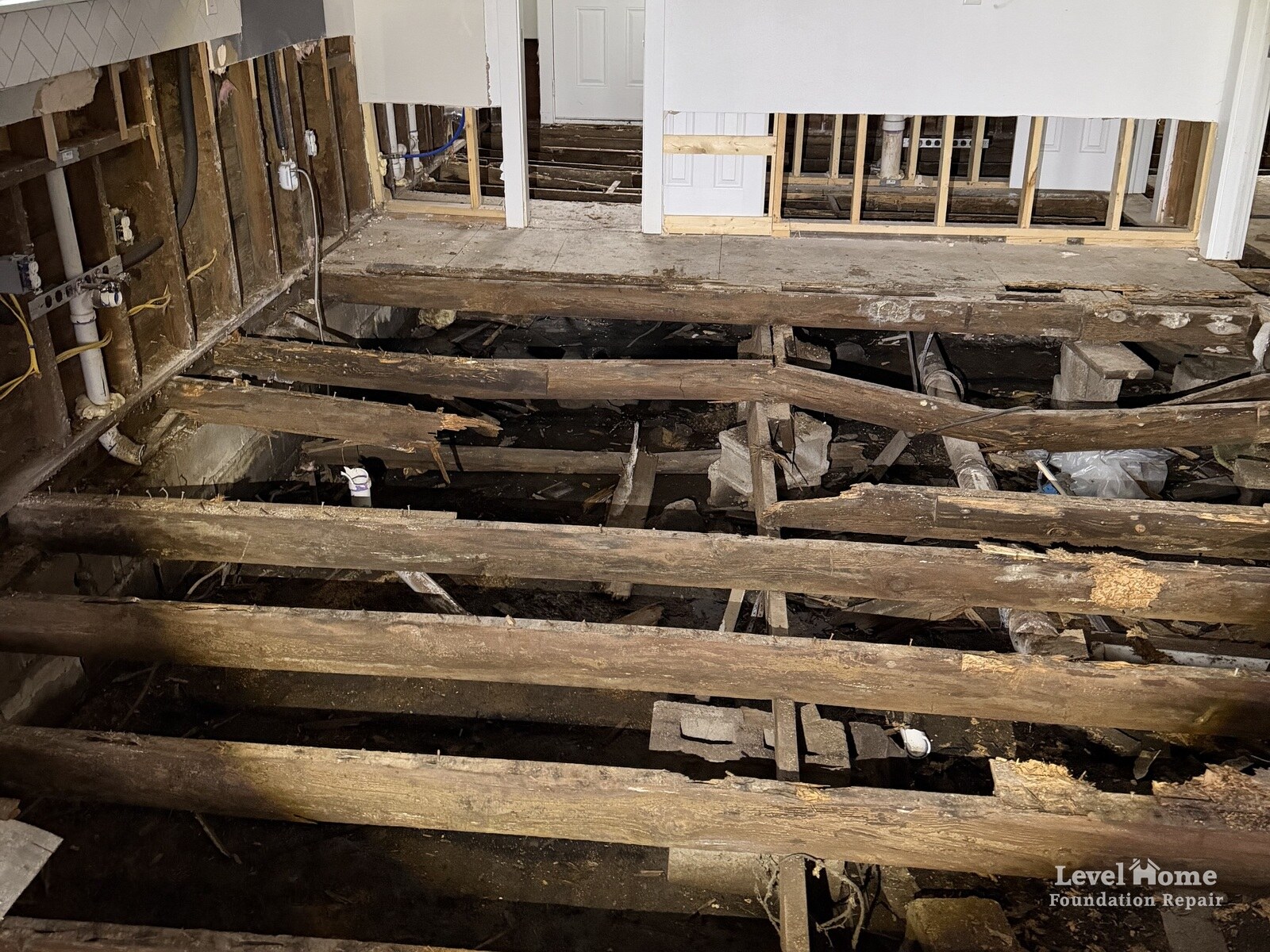
The photo at the top of this post shows what can be waiting under a finished floor once the subfloor comes up. The joists are darkened and breaking down, and one has bowed noticeably out of line. Rotted floor joists like these rarely show from inside a room until the floor starts to give.
How Moisture and Water Get Into a Crawl Space
Water in a crawl space usually comes from one of four sources, and plenty of homes have more than one at work at the same time.
Rain that drains toward the house
Roof runoff is a big one. An inch of rain falling on 1,000 square feet of roof adds up to roughly 620 gallons of water, and every downspout that empties right beside the foundation drops its share of that water into the soil against the wall. Clogged gutters overflow at the corners, and yards that slope toward the house carry rain straight to the foundation. Oklahoma clay soil makes it worse, because dense clay holds water against foundation walls instead of letting it drain away.
Saturated soil and groundwater
After long stretches of rain, the ground around and under a home can stay saturated long after the rain stops. Water then seeps through block foundation walls, up around piers, and into the low spots of the crawl space. Homes on sloped lots or near the bottom of a hill tend to see this the most. Our post on what heavy spring rain does to a Tulsa crawl space covers storm flooding in more detail.
Humid outdoor air
Vented crawl spaces were built on the idea that outside air would keep them dry. In a humid climate it often works the other way. The U.S. Department of Energy’s Building America research points out that in humid climates, outside air is often more moist than the air already in the crawl space, which leads to structural, mold, and pest problems. On a muggy Oklahoma summer day, warm, damp air drifts in through the vents, meets cooler wood, ductwork, and soil, and leaves moisture behind as condensation.
Plumbing leaks and sweating ducts
A slow drip from a supply line, a cracked drain pipe, or an air conditioning duct that sweats every summer can wet the same few joists for years without anyone noticing. Rot tends to concentrate right under those spots.
Why Damp Wood Turns Into Rotted Floor Joists
Wood rot is caused by fungi that break down the fibers that give wood its strength, and those fungi need moisture to get going. Researchers at the USDA Forest Products Laboratory sum it up this way: wood will decay above 30 percent moisture content and will not decay below 20 percent, with a gray area in between. Keeping the framing under that 20 percent line is the whole point of crawl space moisture control.
Mold runs on the same fuel. The EPA advises drying water damaged materials within 24 to 48 hours to prevent mold growth, which never happens when the source is a crawl space that stays damp all season. And the crumbly brown decay people call dry rot has a misleading name. It still needed water to start. The wood just looks dry by the time someone finds it.
Rot also does not stay in one place. Decayed wood soaks up water more easily than sound wood, so the damage tends to spread along a board and into the framing it touches. That is how one wet corner of a crawl space can turn into a rebuild that covers half a room.
The Floor Parts Moisture Ruins
A crawl space floor structure works as one system. When one part fails, the parts around it pick up load they were never meant to carry. Here is how moisture damage shows up in each piece.
Sill plates
The sill plate is the board that sits on top of the foundation wall and ties the house to it. Because it rests directly on masonry, it is the first piece of wood to absorb moisture wicking up through the foundation. A rotted sill plate can let the floor and the walls above it settle along the outside edge of the house, and the joists resting on it lose their support too. That is why sill plate replacement is often part of a floor structure rebuild.
Floor joists
Floor joists are the parallel boards that span the crawl space and hold up the subfloor. Rot usually starts at the ends, where joists rest on the sill plate or a beam, and anywhere water drips onto them. As a joist loses strength it sags and bounces, and the floor above develops dips and soft spots.
Support beams
Beams, sometimes called girders, run under the joists and carry their weight down to the piers. Rot where a beam sits on a pier, or along its length, can let an entire section of floor drop. Beam problems often show up as a long dip that runs across more than one room.
Subfloor
The subfloor is the plywood, OSB, or plank layer fastened across the top of the joists. When it stays damp from below, it softens, swells, and starts to come apart, and the fasteners holding it down lose their grip. Soft spots near kitchens, bathrooms, laundry rooms, and exterior doors are classic signs of a rotted subfloor.
Signs the floor structure is already damaged
- Soft or spongy spots when you walk across a room
- Floors that dip, slope, or bounce more than they used to
- Cracked tile or grout, or gaps opening up under baseboards
- A musty smell in the house that comes back no matter how much you clean
- Mold, dark staining, or crumbling wood on the framing when you look into the crawl space
- Doors that start sticking in rooms built over the crawl space
Our list of warning signs your crawl space needs structural repair goes deeper on each one, and our guide to pier and beam foundation problems explains how the piers underneath can fail too.
Can Rotted Floor Joists Be Repaired, or Do They Need Replacing?
It depends on how far the rot has spread. When a joist has a small soft area and the rest of the board, including both ends, is still solid, sistering a new joist alongside it can restore its strength. Our article on how crawl space structural repairs fix sagging floors walks through sistering and beam reinforcement.
Sistering stops making sense when the rot has reached the ends of the joists, when several joists in a row are soft, or when the sill plate or beam those joists rest on is failing too. Fastening new lumber to wood that is still decaying only hides the problem. In those situations, replacing the damaged members, and sometimes the entire floor system over that area, is the repair that lasts.
This is also where the cheapest quote can get expensive. A patch looks like a bargain on paper, but if the framing around it keeps rotting, you pay for the patch now and the rebuild later. Don’t pay twice by choosing the cheap quote. If you are comparing bids, our breakdown of foundation repair costs by home type explains what drives the price of crawl space work.
How Level Home Rebuilds a Damaged Crawl Space Floor Structure
Level Home Foundation Repair completely rebuilds damaged crawl space floor structures. Many of the rebuilds we take on trace back to moisture that ruined the floor components over time: floor joists, sill plates, support beams, and in many homes the subfloor as well. That kind of crawl space wood rot repair is part of our crawl space structural repair service.
Every home is different, but a full rebuild generally follows the same path.
- Inspection. Our team goes into the crawl space, probes the framing to find where solid wood ends and rot begins, checks moisture and drainage, measures floor levels, and tracks down where the water is coming from.
- A written scope. You get a clear plan that spells out which members need to be replaced, what support the floor needs, and how the moisture source will be handled.
- Temporary support. The floor and the walls above it are supported while damaged framing comes out, so the house stays safe during the work.
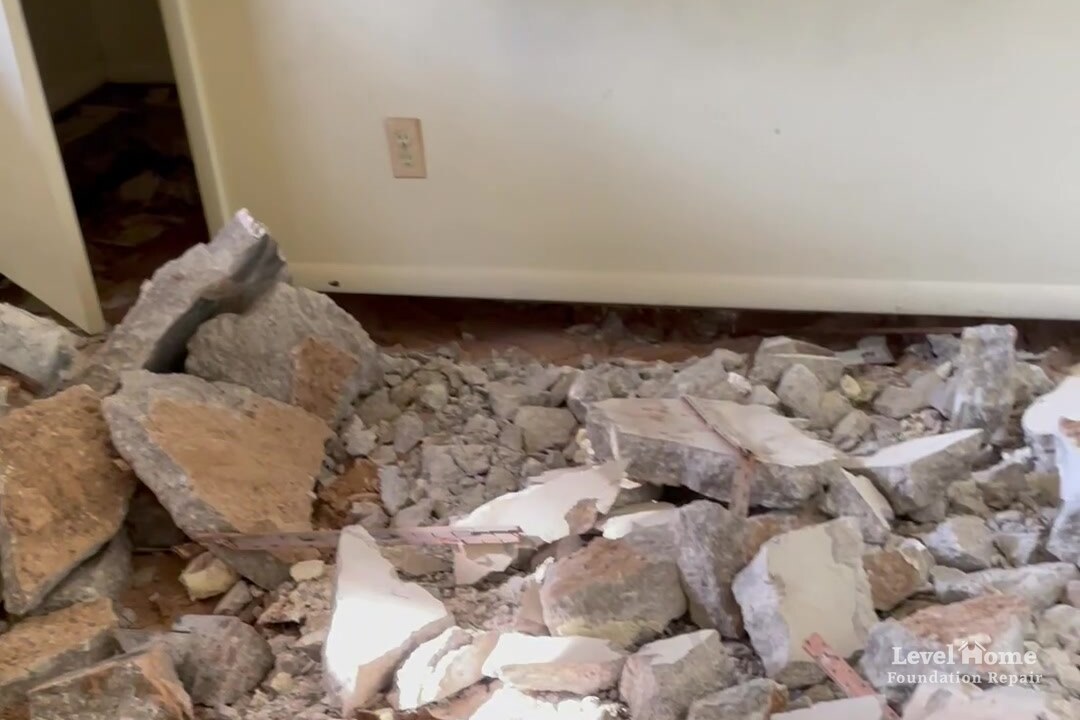
- Removing the damaged wood. Rotted sill plates, joists, beams, and subfloor are removed. Some rebuilds can be done entirely from the crawl space. When the subfloor itself is ruined, the floor may need to be opened from inside the home, as in the photo above.
- Rebuilding the structure. New sill plates, joists, beams, and subfloor go in, with steel support piers wherever the old supports have failed. If the floor has dropped, it can be brought back toward level as the new structure is set.
- Protecting the new framing. Drainage and encapsulation are planned as part of the job, so new wood is not left in the same conditions that destroyed the old wood.
Our processes are approved by engineering firms across Texas and Oklahoma, and we have never failed an engineer reinspection. If you would like an independent opinion first, we offer structural engineer fee reimbursement. For older homes, this work often goes hand in hand with pier and beam foundation repair, and when the original piers have given out, crawl space pier replacement becomes part of the plan.
Exterior Drainage: Stop the Water Before It Reaches the Crawl Space
A new floor structure will rot again if the water keeps coming, so we look at exterior drainage first. A lot of crawl space moisture starts as rain that lands on the roof or the yard and is allowed to run toward the house. Fixing that is often simpler and less expensive than dealing with the water once it is under the floor.
- Gutters and downspouts. Keep gutters clean and carry downspout water well away from the foundation with extensions or buried lines that empty where the water can drain off.
- Grading. The International Residential Code calls for the ground to fall at least 6 inches within the first 10 feet away from a foundation. Over the years, settled backfill, landscaping, and new flower beds can flatten that slope or turn it back toward the house.
- French drains and surface drains. Where a yard holds water or a slope sends runoff at the house, our foundation drainage systems give that water a planned path around the home. Here is how French drains compare with surface drains.
- Perimeter drainage. On homes that take on water from every side during heavy storms, perimeter drainage intercepts it before it reaches the foundation.
For a full look at the options and what they cost, see our foundation drainage solutions guide, or see what a professional yard drainage installation looks like from start to finish.
When Interior Crawl Space Drainage Is Also Needed
Exterior drainage handles water coming from above. Some homes also take on water from below or through the foundation walls, and no amount of gutter work will stop that. These are the signs we look for:
- Standing water in the crawl space after storms, even with gutters and grading in good shape
- Water lines, silt, or mud on piers and foundation walls
- Water seeping through block walls or bubbling up at low spots in the soil
- Homes on hillsides or low lots where groundwater rises after heavy rain
A crawl space drainage system collects that water inside the foundation and moves it out. It typically pairs a drain line along the inside of the foundation walls with a sump pump basin at the low point, which pumps the water outside and away from the house. Level Home installs crawl space drainage systems, and when a rebuild calls for one, we include it in the same plan so the new framing is not sitting over standing water.
Encapsulation: Protecting the New Structure and the Air You Breathe
Drainage moves liquid water. Encapsulation controls the crawl space moisture that is left over: damp soil, humid air, and the condensation that keeps a vented crawl space wet through an Oklahoma summer.
A complete encapsulation seals the crawl space off from the outside. A heavy liner covers the ground and runs up the walls and around the piers, the seams are sealed, vents and openings are closed, and a dehumidifier keeps humidity in check. Level Home offers complete crawl space encapsulation in Tulsa, and our comparison of encapsulation and a basic vapor barrier explains why the full system matters in our climate.
Why the crawl space affects your indoor air quality
Warm air rises and leaks out through the upper parts of a house, and the air that replaces it gets pulled in low. In a crawl space home, some of that replacement air comes up through the floor, carrying moisture, musty odors, and mold spores with it. That is why a lingering musty smell in the house can often be traced back to the crawl space.
Sealing and drying the crawl space cuts off that source. The EPA recommends keeping indoor humidity below 60 percent, ideally between 30 and 50 percent, and notes that the key to mold control is moisture control. Building America research found that closed, conditioned crawl spaces reduced humidity by more than 20 percent while also using 15 to 18 percent less energy for heating and cooling. That is why we offer complete encapsulation: to keep the crawl space dry and help protect the air quality inside your home.
One caution. Encapsulation works best once the structure is sound and the water is under control. We do not sell it as a cover for rotted framing, because sealing a liner over a failing floor structure only hides damage that keeps getting worse.
Why the Repair Has to Cover Water, Structure, and Air
Moisture and structural damage feed each other, so a repair that only handles one of them is not finished. A sound plan:
- Stops the water at the source with exterior drainage, plus interior drainage wherever water still gets in.
- Repairs or rebuilds the damaged floor structure on solid support.
- Seals and dries the crawl space with encapsulation so the new wood stays below the moisture levels that let rot start.
Skip a step and the clock starts on the next repair. New framing over a wet crawl space is set up to rot again, and a liner over rotted framing hides damage while it spreads. For a broader look at every type of crawl space work, see our complete guide to crawl space repair in Tulsa.
Key Takeaways
- Crawl space moisture comes from roof and yard runoff, saturated soil and groundwater, humid outdoor air entering through vents, and plumbing or duct leaks.
- USDA Forest Products Laboratory researchers note that wood decays above 30 percent moisture content and does not decay below 20 percent.
- Moisture rots the sill plates, floor joists, support beams, and subfloor that make up a crawl space floor structure.
- Sistering can fix a joist with limited damage, but rot at the joist ends or in the sill plate and beam calls for replacement.
- Level Home Foundation Repair completely rebuilds damaged crawl space floor structures and installs crawl space drainage systems and complete encapsulation.
- Exterior drainage comes first. Interior drainage is needed when water still gets in from below or through the walls. Encapsulation controls humidity and helps keep damp crawl space air out of your living space.
Frequently Asked Questions
Can moisture in a crawl space rot floor joists?
Yes. Wood decay fungi grow when wood stays wet, and USDA Forest Products Laboratory researchers note that wood decays above 30 percent moisture content and does not decay below 20 percent. A crawl space that stays damp from runoff, groundwater, humid air, or leaks can keep joists, sill plates, beams, and subfloor in that danger zone for years.
Is water in a crawl space normal?
Standing water is not normal and should not be ignored. It raises the humidity under your home, feeds rot and mold, and usually points to a drainage problem such as downspouts emptying at the foundation, a yard that slopes toward the house, or groundwater coming in after heavy rain.
Can rotted floor joists be repaired, or do they have to be replaced?
A joist with a small area of rot and solid ends can often be sistered. When rot reaches the ends of the joists, spreads across several joists, or affects the sill plate or beam they rest on, replacing the damaged members is the lasting repair. In those cases, Level Home rebuilds the floor structure over the affected area.
Do I need interior crawl space drainage if my gutters and grading are fixed?
Not always. Exterior drainage handles water from the roof and yard. If water still collects in the crawl space after storms, seeps through the foundation walls, or rises from below, an interior drainage system with a sump pump is usually needed to move it out.
Does crawl space encapsulation improve indoor air quality?
It helps. Air from a crawl space moves up into the living space as warm air rises and escapes through the upper parts of the house. Encapsulation seals out damp soil and humid outdoor air and controls humidity with a dehumidifier, which limits the moisture, musty odors, and mold growth that would otherwise come up with that air.
How can I tell if my subfloor is rotted?
Soft or spongy spots, floors that flex near kitchens, bathrooms, laundry rooms, or exterior doors, loose or cracked tile, and a musty smell are common signs. The only way to know how far the damage goes is to inspect the framing from the crawl space.
Worried About Moisture Under Your Floors?
If you have soft spots, a floor that has started to dip, or a musty smell you cannot get rid of, our team will inspect your crawl space, show you what we find, and give you an honest assessment of what needs to be done and what does not. We serve Tulsa and communities across northeast Oklahoma.
Our repairs come with a written transferable warranty that passes to the next owner at no cost, and we will walk you through the exact coverage for your project before any work begins. You also get a free Home Health Check for the first two years after your repair, and financing options are available. Schedule a free inspection or call (918) 361-7787.