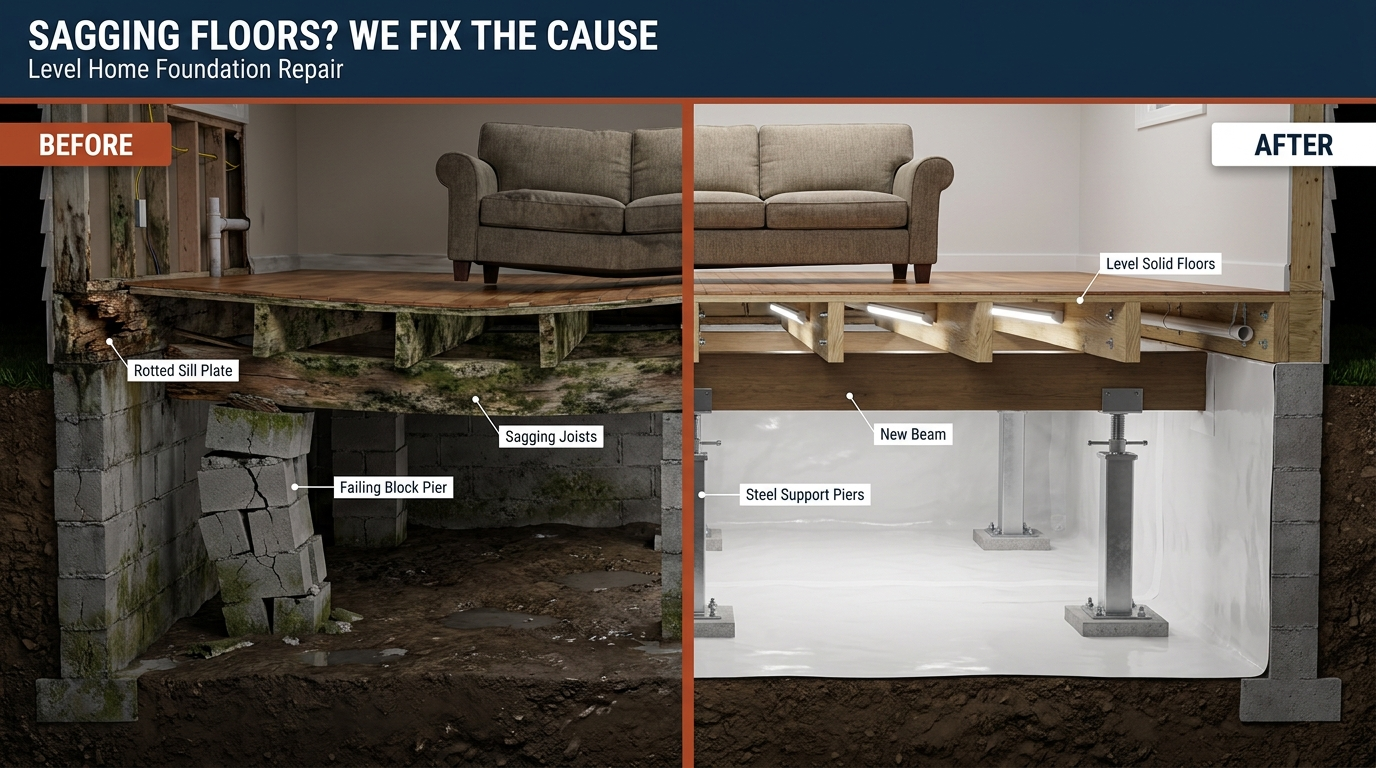
When your floors start dipping in the middle of a room or feel soft underfoot, the problem almost never starts at floor level. In most Tulsa pier-and-beam homes, sagging floors trace back to structural failure in the crawl space: rotted sill plates, deteriorating joists, and block piers that have shifted or crumbled under decades of Oklahoma soil movement.
This is not a cosmetic issue. Sagging floors signal active structural decline underneath your home, and the longer it goes unaddressed, the more expensive the repair becomes. Here is what actually happens below your floors and how a proper crawl space structural repair restores your home to level.
What Causes Crawl Space Structural Failure in Tulsa
Tulsa sits on expansive clay soil that swells during our wet spring months and shrinks through summer drought. That seasonal cycle puts constant lateral and vertical pressure on everything in your crawl space. Three components tend to fail first:
Rotted Sill Plates
The sill plate is the first piece of wood that sits on top of your foundation wall. In Tulsa crawl spaces, moisture wicking up from clay soil and condensation from temperature swings saturate the sill plate over time. Once rot sets in, the sill plate loses its load-bearing capacity. The perimeter of your floor system drops, and you feel it as a slope toward exterior walls.
Sagging Floor Joists
Floor joists span the distance between your foundation walls and the center beam. When the beam drops, the center support pier fails, or the joists themselves weaken from moisture damage, the middle of your floor sags. This is the classic “soft spot” homeowners notice when walking through hallways or living rooms. In older Tulsa homes built before the 1970s, undersized joists compound the problem because they were never engineered for modern loads.
Failing Block Piers
Concrete block piers were the standard interior support method for decades. Stacked blocks sitting on shallow footings shift when the soil beneath them expands and contracts. Once a block pier tilts or sinks, it no longer supports the beam above it. The beam drops, the joists follow, and your floors sag. This is one of the most common structural problems I see in Tulsa crawl spaces.
How Steel Support Piers Permanently Fix the Problem
A proper crawl space structural repair replaces every failing component with materials designed to handle Oklahoma soil conditions permanently. The process involves three key upgrades:
1. Steel Adjustable Support Piers Replace Block Piers
Engineered steel support piers bolt to concrete footings poured to the correct depth for your soil type. Unlike stacked blocks, steel piers are adjustable. This means the beam height can be fine-tuned during installation to bring your floors back to level. They resist lateral movement from soil pressure and will not deteriorate from moisture exposure. These are fundamentally different from exterior steel push piers used for settling foundations: interior support piers are designed specifically to carry vertical load from beams and joists inside the crawl space.
2. New Engineered Beams Replace Damaged Ones
If the existing center beam has cracked, split, or dropped from failed pier support, it gets replaced with a properly sized engineered beam. The new beam sits on the steel piers and redistributes floor load evenly across the span. This eliminates the localized sag points that create dips and soft spots in your floor above.
3. Sill Plate and Joist Repair or Sistering
Rotted sill plates get cut out and replaced with pressure-treated lumber rated for ground contact. Damaged joists are either replaced entirely or reinforced through a process called sistering, where a new joist is bolted alongside the weakened one. Both methods restore the original structural capacity of the floor system.
What the Repair Process Looks Like
Crawl space structural repairs in Tulsa typically follow this sequence:
- Crawl space inspection: I get under the house with a flashlight and moisture meter to identify every failing component. This tells me exactly what needs replacement versus what is still structurally sound.
- Temporary support installation: Before removing any failing piers or beams, temporary jacks support the floor system so nothing shifts during the work.
- Failing component removal: Crumbling block piers, rotted sill plates, and damaged joists come out.
- Steel pier installation: New concrete footings are poured, and adjustable steel piers are set and leveled.
- Beam and joist work: New beams go in on the steel piers. Damaged joists are sistered or replaced.
- Floor leveling: The adjustable piers allow fine-tuning until the floor above reads level. This is where the “before and after” difference becomes dramatic.
Most crawl space structural repairs take one to three days depending on how many piers and joists need replacement. Your home stays livable during the entire process.
Signs Your Tulsa Home Needs Crawl Space Structural Repair
Not every floor creak means structural failure. But several signs together usually point to active crawl space problems:
- Floors that visibly slope toward the center of the house or toward exterior walls
- Soft spots that flex when you walk across them
- Doors that stick or swing open on their own (the frames are no longer plumb)
- Gaps between baseboards and the floor
- Bouncy or springy floors, especially in hallways
- Visible moisture, mold, or musty smell coming from crawl space vents
If you notice two or more of these, a free crawl space inspection will confirm whether structural repair is needed. I document everything with photos so you can see exactly what is happening under your home before any work begins.
Why Tulsa Clay Soil Makes This Worse Over Time
Foundation and crawl space problems in Tulsa are progressive. Oklahoma’s clay soil does not stop moving. Every wet-dry cycle pushes block piers further out of alignment and introduces more moisture to wood components. A crawl space that shows early signs of pier shifting this year will have visibly sagging floors within two to three years if left alone. The repair scope and cost grow with each season of delay.
The Difference Between a Patch and a Permanent Fix
Some contractors offer to shim existing block piers or add temporary jack posts as a quick fix. These approaches treat the symptom without addressing the root cause. Shimmed blocks still sit on inadequate footings in moving soil. Temporary jacks are designed for short-term use and can fail under sustained load.
A permanent crawl space structural repair replaces the failing support system entirely: engineered steel piers on proper footings, new beams rated for the span, and restored joist integrity. That is the difference between a repair that lasts five years and one that lasts the remaining life of the home.
Schedule a Free Crawl Space Inspection in Tulsa
If your floors are sagging, bouncing, or sloping, the answer is in the crawl space. I offer free structural inspections for homeowners across the Tulsa metro area, and I will show you exactly what is happening under your home with photos and a written assessment. No pressure, no sales pitch: just honest information about what your home needs.
Schedule your free crawl space inspection here or call to set up a time that works for you.