When a Tulsa homeowner discovers their foundation is settling, one of the first decisions our team helps them make is which pier system fits their situation. Steel piers and helical piers are both engineered to stabilize and lift foundations, but they work in fundamentally different ways and perform best under different conditions. Understanding the difference can save you thousands of dollars and years of worry.
How Steel Piers Stabilize Tulsa Foundations
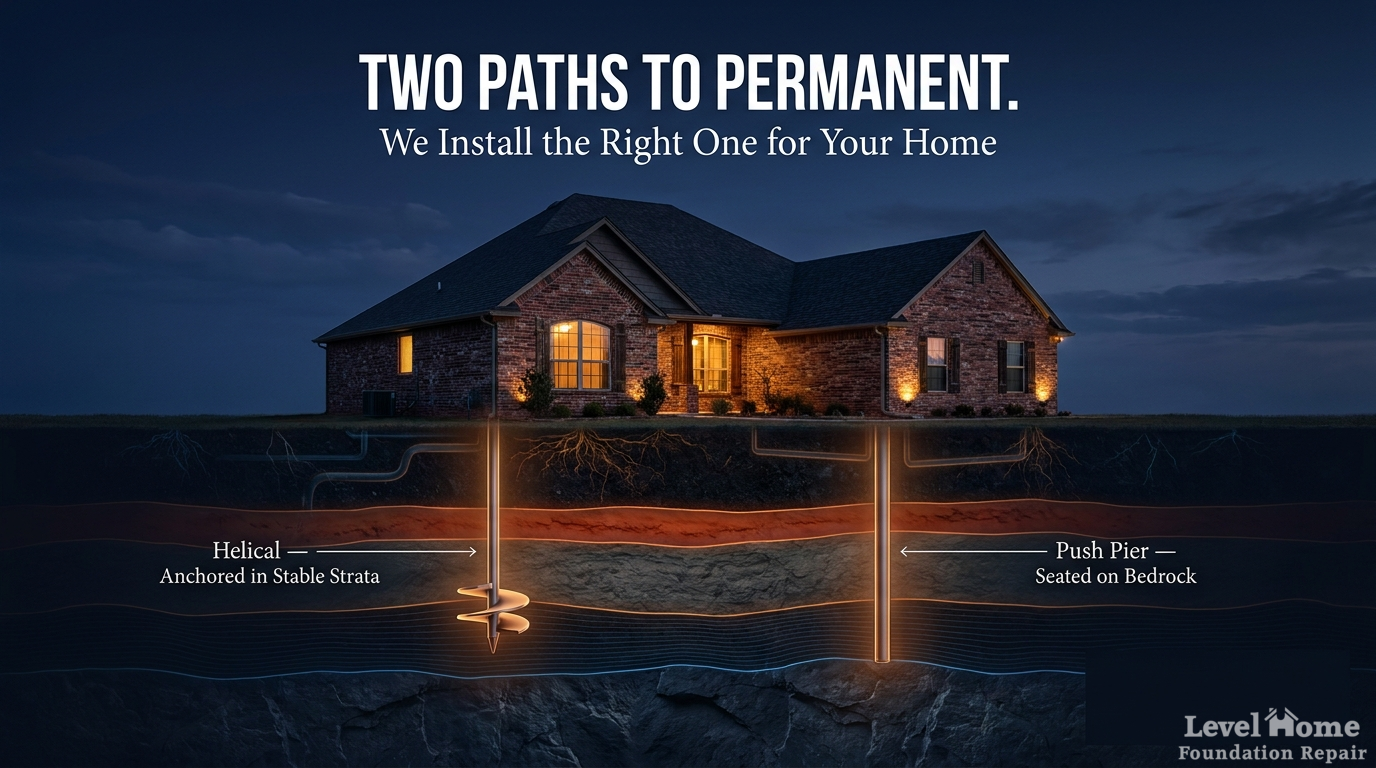
Steel piers — sometimes called push piers or resistance piers — are hydraulically driven straight down through unstable soil until they reach load-bearing strata or bedrock. The weight of your existing structure provides the resistance that drives each pier deeper. In Tulsa’s geology, that typically means pushing through 15 to 30 feet of expansive clay before hitting limestone or competent shale.
Because steel piers rely on the structure’s own weight, they are ideal for existing homes and buildings that have already settled. Once seated on stable ground, the hydraulic system can often lift the foundation back toward its original elevation — not just stop the sinking, but actually recover lost ground.
Our team designs and fabricates our steel pier systems in-house, which means every bracket, sleeve, and drive head is engineered specifically for Tulsa’s soil conditions rather than pulled from a one-size-fits-all catalog. Learn more about our steel pier underpinning process.
How Helical Piers Work Differently
Helical piers look like giant steel screws. Each shaft has one or more helix plates welded along its length, and a hydraulic torque motor rotates the pier into the ground. Instead of relying on building weight for resistance, helical piers generate holding power through the mechanical interaction between those helix plates and the surrounding soil.
This makes helical piers uniquely versatile. They can be installed on structures that do not yet exist — like new home additions or pre-construction projects — because they do not need an existing load to drive against. They also work well in lighter structures like porches, decks, and retaining walls where there simply is not enough weight to push a steel pier to depth.
Steel Piers vs Helical Piers: Key Differences for Tulsa Homeowners
The choice between steel and helical piers is not about one being “better” than the other. It is about matching the right tool to the specific problem. Here is how the two systems compare across the factors that matter most in northeast Oklahoma:
Installation method: Steel piers are driven vertically by hydraulic pressure using the structure’s weight. Helical piers are mechanically screwed into the ground with a torque motor. Both methods are minimally invasive, but helical installations tend to produce slightly less vibration — an advantage when working near sensitive structures or utilities.
Ideal applications: Steel piers excel at stabilizing and lifting existing settled foundations. Helical piers are the go-to choice for new construction, home additions, lighter structures, and sites where the building weight alone cannot drive a push pier to competent soil.
Depth and capacity: Both systems can reach depths of 30 feet or more in Tulsa’s clay-heavy soil profile. Steel piers often achieve slightly higher load capacities per pier, making them the preferred choice for heavier commercial structures. For most residential applications, both systems exceed the required capacity by a comfortable margin.
Soil suitability: Tulsa sits on a mix of expansive clay, weathered shale, and occasional limestone. Steel piers perform best when there is a defined bearing layer to seat against. Helical piers generate friction and end-bearing along their entire helix plate area, which can be advantageous in soils without a single clean bearing stratum.
Why Tulsa’s Clay Soil Makes the Decision Harder
Oklahoma’s expansive clay — primarily the Permian-era red clay that dominates the Tulsa metro — is one of the most challenging soils in the country for foundations. It swells dramatically when wet and shrinks when dry, creating a seasonal cycle of heave and settlement that no surface-level fix can address. Both steel and helical piers solve this by bypassing the active clay zone entirely, anchoring your foundation to stable ground below the moisture fluctuation depth.
The specific challenge in Tulsa is that the depth to stable bearing varies significantly across neighborhoods. In midtown and south Tulsa, competent shale may sit at 18 feet. In Broken Arrow or Bixby, it can be 25 feet or deeper. Our team conducts free on-site inspections with soil analysis to determine exactly what each property needs before recommending a pier system. Read more about how Oklahoma’s clay soil affects foundations.
When Our Team Recommends Steel Piers
We reach for steel piers most often when an existing Tulsa home shows clear signs of active settlement — stair-step cracks in the brick, doors that no longer latch, sloping floors, or visible gaps between walls and ceilings. The hydraulic lift capability of steel piers means we can frequently restore the slab or footing to within fractions of an inch of its original position.
Steel piers are also our recommendation for heavier structures, including commercial buildings with multi-story loads, because they deliver higher per-pier capacity without increasing the number of installation points. Our in-house steel fabrication allows us to customize pier diameter and bracket configuration to match the specific load requirements of each project.
When Helical Piers Are the Better Choice
Helical piers earn the nod when the project involves new construction, lightweight structures, or sites with limited access. They are the standard for pre-construction stabilization because they can be installed before any concrete is poured, giving the foundation engineered support from day one.
We also prefer helical piers for crawl space foundations where interior access is tight. The torque-driven installation requires less overhead clearance than a hydraulic ram setup, making helical piers practical in spaces where steel pier equipment simply cannot operate efficiently.
Can You Use Both Systems on the Same Foundation?
Yes, and we do it regularly. A Tulsa home might need steel piers along the exterior perimeter where settlement is most severe and helical piers at interior support points accessed through the crawl space. Combining both systems lets us address every failure point with the most effective tool for that specific location.
This hybrid approach is especially common in older Tulsa homes with pier-and-beam foundations where the perimeter footings and interior piers have settled at different rates and for different reasons.
What Tulsa Homeowners Should Ask Before Choosing
Before any pier is installed, you deserve clear answers to these questions from your foundation repair contractor:
- What soil conditions exist at my specific property, and what depth will the piers need to reach?
- Is my foundation heavy enough to drive steel piers effectively, or would helical piers be more reliable?
- Will the chosen system allow for lift, or only stabilization?
- Are the piers designed and fabricated for Oklahoma soil conditions, or are they generic off-the-shelf components?
- What warranty transfers to the next homeowner if I sell?
Our team answers every one of these during our free foundation inspection. We walk you through exactly what we found, what we recommend, and why — with no pressure and no obligation. Learn more about common steel pier questions Tulsa homeowners ask.
Frequently Asked Questions
Are steel piers or helical piers more expensive in Tulsa?
Costs are comparable for most residential projects in Tulsa. Steel piers may cost slightly more per pier due to deeper installation depths, while helical piers may require more units for the same load capacity. The total project cost depends on the number of piers needed, depth to bearing, and site access — not just the pier type.
How long do steel and helical piers last?
Both systems are engineered for permanent performance. Galvanized and epoxy-coated steel piers and helical piers installed in Tulsa’s soil conditions carry lifetime transferable warranties. Level Home’s warranty transfers to the next homeowner at no additional cost.
Can helical piers lift a settled foundation like steel piers can?
Helical piers can provide some lift, but steel piers are generally more effective for significant elevation recovery. If your Tulsa home has settled more than an inch, steel piers with hydraulic lift capability are typically the better choice for restoring the foundation toward its original position.
Do foundation piers work in Tulsa’s clay soil?
Both steel and helical piers are specifically designed to bypass Tulsa’s problematic expansive clay. They anchor into stable bearing strata below the active zone where seasonal moisture changes cause the clay to swell and shrink. This is why pier systems are the permanent solution — they remove your foundation from the clay’s influence entirely.
How many piers does a typical Tulsa home need?
Most residential foundation repairs in Tulsa require between 8 and 20 piers, depending on the size of the home, the extent of settlement, and the soil conditions. Our team determines the exact count during the free inspection based on engineering analysis of load distribution and settlement patterns.
Is there any disruption to landscaping during pier installation?
Both steel and helical pier installations are minimally invasive. We typically excavate small access holes approximately 2 to 3 feet wide at each pier location. Most Tulsa homeowners are surprised at how little their yard is disturbed. We backfill and restore each access point as part of every project.