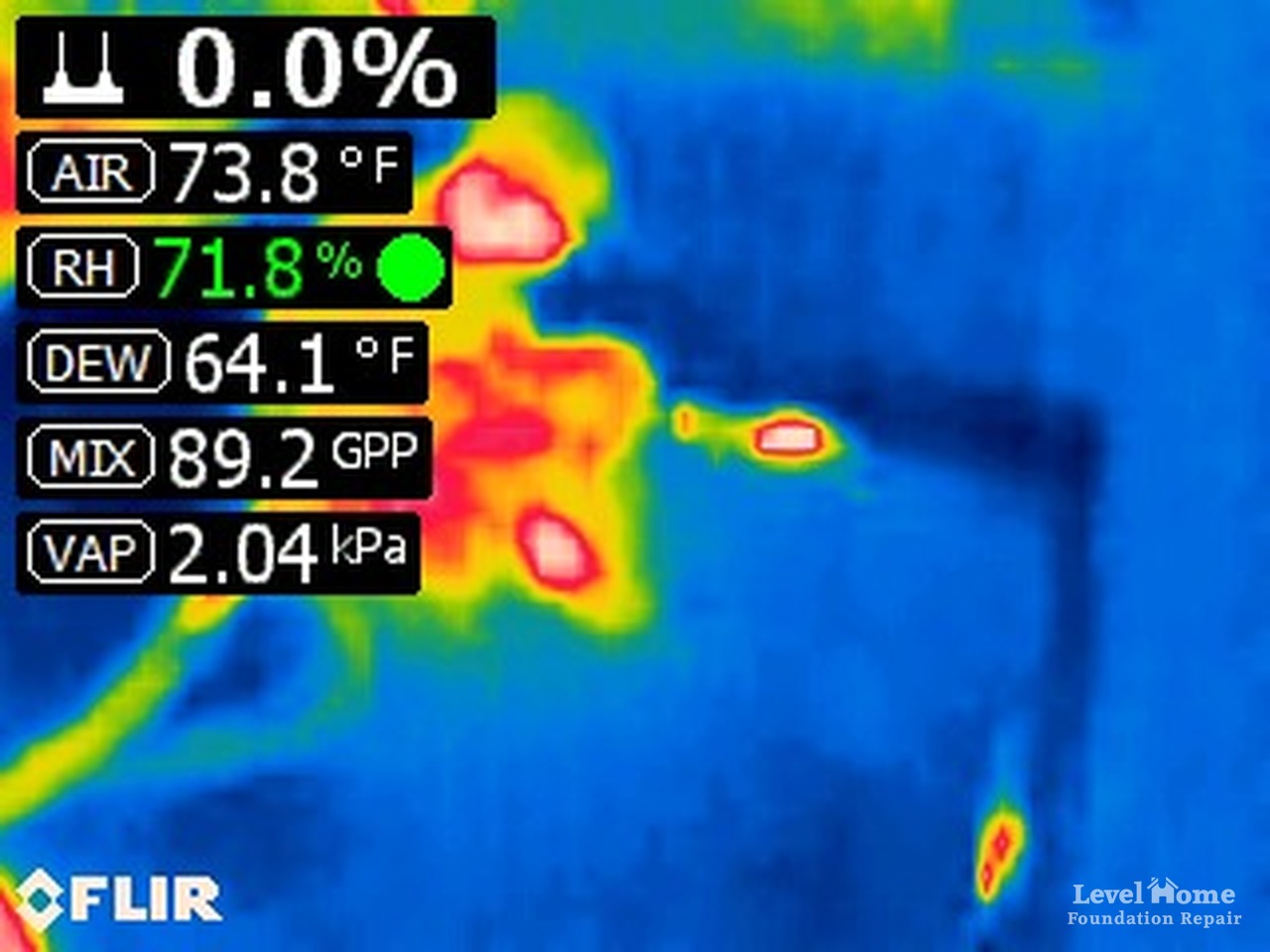
In a thermal camera image from a Level Home job, a bright signature appears near an injection point and spreads toward both edges of a concrete slab. The camera is not seeing through concrete. It is detecting surface temperature differences as our team injects a two part polyurethane system into a void below. The reaction produces heat, and foam visible at both edges is a useful field observation about where material has traveled. Understanding that distinction is central to polyurethane foam injection foundation repair: the science helps guide a repair, but no single image substitutes for a structural assessment.
What polyurethane foam injection is designed to do
Polyurethane foam injection is a controlled way to fill spaces beneath a slab and, where appropriate, bring settled concrete closer to its intended elevation. Our team drills carefully located ports through intact concrete and introduces liquid components that react beneath the surface. As the material expands, it contacts the underside of the slab and the bearing surface below. Depending on geometry and soil conditions, that expansion can both fill a void and lift a section. The method is often relevant to sidewalks, driveways, patios, garage floors and some interior slab areas, but those are not interchangeable structural situations.
For a broader comparison of methods, see our Tulsa concrete leveling service and our concrete leveling guide. This article instead focuses on what the chemical reaction and the thermal image tell us during an injection.
First, determine why a void exists
A space beneath concrete can form when soil consolidates, poorly compacted fill settles, water carries fines away, or changing moisture causes soil volume to change. Oklahoma clay can shrink as it dries and swell again when wet. Injection into a void without examining drainage and settlement history may address the visible gap while leaving its cause in place. Our structural analysts consider cracking, joint offsets, water routes, slab condition and the pattern of movement before a project manager specifies a method.
Our Oklahoma clay soil guide explains moisture related movement. A slab near persistent ponding also warrants a look at foundation drainage systems and our article on ponding and sinking concrete. Filling a void and controlling the water that helped create it are separate decisions.
Two liquid components become one expanding material
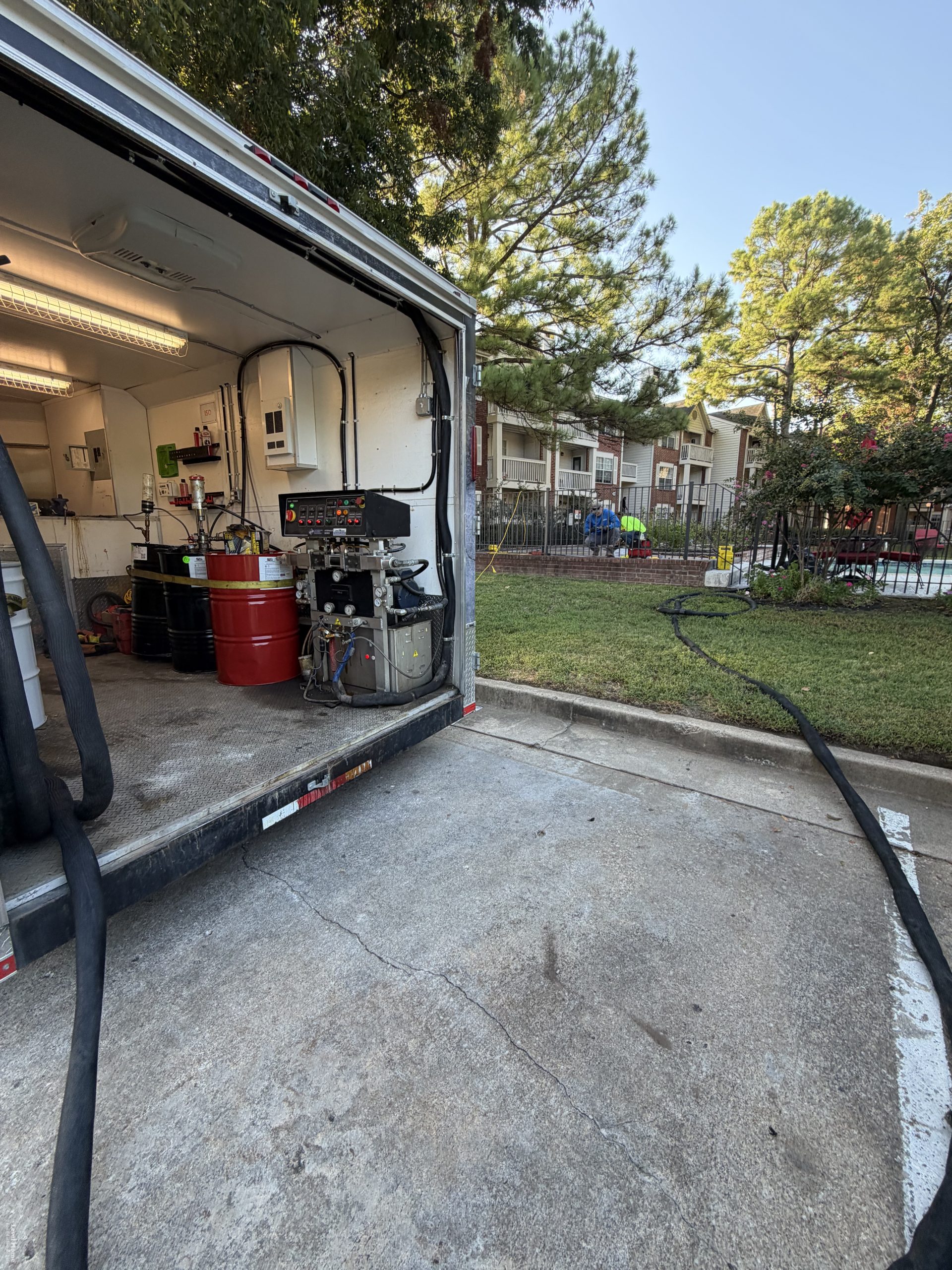
A polyurethane system generally combines an isocyanate component with a formulated polyol component. Specialized equipment meters and mixes them as the material enters the injection port. Their chemical reaction builds a polymer network and produces gas that forms cells within the expanding foam. Formulations vary in density, reaction speed, expansion and intended application. That is why our team does not treat every slab, loading condition or cavity as if one universal foam were appropriate.
Level Home has 7 proprietary licensed products available across its work, and selection depends on the actual application rather than a blanket claim about any one product. The mixing ratio, equipment condition, substrate temperature and water conditions all affect how a particular formulation behaves. Product specific technical data and trained handling matter more than a generic expansion figure from an advertisement. The poly foam lifting service page outlines where this method fits within our work.
Why the reaction creates a thermal signature
The chemistry is exothermic: as new bonds form, the reaction releases heat. Initial temperature can influence the rate and performance of the system, but the foam is not simply switched on by the camera or by externally heating the slab. The reaction itself generates the heat visible as a transient thermal pattern at the surface and at exposed edges. A FLIR camera records emitted infrared radiation from surfaces and translates temperature differences into a color image. It does not directly photograph the hidden foam inside a slab.
That distinction keeps the image useful without overclaiming. Thickness, moisture, sunlight, wind, surface coatings and camera settings can change the apparent temperature pattern. A hot area alone cannot establish the depth, compressive strength or continuous coverage of the finished fill. Our team interprets the thermal view alongside physical evidence and measured slab movement.
What this Tulsa thermal image actually shows
In the featured image, a Level Home specialist is injecting a two part chemical system beneath concrete. The FLIR view captures the active exothermic reaction and heat signatures where foam emerges at both sides of the injection area. Visible material at both slab edges indicates that the foam reached those accessible boundaries during this operation. That is stronger evidence of distribution than a warm spot at the port alone, although it does not prove that every inaccessible pocket under the slab is filled.
For this job, our team observed material filling the void on both sides of the injection site. Thermal imaging helps us document the process in action and notice where a surface or edge response develops. It is one observation among several, not a standalone map of everything below the slab. The image is most valuable when paired with the original void assessment, injection records and final elevation checks.
Port placement and controlled injection
Before drilling, our team maps slab boundaries, visible cracks, joints, likely void locations and possible utilities. Injection points are selected to give material a plausible flow path while avoiding unnecessary holes. A crew introduces material in measured stages and watches for lift, surface movement, edge emergence or unexpected pressure behavior. If one area responds differently than expected, the team reassesses instead of assuming more foam will solve the issue.
Port layout is not merely a grid. A narrow void beside a joint can behave differently from a broad gap beneath an otherwise intact panel. Nearby water, a buried obstruction, an open edge and the slab’s own stiffness change the route of least resistance. The wider foundation repair process begins with diagnosis for this reason. Our foundation inspection guide describes why inspection precedes method selection.
Expansion fills space before it lifts concrete
Liquid components initially occupy relatively little space. As foam forms, it expands into connected gaps and bears against both the ground and the slab. Where there is an open route to an edge or a larger cavity, foam may travel laterally before significant vertical lift occurs. Once the available space is occupied and the reaction continues, force can move the slab if the slab remains sufficiently sound and the supporting ground can resist that force.
This sequence explains why a repair should not be judged only by whether the surface rises. Void filling may be a valid stabilization goal even when elevation change is minimal. Conversely, a rising surface does not by itself demonstrate uniform support beneath every section. Our team tracks the desired outcome and stops when observed movement, edge conditions and project tolerances indicate the correct endpoint. The related slab settlement repair comparison distinguishes foam from methods intended to support deeper structural loads.
How thermal imaging complements other checks
Thermal images can help reveal where heat from the chemical reaction is expressed on a surface or at an accessible boundary. If the signature advances toward both edges, that can support an inference about material movement. Our team also checks grade and elevation, observes whether joints align, watches for surface cracking or over lift, and compares the result with the preinjection plan. Where a project requires stronger confirmation of a hidden void, additional methods may be warranted rather than treating thermal color as conclusive.
Camera readings depend on emissivity, reflected heat and the temperature of surrounding concrete. Comparing a before image with an image during and after injection is more informative than treating one frame as an exact measurement of foam volume. Thermal imaging is a verification aid, not a replacement for load analysis or for the judgment of structural analysts and project managers.
What the finished foam can and cannot address
Properly selected and installed foam can occupy a void and provide support beneath an intact slab. It cannot reconnect badly fractured concrete into a sound single panel, repair a leaking pipe, remove expansive soil behavior or create competent bearing soil where none exists. An uneven garage floor may require different decisions from a settled walkway, even if both look like a concrete lifting foam injection candidate at first glance.
We discuss related conditions in our articles on plumbing leaks and foundation damage, sinking garage floors and foundation repair misdiagnosis. In any polyurethane foam foundation repair in Oklahoma, the underlying cause matters at least as much as the material injected.
When lifting is reasonable and when replacement is better
Most slabs can be lifted with polyurethane foam when the concrete has enough integrity, the movement is understood and an appropriate bearing surface remains. That does not mean every slab should be lifted. Extensive breakage, severe spalling, disconnected fragments or compromised reinforcement can make a full replacement more appropriate. Level Home offers full slab replacement when a slab is too broken for foam to be a sensible remedy.
Our Tulsa slab replacement article explains those limits. A specific Greenbriar Apartments pool deck project shows a different, site based application of void filling. Neither example should be treated as a guarantee of the same outcome at another property.
Who evaluates the work at Level Home
Founder Adam Sedlak and the Level Home team bring 10+ years in the field and experience with thousands of Oklahoma foundations to diagnosis and method selection. Structural analysts assess the observed condition, while project managers coordinate the scope and field execution. The team considers whether the issue is limited to a slab void, tied to drainage, or part of a broader foundation concern. Experience informs judgment, but site specific observations still control the recommendation.
For context on the organization, see about Level Home. If movement extends beyond a slab panel into structural elements, our slab foundation repair page and Tulsa foundation repair guide discuss broader options. A thermal image should not be used to bypass that distinction.
Common questions about the foam injection process
What causes the heat visible in a thermal image?
Mixing the two reactive liquid components starts an exothermic chemical reaction. The heat generated during foam formation can create a temporary temperature difference at a slab surface or exposed edge.
Can a thermal camera see foam beneath concrete?
No. It senses infrared emission from visible surfaces. A thermal pattern may indicate where heat is transferring, but it cannot directly show every hidden cavity or prove complete coverage on its own.
Does foam fill a void before lifting the slab?
Typically the material expands along available space and begins exerting lifting pressure as the space fills. Actual flow depends on the cavity, open edges, soil support and the chosen formulation.
Can every broken slab be repaired by injection?
No. Intact or repairable slabs are better candidates. Concrete fragmented into unstable sections may need replacement rather than lift, even if foam could occupy space beneath it.
Why does the team assess drainage and soil first?
Water movement and changing Oklahoma soil moisture can create or enlarge voids. Addressing the cause helps avoid confusing a successful injection with a permanent cure for ongoing settlement.
The practical takeaway from the image
This image documents an active foam injection and visible heat related to the reaction, with material observed at both sides of the slab. It illustrates how field observation can add confidence that foam has moved through a target space. It does not independently certify every inch of hidden support. The sound approach combines two part chemistry, controlled injection, measurements and an honest evaluation of the concrete and soil conditions. That is the technical context our team applies to polyurethane foam injection in Tulsa and across Oklahoma.