Most homeowners who search for information on steel pier foundation repair are not casually browsing. They have noticed a stuck door, a stair-step crack in the brick, or a floor that no longer feels level, and they want a straight answer before anyone shows up with a sales pitch. That instinct is a good one. Foundation repair is a significant investment, and the industry has earned its share of skepticism from homeowners who received wildly different quotes for the same problem, or who bought a home with a “repaired” foundation and were left wondering what that repair actually included.
This article sets aside the sales language and answers the questions our team hears most often from Tulsa homeowners, drawn from thousands of Oklahoma foundation inspections and the same concerns that come up again and again in homeowner communities online. Whether a homeowner ends up working with our team as an engineer-recommended contractor or with someone else entirely, these are the questions worth asking before signing anything.
Do Steel Piers Actually Work — Or Will My Foundation Keep Moving?
The single biggest fear we hear from homeowners is not about cost. It is about whether the repair will actually hold, or whether the same clay that caused the problem will simply cause it again in a year or two. It is a fair question, and the answer comes down to how the piers are installed rather than the piers themselves.
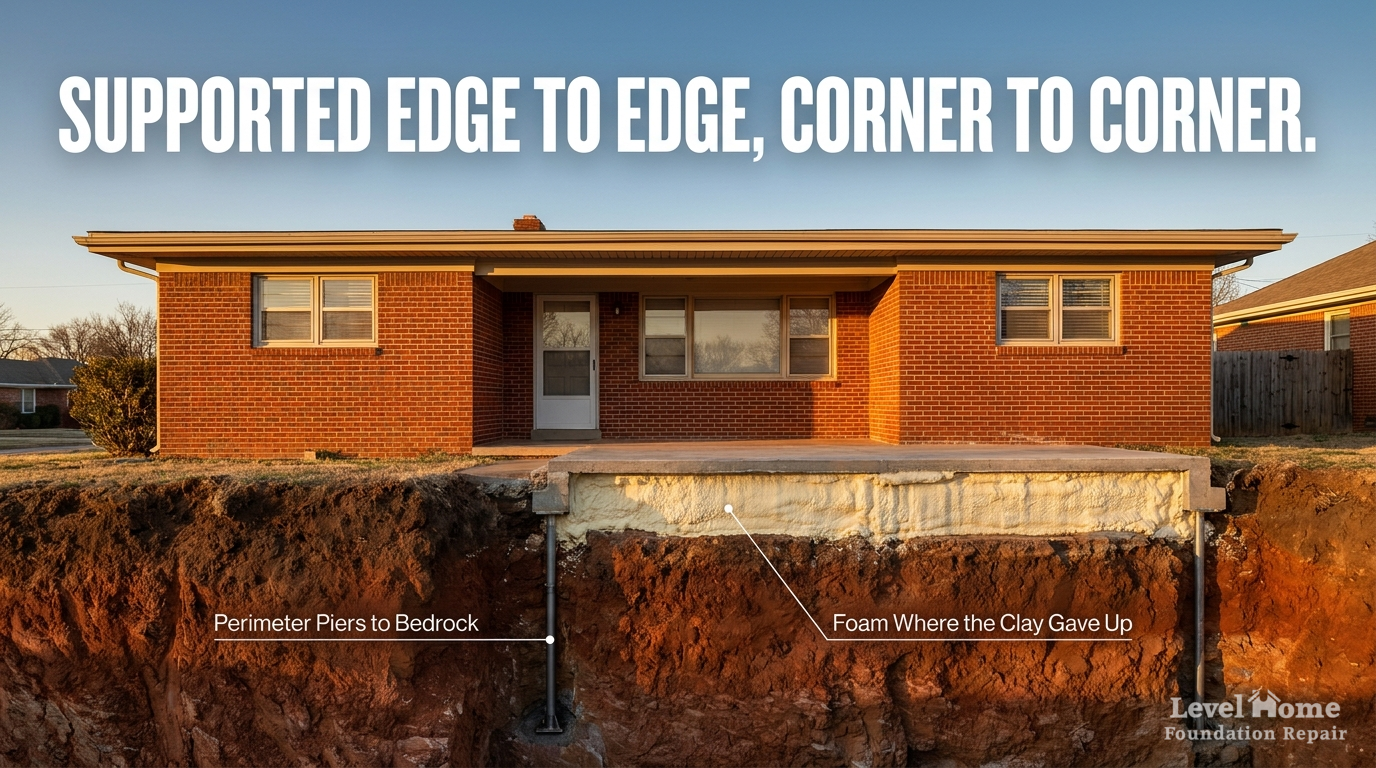
Steel piers are designed to be driven hydraulically through Oklahoma’s expansive clay until they reach refusal — the point at which a segment can no longer advance because it has reached soil, rock, or bearing strata dense enough to support the structure permanently. Refusal is not a guess or an estimate. It is measured, foot by foot, during installation, so the pier ends up bearing on material that will not compress or shift the way the upper clay layers do.
That is a meaningful distinction from methods that install to a preset depth without confirming what the pier has actually reached. If a pier stops short of competent bearing material, it can settle again as the surrounding clay continues its wet-dry cycle. Depth on its own does not guarantee stability — reaching the right material does.
This is also why the number of piers, their spacing, and where they are placed matter as much as the piers themselves. A plan built around the structure’s actual load points, verified during installation rather than assumed on paper, is what keeps a foundation from moving again after the crew leaves. It is also worth noting that piers address the foundation’s structural movement itself — visible symptoms like stair-step or diagonal cracks in brick and drywall are a related but separate issue with their own repair considerations, covered in detail on our foundation crack repair page.
How Deep Do Steel Piers Need to Go in Tulsa?
Homeowners often ask for a specific number — 10 feet, 20 feet, 30 feet — because a number feels reassuring. The honest answer is that there is not one universal depth, and any contractor who quotes an exact figure for every pier before installation begins is estimating, not measuring.
In the Tulsa area, steel piers commonly reach somewhere in the range of 15 to 30 feet, but that range varies significantly by neighborhood, soil layering, and what lies beneath a specific lot. Some properties reach competent bearing strata closer to the surface; others require piers to go considerably deeper before hitting refusal. Bedrock itself is often not required and, in many residential settings, is not reached at all — what matters is bearing capacity, not a specific geologic layer.
This is one of the reasons a proposal listing an exact depth for every pier before any work has started deserves a second look. Depth should be a result of the installation, confirmed foot by foot, not a number written into a contract in advance. For a full walkthrough of how that installation and lifting process actually works, our steel pier installation process page covers it step by step.
Steel Piers vs. Concrete Pressed Pilings: What’s the Real Difference?
Cost comparisons between steel and concrete repair methods come up constantly, and the difference is not only about price — it is about how each method is installed and verified.
Concrete pressed pilings are typically manufactured in short segments, stacked, and pushed into the ground using hydraulic pressure until they reach a target depth or the equipment reaches its maximum push capacity. In many cases, that depth is closer to a planned estimate than a confirmed measurement of bearing capacity, and the segments themselves are more brittle than steel, which can matter if the surrounding soil continues shifting.
Steel piers are driven in galvanized segments to refusal, confirming that the pier has reached soil or bearing strata strong enough to carry the structure’s weight without further settlement. The steel itself is more resistant to the stresses of Oklahoma’s wet-dry clay cycles than concrete, which can crack or shift incrementally as the same expansive soil moves around it.
None of this means concrete pressed pilings never work — plenty of foundations have been stabilized with them. But in Oklahoma’s clay-heavy soil specifically, the combination of refusal-verified installation and a more durable material is why steel is generally the stronger long-term choice, and why it tends to cost more per pier. Homeowners comparing quotes side by side should ask exactly which method each bid includes, not just the total price. Steel and concrete are not the only options, either — for lighter loads, new construction, or locations with limited excavation access, helical piers are sometimes a more appropriate comparison than either driven steel or pressed concrete.
Why Do Foundation Repair Quotes Vary So Much?
It is not unusual for two contractors to inspect the same house and come back with wildly different numbers — one proposing two dozen piers for around $30,000, another recommending seven piers for roughly $9,000. That kind of gap understandably makes homeowners wonder whether they are being oversold, or whether the lower bid is missing something important.
A few variables typically explain the spread: how many piers are proposed and why, whether the plan calls for steel or concrete, how deep piers are expected to go, whether an engineer was involved in designing the plan or a salesperson estimated pier count in the field, and how much the warranty and post-repair documentation actually cover. A company that is paid per pier has an incentive to recommend more of them, which is exactly why an independent perspective matters.
Before signing anything, it is worth asking for a written, itemized proposal and, ideally, having an independent structural engineer confirm the scope of work matches what the house actually needs. Our guide to choosing a foundation repair company in Tulsa walks through the specific questions to ask multiple contractors so bids can be compared on equal terms.
Our team backs its own proposals with a best price guarantee alongside a free foundation inspection, so homeowners can get an engineer-recommended assessment and a transparent, itemized quote before committing to any repair.
What Does a Steel Pier Warranty Actually Cover?
A “lifetime warranty” sounds reassuring until homeowners start asking the follow-up questions: is it written down, does it transfer to a future buyer, does transferring it cost anything, and will the company still be around to honor it years from now.
These are the right questions to ask any contractor, and the answers should be in writing before a contract is signed. Our team’s steel pier warranty is transferable — it follows the home rather than expiring when the home is sold, and there is no fee to transfer it to a new owner. That matters both for peace of mind and for resale, since a documented, transferable warranty gives a future buyer confidence that the repair was done to a standard that is backed in writing, not just a verbal promise from the previous owner.
Warranty coverage does typically come with maintenance expectations. Keeping gutters functional, directing downspouts away from the foundation, maintaining proper grading, and avoiding sprinkler placement that saturates the soil next to the repaired area are common conditions for keeping coverage valid. None of that is unusual or unreasonable — it simply means the homeowner needs to manage the water around the foundation, which was very likely part of the original problem in the first place.
Will Foundation Repair Hurt or Help My Home’s Value?
Homeowners preparing to sell — and buyers considering a home with a repaired foundation — often ask the same underlying question from opposite directions: does a foundation repair history hurt the sale, or does it actually help?
In most cases, a properly documented repair is a selling point rather than a red flag. A transferable warranty, an engineer-reviewed plan, and before-and-after elevation measurements give a buyer, and their lender, concrete evidence that the issue was identified and corrected to a verifiable standard, rather than papered over. Conventional lenders can and do finance homes with a documented foundation repair, particularly when the paperwork includes the warranty, the engineering plan, and proof the work was completed and paid for.
What tends to concern buyers is not the fact that a repair happened — it is the absence of documentation. A seller who can produce the paid invoice, the warranty, and measurable proof of the work is in a far stronger position than one who can only say the foundation “was fixed a while back.” Our team provides full documentation, including before-and-after elevation readings, with every completed repair, specifically so that record exists if the home is ever sold.
What Should You Look for in a Foundation Repair Contractor?
With so many companies offering foundation repair in Tulsa, the practical question is what actually separates a trustworthy contractor from one who is simply good at selling. A few specifics are worth asking about directly, rather than taking “certified” or “licensed” at face value.
Ask whether the proposed plan came from a licensed structural engineer or was estimated by a sales representative in the field. Ask whether pier installation is logged with torque or pressure readings at each location, so there is a verifiable record of what the ground actually required rather than an assumption written before the crew arrived. Ask for the warranty in writing, and confirm it is transferable. And ask for elevation measurements before and after the work, not just a verbal assurance that the house is “level now.”
Our team works as an engineer-recommended contractor, with inspections led by people who have handled thousands of Oklahoma foundations rather than being handed off entirely to sales staff. The right questions also depend on what type of foundation is involved — a pier-and-beam crawl space is inspected differently than a concrete slab, and homeowners dealing with a slab foundation should confirm the contractor has specific experience with that structure type. For a broader checklist covering red flags to watch for across any repair method, our foundation repair guide walks through what to look for from the first inspection through the signed proposal.
Financing Your Foundation Repair
Cost is, understandably, one of the first questions homeowners ask, and it is a legitimate concern — foundation repair is rarely a small expense. Our team offers multiple financing options, including 0% financing for qualified applicants, so the cost of a repair does not have to be paid upfront in full.
Pricing itself is backed by a best price guarantee, meaning homeowners get competitive, itemized pricing without being asked to sacrifice the engineering standards or materials that make the repair last. None of this requires a commitment up front — every project starts with a free foundation inspection, with no pressure to sign anything on the spot. Homeowners who want to talk through financing options, ask questions about a specific quote, or simply understand what a repair would involve before scheduling an inspection can reach out to our team directly.
Schedule Your Free Foundation Inspection
Every question in this article comes back to the same starting point: an accurate, honest assessment of what a specific home actually needs. That starts with a free foundation inspection — no obligation, no pressure, and no pier count decided before an inspector has actually looked at the house.
Our team works as an engineer-recommended contractor, backs every repair with a transferable warranty that protects the investment even after the home is sold, and offers multiple financing options for homeowners who need them. Inspections are owner-led, which means the person answering questions on-site has handled thousands of Oklahoma foundations and can speak plainly about what is actually needed — not just what is billable.
Homeowners ready to get straight answers about their own foundation can schedule a free foundation inspection. Those who would rather talk through the process by phone or text before scheduling anything are welcome to get in touch as well.
Frequently Asked Questions
Do steel piers really stop a foundation from moving?
When installed to refusal — the point where a pier reaches soil or bearing strata strong enough to support the structure — steel piers provide permanent support at that location. Movement can still occur in unsupported areas of the same home if the surrounding clay continues shifting, which is why pier placement and spacing matter as much as the piers themselves.
How deep are steel piers installed in Tulsa?
Most piers in the Tulsa area reach somewhere between 15 and 30 feet, though the exact depth depends on the soil beneath a specific lot. Depth is determined by refusal during installation, not a fixed number decided in advance.
Are steel piers better than concrete pressed pilings?
In Oklahoma’s expansive clay, steel piers driven to refusal generally hold up better over time than concrete pilings pushed to a preset depth, because refusal confirms the pier has reached bearing material strong enough to prevent further settlement.
Why did I get such different quotes for the same repair?
Quotes vary based on pier count, pier type, depth, whether an engineer designed the plan, and what the warranty covers. Getting a written, itemized proposal and an independent structural engineer’s opinion helps homeowners compare bids accurately.
Is a foundation repair warranty transferable to a new homeowner?
A written, transferable warranty follows the home rather than expiring at sale, and reputable contractors transfer it to a new owner at no cost. Homeowners should confirm this in writing before signing a repair contract.
Does a repaired foundation lower my home’s resale value?
A documented repair with a transferable warranty and elevation measurements is typically viewed as a positive by buyers and lenders, since it provides evidence the issue was identified and properly corrected.