Every July, I get a wave of calls from Tulsa homeowners who noticed new cracks in their walls, doors that stopped latching, or floors that feel uneven. The timing is not a coincidence. Oklahoma’s summer heat does real, measurable damage to residential foundations, and most homeowners do not realize the connection until the damage is already serious.
I have been repairing foundations across Northeast Oklahoma since 2016, and the pattern is consistent: the worst structural damage I see every year happens between June and September. Here is why that happens, what it looks like, and what you can do about it before a cosmetic crack becomes a structural emergency.
How Summer Heat Damages Your Foundation
The damage does not come from the heat alone. It comes from what the heat does to the soil underneath and around your home.
Soil Shrinkage and Settlement
Tulsa sits on expansive clay soil that swells when it absorbs moisture and shrinks when it dries out. During a typical Oklahoma summer, surface temperatures regularly hit 100°F and ground temperatures can exceed 130°F in direct sun. That heat pulls moisture out of the soil aggressively.
As the clay soil loses moisture, it contracts. When it contracts, it pulls away from your foundation. Your slab or footings lose the uniform support they were designed for, and gravity takes over. The result is differential settlement: one part of your home sinks while another stays put.
Thermal Cycling in the Concrete
Concrete expands when it heats up and contracts when it cools down. During an Oklahoma summer, your slab might reach 140°F on the surface during the afternoon and drop to 75°F overnight. That 65-degree swing happens every single day for three to four months.
Each cycle creates microscopic stress. Over time, those micro-stresses become hairline cracks. Hairline cracks become structural fractures. I have seen slabs with crack patterns that map perfectly to the thermal cycling zones: the south and west faces of a home, where sun exposure is greatest, almost always crack first.
Foundation Heave After Summer Storms
The other side of the problem is what happens when rain finally arrives. Dried, contracted clay soil absorbs water rapidly and swells. That sudden expansion pushes up on your foundation unevenly, a process called heave. The combination of shrinkage during drought and heave during storms creates a cycle that gets worse every year.
Warning Signs That Summer Heat Is Damaging Your Foundation
These symptoms often appear for the first time between June and September. If you are seeing any of them right now, the heat is likely accelerating existing foundation movement.
- New diagonal cracks in drywall, especially near door frames and window corners. Diagonal cracks indicate differential settlement, meaning one part of your home is moving while another is not.
- Doors and windows that stick or will not close. When your frame shifts even a fraction of an inch, doors and windows bind. If a door closed fine in May and sticks in July, your foundation has moved.
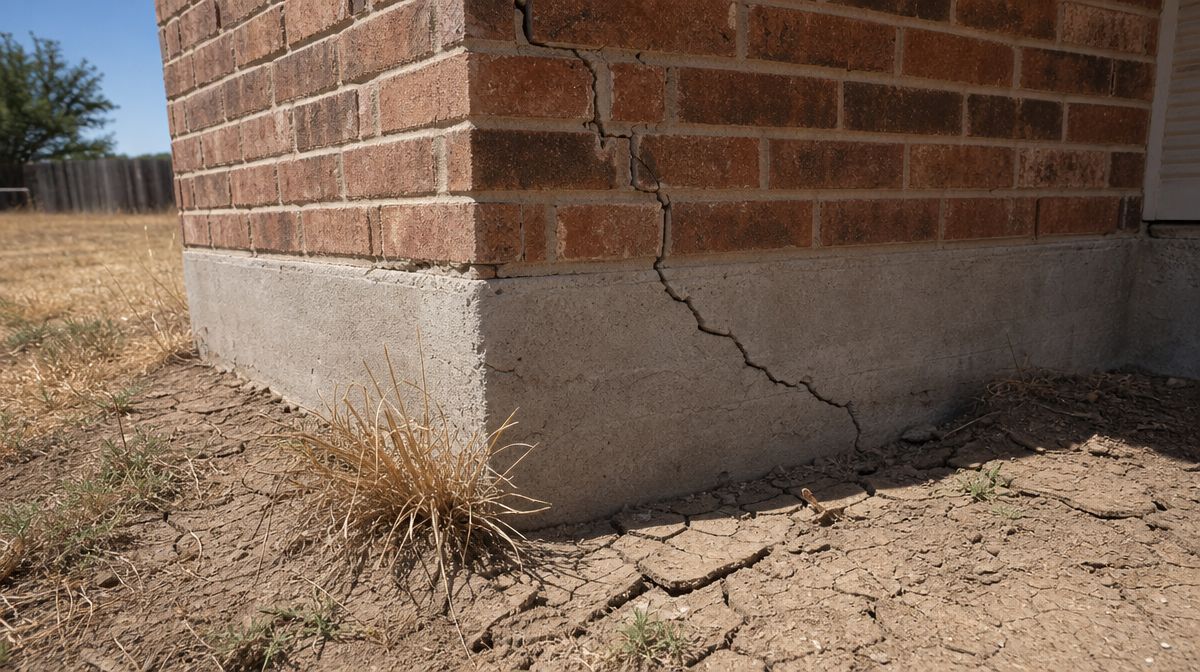
- Visible gaps between the foundation and the surrounding soil. Walk the perimeter of your home. If you can see a gap where the dirt has pulled away from the concrete, the soil has contracted and your foundation has lost support.
- Uneven or bouncy floors. This is especially common in pier-and-beam and crawl space homes where heat and moisture changes affect the support system directly.
- Stair-step cracks in exterior brick. Brick does not bend. When the foundation underneath shifts, the mortar joints crack in a stair-step pattern following the path of least resistance.
- Cracks in the garage floor or driveway near the house. Concrete slabs adjacent to the foundation often crack first because they are thinner and have less structural reinforcement.
Why Waiting Until Fall Is a Mistake
I hear it often: “I will deal with it when it cools down.” Here is why that approach usually costs more.
Foundation damage is progressive. A foundation that has settled half an inch in June will likely settle a full inch by September if the cause is not addressed. The repair scope — and the cost — grows proportionally. A problem that requires four helical piers in July might require eight by October.
There is also a secondary damage factor. As your foundation moves, it stresses plumbing lines embedded in or running beneath the slab. Slab leaks caused by foundation movement are common in Tulsa. Fixing the leak without fixing the foundation means you will be fixing the same leak again next summer.
What I Recommend for Tulsa Homeowners Right Now
1. Maintain Consistent Moisture Around Your Foundation
This is the single most effective preventive measure during a heat wave. Use soaker hoses or a drip system to keep the soil around your foundation consistently damp — not saturated, just damp. The goal is to prevent the extreme shrinkage that causes settlement.
Focus on the south and west sides of your home where sun exposure is greatest. Run the water in the early morning or late evening to minimize evaporation.
2. Get a Free Foundation Inspection
If you are seeing any of the warning signs listed above, do not wait to find out how serious they are. I offer free foundation inspections across the Tulsa metro and Northeast Oklahoma. I will tell you exactly what is happening, whether it needs repair now or monitoring, and what the options are.
There is no sales pitch. If your foundation is fine, I will tell you it is fine.
3. Document What You See
Take photos of any cracks with a ruler or coin for scale. Date them. If the cracks grow over the next few weeks, that documentation becomes valuable for insurance claims, home warranty discussions, and understanding the progression of the damage.
4. Do Not Fill Structural Cracks With Caulk
Caulking a structural crack is like putting a bandage on a broken bone. It hides the symptom and prevents you from monitoring the actual movement. If a crack is structural, it needs a structural solution: slab stabilization, pier installation, or both.
How I Fix Summer Heat Foundation Damage
The repair method depends on the type and severity of the damage.
For settlement (sinking): I install steel push piers or helical piers that extend down to load-bearing bedrock or stable soil below the clay layer. This is not a temporary fix. The piers transfer the weight of your home to stable ground and can often lift the foundation back to its original position.
For concrete slab settling: Polyurethane foam injection fills the void beneath the slab and lifts it back to level. The foam is waterproof and does not degrade, so it provides permanent support even through future wet-dry cycles.
For crawl space damage: Crawl space structural repair addresses sagging joists, failing supports, and moisture problems that heat and drought make worse. Proper support and encapsulation can stabilize the entire floor system.
For drainage-related problems: When poor drainage is accelerating the soil movement, I install French drains or surface drainage systems to manage water flow and maintain consistent soil moisture year-round.
Seeing New Cracks This Summer?
Do not let Oklahoma’s heat turn a small problem into an expensive one. I offer free, no-obligation foundation inspections across the Tulsa metro.