When homeowners hear that helical piers are the solution for their settling foundation, the first question is almost always the same: how deep do they actually go?
It’s a fair question. You’re about to anchor your home to steel shafts driven into the earth — the depth matters. But the answer isn’t a single number. Helical pier depth depends on soil conditions, load requirements, and what the engineer’s torque readings tell the crew during installation.
After installing helical piers on over 3,000 homes across Oklahoma and beyond, here’s what we’ve learned about how deep these systems need to go — and why guessing is never an option.
The Short Answer: 10 to 30 Feet (Sometimes Deeper)
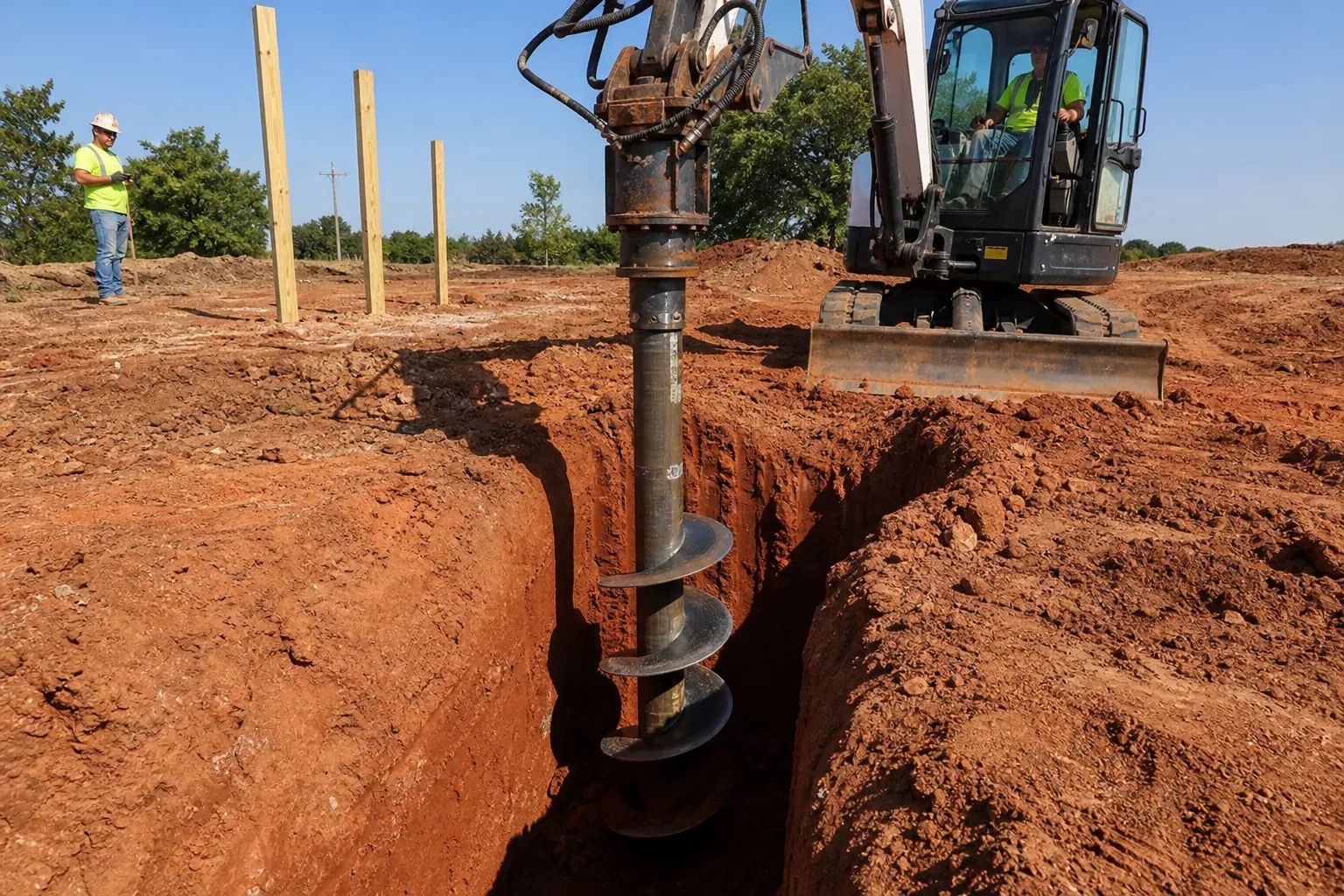
Most residential helical pier installations reach between 10 and 25 feet below grade. Commercial projects can push past 30 or even 50 feet. But those numbers are just ranges — the actual depth on your property depends on three things:
- Soil bearing capacity — how much weight the soil at depth can support
- Structural load — how much weight the pier needs to carry from the building above
- Torque correlation — the relationship between installation torque and bearing capacity
The crew doesn’t stop at a predetermined depth. They stop when the torque readings confirm that the helical plates have reached competent, load-bearing soil. That’s what separates helical piers from older methods like concrete pilings that are driven to a fixed depth regardless of conditions.
Why Soil Type Is the Biggest Variable
Different soil types require dramatically different pier depths. Here’s what we see across our projects:
Expansive Clay (Oklahoma, Texas, the Midwest)
Oklahoma’s notorious red clay — technically classified as CH (fat clay) on engineering soil charts — expands when wet and shrinks when dry. This seasonal movement is the #1 cause of foundation damage in Tulsa and across the state. In expansive clay, helical piers typically need to reach 15 to 25 feet to get below the active zone where moisture causes soil movement.
Sandy or Granular Soil
Sandy soils drain well and don’t expand, but they can be loose near the surface. Piers in sandy conditions often reach load-bearing capacity at 10 to 15 feet — shallower than clay, because dense sand at moderate depth provides excellent bearing strength.
Fill Soil or Disturbed Ground
Properties built on fill material — common in new developments and areas with grading work — can require piers that go 20 to 30+ feet to pass through the uncompacted fill and reach natural, undisturbed soil below.
Bedrock or Dense Till
When limestone, shale, or dense glacial till sits relatively close to the surface, piers may only need 8 to 15 feet. In these cases, the helical plates don’t so much screw into the rock as they seat against it, and the torque readings spike immediately.
How Engineers Determine the Right Depth
Professional helical pier installation isn’t guesswork. The depth is determined by a combination of:
- Geotechnical soil reports — Boring logs taken from your property reveal what soil types exist at each depth, where the water table sits, and what the bearing capacity is at various layers.
- Structural load calculations — Engineers calculate the dead load (weight of the structure) and live loads (occupants, furniture, snow, wind) to determine how much each pier must support.
- Torque-to-capacity correlation — During installation, the hydraulic motor measures torque in real time. Using the ICC-accepted formula (Capacity = K × Torque), the installer knows exactly when the pier has reached sufficient bearing capacity. The K factor depends on the pier shaft diameter — typically 9 for 1.5″ square shafts and 7 for 1.75″ round shafts.
- Factor of safety — Most residential designs use a 2:1 safety factor, meaning the pier is driven until its calculated capacity is double the required load.
Helical Pier Depth by Application
The type of project also influences how deep piers need to go:
| Application | Typical Depth Range | Notes |
|---|---|---|
| Residential foundation repair | 12–25 feet | Most common in Oklahoma clay soils |
| New construction (pre-build) | 10–20 feet | Installed before the slab is poured |
| Commercial/industrial | 20–50+ feet | Heavier loads, larger helix plates |
| Retaining walls and boardwalks | 8–15 feet | Lateral load design |
| Solar panel arrays and towers | 10–20 feet | Uplift/tension resistance critical |
What Happens If Piers Aren’t Deep Enough?
Shallow piers that don’t reach competent soil will eventually fail. We’ve seen it on jobs where we’re called in to fix another company’s work — piers driven to an arbitrary depth without torque verification that settled again within a year or two. The symptoms come back: uneven floors, sticking doors, new cracks in drywall and brick.
This is why torque-verified installation matters more than depth alone. A pier at 12 feet in dense soil with proper torque readings will outperform a pier at 25 feet in loose fill that was never verified.
Can You Check Pier Depth After Installation?
Yes — reputable installers provide pier installation logs documenting the depth, torque readings, and bearing capacity for every single pier. At Level Home Foundation Repair, every project comes with a complete log. If you’re buying a home with previous pier work, ask for these logs. If they don’t exist, that’s a red flag about the quality of the original installation.
For more on evaluating previous work, read our guide on buying a home with previous foundation repairs.
The Bottom Line on Helical Pier Depth
There is no universal answer to “how deep do helical piers go” because every property is different. The soil under your home is unique, the loads are unique, and the required depth will be unique. What matters is that the installer uses real-time torque data — not assumptions — to determine when each pier has reached stable, load-bearing ground.
If you’re dealing with foundation settlement, cracks, or uneven floors, schedule a free inspection with our team. We’ll assess your soil conditions, explain exactly what depth your home needs, and give you a transparent, fixed-price quote — no surprises below the surface.
Level Home Foundation Repair has stabilized over 3,000 homes across Oklahoma with engineered helical pier systems. Call (918) 361-7787 or request your free estimate online.