Why Oklahoma’s Clay Soil Is the #1 Enemy of Your Foundation
If you’ve lived in Tulsa or anywhere in northeastern Oklahoma for more than a few years, you’ve probably noticed something about the dirt around here — it’s red, it’s sticky when wet, and it cracks like a desert floor when it dries out. That red Oklahoma clay isn’t just a nuisance on your boots. It’s the single biggest reason homeowners in our area need foundation repair Tulsa services.
At Level Home Foundation Repair, we’ve inspected thousands of homes across the Tulsa metro, and the story is almost always the same: expansive clay soil has been quietly pushing, pulling, and shifting underneath a home for years before the homeowner notices the first crack. Understanding how clay soil destroys foundations — and what you can do about it — is one of the smartest things you can do as an Oklahoma homeowner.
In this guide, we’ll break down the science behind clay soil foundation damage, explain why Tulsa is especially vulnerable, walk you through the warning signs, and show you exactly how professional foundation repair works on Oklahoma’s challenging soil.
What Makes Oklahoma Clay Soil So Destructive
Not all dirt is created equal. Oklahoma sits on top of some of the most expansive clay soil in the entire United States. The dominant clay mineral in our region is called montmorillonite, and it has a remarkable — and destructive — property: it absorbs water like a sponge and expands dramatically when wet, then shrinks and cracks when it dries out.
Here’s the science in plain English. Imagine a sponge sitting under your foundation. When it rains, that sponge swells up and pushes against the bottom of your foundation with incredible force — sometimes generating pressures of 5,000 to 10,000 pounds per square foot. When the sun comes out and the moisture evaporates, that sponge shrinks back down, leaving gaps and voids beneath your foundation.
This is called the shrink-swell cycle, and it’s the root cause of the vast majority of foundation settlement Oklahoma homeowners deal with. Over months and years, this constant cycle of expansion and contraction creates uneven pressure beneath your home. Some areas push up (a condition called heaving), while others sink down (settlement). The result? Cracks, gaps, uneven floors, and eventually, serious structural damage.
How Expansive Is Oklahoma’s Clay?
The Plasticity Index (PI) measures how much a soil expands and contracts. Soils with a PI above 20 are considered problematic for construction. Many areas across Tulsa County and surrounding counties test at a PI of 35 to 50 or higher. That puts our soil firmly in the “highly expansive” category — meaning your foundation is sitting on some of the most active, movement-prone ground in the country.
The red clay you see when you dig a hole in your Tulsa backyard isn’t just cosmetic — that color comes from iron oxide, and the clay particles themselves are incredibly fine-grained. Those tiny particles create a dense, almost waterproof layer when compacted, but they also have enormous capacity to absorb moisture and swell. It’s this combination of properties that makes clay soil expansion such a persistent foundation threat.
How Seasonal Changes Affect Your Foundation in Tulsa
Oklahoma’s weather is famously unpredictable, and those wild seasonal swings are exactly what makes clay soil foundation damage so severe here. Let’s walk through a typical year and what it does to the soil beneath your home.
Spring: The Wet Season (March–May)
Tulsa averages over 5 inches of rain in May alone, and spring storms can dump several inches in a single event. All that water saturates the clay soil around your foundation, causing it to expand rapidly. If your home doesn’t have proper foundation drainage systems, that water pools against your foundation walls and slab, creating enormous upward and lateral pressure.
Spring is when we see the most calls for heaving — foundations being pushed upward in certain areas because the saturated clay beneath them is swelling with incredible force.
Summer: The Drought Cycle (June–September)
Then summer hits, and Oklahoma turns into an oven. Temperatures regularly exceed 100°F, and rainfall drops off dramatically. The same clay that was saturated in May starts drying out and shrinking. You’ll see deep cracks forming in exposed soil around your home — sometimes two or three inches wide.
As the soil contracts, it pulls away from your foundation, leaving voids and gaps. Your foundation, which was being pushed up by swollen clay just weeks ago, now has nothing supporting certain sections. Gravity takes over, and those unsupported areas settle downward. This is the most dangerous part of the cycle for foundation repair Tulsa homeowners, because settlement can happen quickly and cause significant structural damage in a short period.
Fall and Winter: Freeze-Thaw Cycles
Oklahoma winters bring another challenge. When temperatures drop below freezing, any moisture in the clay soil near the surface freezes and expands. This frost heave adds yet another force pushing against your foundation. When it thaws, the soil contracts again. In a typical Tulsa winter, we might go through dozens of freeze-thaw cycles, each one causing micro-movements in the soil beneath your home.
Over years, these seasonal cycles compound. Each expansion and contraction moves the soil — and your foundation — just a little more. The damage is cumulative, and by the time you notice visible signs, the soil has often been working against your foundation for a long time.
Warning Signs of Clay Soil Foundation Damage
One of the most common things we hear from Tulsa homeowners is, “I didn’t think it was that bad.” Foundation damage starts small and gets worse over time. Here are the warning signs every Oklahoma homeowner should watch for:
Cracks in Walls, Floors, and Exterior Brick
The most obvious sign is cracking. Look for diagonal cracks running from the corners of windows and doors — these are stress cracks caused by differential settlement. Stair-step cracks in exterior brick or block walls are another telltale sign. Horizontal cracks in basement or crawl space walls are especially serious, as they can indicate lateral pressure from expanding clay soil. If you spot these, professional foundation crack repair is essential.
Sticking Doors and Windows
When your foundation shifts, the door and window frames shift with it. If doors that used to close smoothly are suddenly sticking or won’t latch, or if windows are getting harder to open, foundation movement is a likely cause. Pay special attention to doors and windows on upper floors — they can magnify even small foundation shifts.
Uneven or Sloping Floors
Place a marble or ball on your floor. If it rolls consistently in one direction, your floor is sloping, and your foundation may be settling unevenly. Even a quarter-inch of slope across a room can indicate significant movement. We use professional-grade laser levels during our inspections to measure this precisely.
Gaps Between Walls and Ceiling or Floor
As a foundation settles, you may notice gaps forming where interior walls meet the ceiling or where baseboards pull away from the floor. Exterior gaps between the foundation and siding are also common signs.
Chimney Leaning or Separating
Chimneys are heavy and sit on their own foundation pad. When clay soil shifts, the chimney often moves at a different rate than the rest of the house, causing visible leaning or a gap between the chimney and the house.
Plumbing Problems
Foundation movement can crack or disconnect underground plumbing lines, leading to unexplained leaks, sewage backups, or sudden increases in water bills. In some cases, a plumbing leak under a slab actually makes clay soil damage worse by introducing additional moisture into the soil beneath your foundation — what we call undermining.
Why Tulsa and Northeast Oklahoma Are Especially Vulnerable
Every part of Oklahoma has some clay soil, but Tulsa and the surrounding counties are especially prone to foundation problems for several specific reasons.
Geological Factors
The Tulsa metro sits on geological formations that include significant deposits of shale and clay. The soil profile in areas like Broken Arrow, Bixby, Jenks, Owasso, and Sand Springs typically includes several feet of highly expansive clay on top of weathered shale. This creates a deep zone of active soil movement that affects foundations more severely than areas with thinner clay layers.
Construction in many Tulsa neighborhoods from the 1960s through the 1990s was done on lots with minimal soil preparation. Builders often placed foundations directly on native clay without adequate compaction or soil treatment, setting the stage for decades of ongoing movement. Tulsa foundation repair professionals see the consequences of these building practices every day.
Climate and Weather Patterns
Tulsa’s climate is practically designed to maximize clay soil damage. We get enough rainfall (around 42 inches annually) to saturate the soil regularly, but we also get extended dry periods that dry it out completely. This extreme wet-dry cycling is far more damaging than a consistently wet or consistently dry climate.
Add in our temperature extremes — from over 100°F in summer to single digits in winter — and you have a climate that puts maximum stress on both soil and foundations year-round. This is exactly why foundation repair Tulsa ok services stay busy twelve months a year.
Mature Trees and Vegetation
Tulsa is known for its beautiful tree canopy, but large trees near your home can accelerate foundation damage. Mature oaks, elms, and other hardwoods can draw hundreds of gallons of water per day from the soil, creating localized dry zones near your foundation. This differential moisture — wet on one side, dry on the other — causes uneven settlement that’s particularly damaging.
How Foundation Repair Works on Clay Soil
The good news is that modern foundation repair methods are highly effective at stabilizing homes built on Oklahoma’s challenging clay soil. At Level Home Foundation Repair, we use engineered solutions designed specifically to bypass the active clay layer and anchor your home to stable ground below.
Steel Push Piers
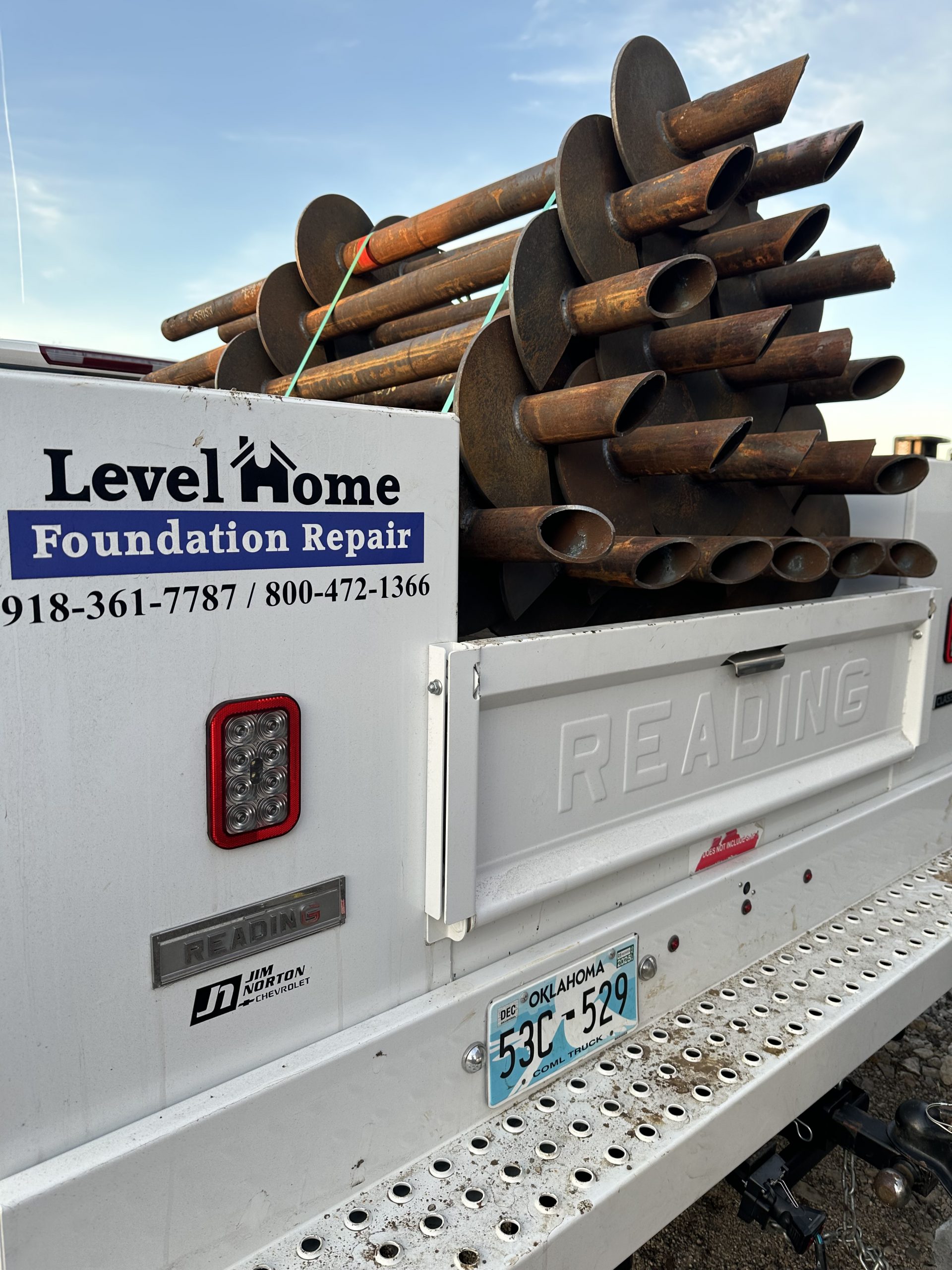
Steel piers are one of the most reliable solutions for foundation settlement on clay soil. Here’s how they work: hydraulic equipment drives galvanized steel pipe sections through the unstable clay layer until they reach load-bearing bedrock or stable strata below. Your home’s weight is then transferred from the unreliable clay soil to these deep, stable piers.
Steel push piers can often lift a settled foundation back toward its original position — not just stop the sinking, but actually reverse it. They’re installed from the exterior of your home with minimal disruption to your landscaping, and the work can typically be completed in one to three days depending on the number of piers needed.
Helical Piers
Helical piers work on a similar principle but use a different installation method. Instead of being pushed, they’re screwed into the ground like giant screws, with helical plates that pull them through the soil. This makes them ideal for lighter structures, areas with limited access, or situations where the load-bearing layer is at a moderate depth.
Helical piers are especially effective in Oklahoma because the helical plates provide resistance in both tension and compression — meaning they resist both upward heaving from expanding clay and downward settlement from shrinking clay. For a deeper understanding of when and how these are used, check out our helical piers guide.
Slab Foundation Solutions
Many Tulsa homes are built on concrete slab foundations, which are particularly susceptible to clay soil movement because they don’t have the flexibility of a pier-and-beam system. Slab foundation repair in our area typically involves installing piers at strategic points around and sometimes through the slab to stabilize and lift it back to level.
For interior settlement issues, we may also use concrete leveling techniques to address sunken sections of the slab without the need for full pier installation in every location.
Crawl Space Stabilization
Homes with crawl spaces face a unique set of challenges in Oklahoma’s clay soil environment. Moisture infiltration, shifting support columns, and sagging floor joists are all common issues. Professional crawl space repair addresses these problems with adjustable steel columns, vapor barriers, and drainage improvements that work together to create a stable, dry environment beneath your home.
The Role of Drainage in Protecting Your Foundation
If clay soil is the enemy, water is its weapon. Managing how water interacts with the soil around your foundation is absolutely critical in Oklahoma. In fact, many foundation repair Tulsa projects include drainage improvements as an essential part of the solution.
Why Drainage Matters So Much on Clay Soil
Remember the shrink-swell cycle we discussed? The more extreme the moisture changes in the soil around your foundation, the more movement you’ll see. Proper drainage doesn’t eliminate the clay — nothing short of excavating and replacing it entirely would do that — but it dramatically reduces the moisture fluctuations that drive the most destructive soil movement.
Installing effective foundation drainage systems can reduce soil moisture variation by 40% to 60%, which translates directly into less foundation movement and longer intervals between needed repairs. Our drainage solutions guide covers the options in more detail.
Key Drainage Solutions for Oklahoma Homes
Surface grading: The ground around your home should slope away from the foundation at a minimum of 6 inches over the first 10 feet. Many Tulsa homes have settled over time and lost this critical slope, allowing water to pond against the foundation.
French drains: These subsurface drainage channels collect water from saturated soil around your foundation and redirect it away from the structure. In Oklahoma’s clay soil, French drains need to be properly designed with the right gravel, filter fabric, and pipe sizing to avoid clogging — clay particles are so fine they can infiltrate and block poorly designed systems within a few years.
Gutter and downspout management: Your roof collects a tremendous amount of water during Oklahoma storms. Every downspout should discharge water at least 6 to 10 feet from your foundation. We see countless homes where downspouts dump water right next to the foundation — it’s one of the easiest problems to fix and one of the most damaging when ignored.
Sump pumps: For homes in low-lying areas or with persistent water intrusion issues, a sump pump system provides an active defense against water accumulation near your foundation.
What a Foundation Inspection Looks Like
If you’re seeing any of the warning signs we discussed, the next step is a professional foundation inspection. Here’s what to expect when Level Home Foundation Repair comes out to your home.
Exterior Assessment
We start by walking the entire exterior of your home, looking for visible cracks, gaps, signs of settlement, and drainage issues. We check the grade around the foundation, inspect gutters and downspouts, and note any large trees growing close to the structure. We also look at concrete flatwork — driveways, patios, sidewalks — for signs of movement that can indicate broader soil issues.
Interior Assessment
Inside, we check for cracking in drywall and plaster, test doors and windows for proper operation, and use laser levels to measure floor elevation across the entire home. This floor mapping is one of the most important diagnostic tools we have — it tells us exactly where and how much the foundation has moved.
Crawl Space or Basement Inspection
If your home has a crawl space or basement, we inspect it thoroughly for moisture, structural issues with support beams and columns, and signs of soil movement or water intrusion.
The Report and Recommendation
After the inspection, we sit down with you and explain exactly what we found, what’s causing the problem, and what the most effective repair options are. We provide a detailed written estimate with clear pricing — no hidden fees or surprise charges. Our inspections are free, and there’s never any pressure to commit on the spot.
Prevention Tips for Oklahoma Homeowners
While you can’t change Oklahoma’s clay soil, you can take steps to minimize the damage it causes to your foundation. These preventive measures are especially important during extreme weather seasons.
Maintain Consistent Soil Moisture
The key word here is consistent. The most damaging thing for your foundation isn’t wet soil or dry soil — it’s the dramatic change between the two. During extended dry periods in July and August, consider running a soaker hose around your foundation perimeter for 30 to 45 minutes every few days. The goal isn’t to saturate the soil — it’s to prevent extreme drying and shrinkage.
A good rule of thumb: if you see cracks forming in the soil within two feet of your foundation, the clay is too dry and you should water. Keep the soil uniformly moist but not soggy.
Manage Trees and Large Shrubs
As a general rule, trees should be planted no closer to your home than their expected mature height. A tree that will grow to 40 feet tall should be at least 40 feet from your foundation. For existing trees closer than this, consider installing a root barrier — a physical barrier in the soil that prevents roots from extending toward your foundation and drawing out moisture.
Keep Drainage Systems Clear
Clean your gutters at least twice a year — in late spring after the cottonwood and pollen season, and again in fall after leaves drop. Check that all downspout extensions are intact and directing water well away from the foundation. If you have French drains or other subsurface systems, have them inspected periodically to ensure they’re not clogged.
Address Small Problems Early
Foundation repair costs increase significantly as damage progresses. A hairline crack that costs a few hundred dollars to monitor and seal today can become a structural issue requiring tens of thousands of dollars in pier work if ignored for years. When it comes to foundation repair Tulsa homeowners trust Level Home because we identify and address problems early, before they become major structural concerns.
Be Mindful During Renovations
If you’re adding on to your home, building a patio, or making any changes that alter drainage patterns around your foundation, consult with a foundation professional first. We’ve seen many situations where well-intentioned home improvements — regrading for a new patio, for example — inadvertently directed water toward the foundation and accelerated damage.
When to Call a Professional
Here’s the honest truth: if you’re reading this article because you’ve noticed signs of foundation damage in your Tulsa home, the best time to call was yesterday. The second best time is right now.
Clay soil foundation damage doesn’t fix itself. It doesn’t stabilize on its own. Every rainy season and every drought cycle pushes your foundation a little further out of alignment. The sooner you get a professional assessment, the more repair options you’ll have — and the less the repair is likely to cost.
At Level Home Foundation Repair, we’ve been helping Tulsa and northeastern Oklahoma homeowners protect their most valuable investment for years. We understand Oklahoma’s unique soil conditions because we live and work here — this is our home, too. Every inspection is free, every estimate is straightforward, and every repair is backed by a transferable warranty.
Whether you’re dealing with wall cracks, sticking doors, uneven floors, or you just want peace of mind about your home’s structural health, we’re here to help. Our team of experienced foundation repair Tulsa ok professionals will give you an honest assessment and a clear plan of action.
Call Level Home Foundation Repair at (918) 361-7787 for a free inspection. Don’t let Oklahoma’s clay soil win — let us help you keep your home safe, stable, and level for decades to come.
Building new instead of repairing? Learn how pre-construction helical piers can prevent foundation problems before they ever start — eliminating the need to choose between repair methods entirely.