Foundation settlement in Tulsa rarely happens in a straight vertical line. Clay-rich Oklahoma soil expands and contracts with moisture changes, and as a foundation loses support, the structure above it does not simply drop — it rotates. Understanding that distinction is the reason the Level Home team designs and installs eccentric steel pier systems rather than relying on a one-size-fits-all repair method.
What Is an Eccentric Pier System?
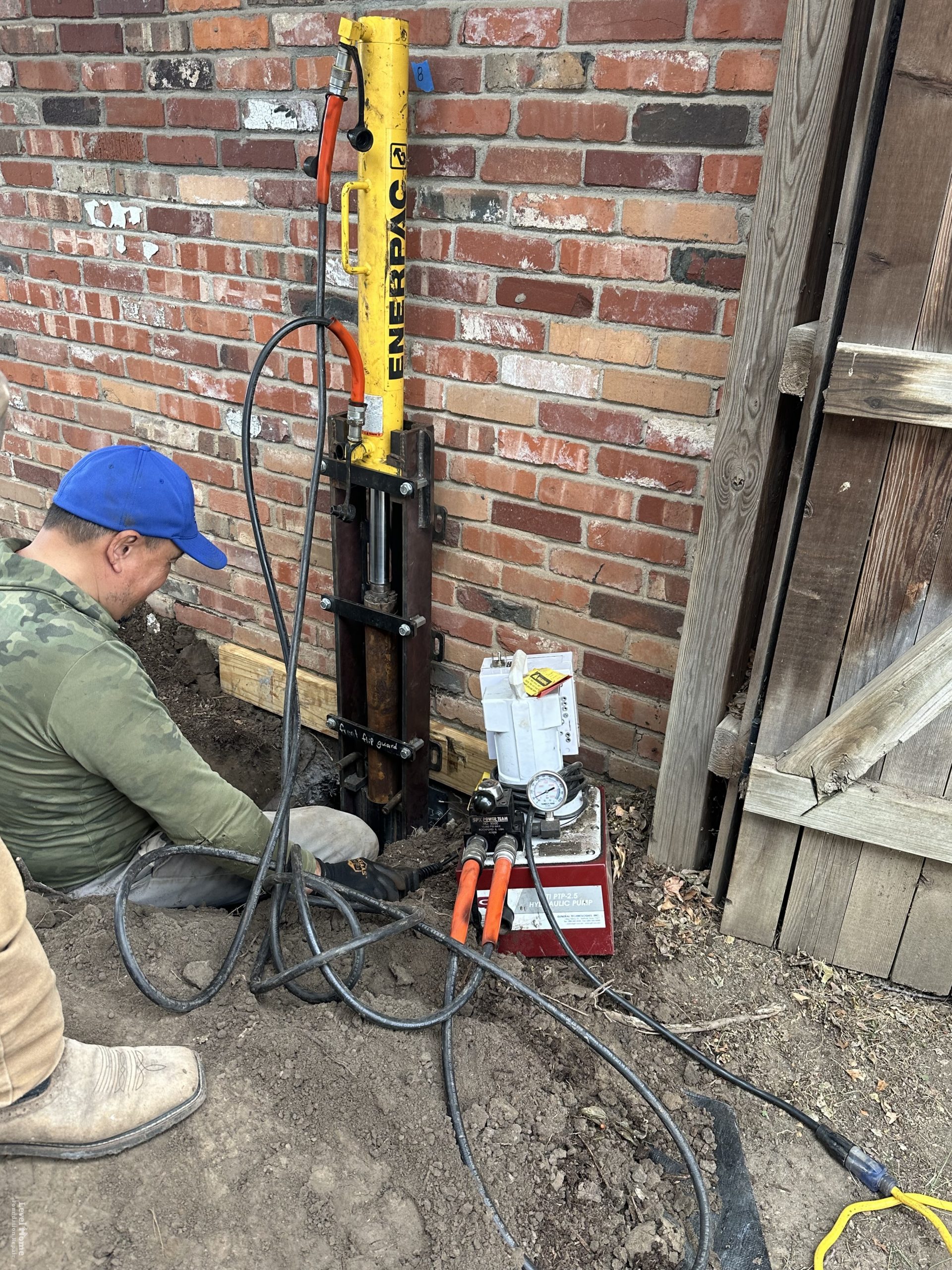
An eccentric pier system is a steel pier and bracket assembly designed so that the lifting force is applied at an offset — or “eccentric” — point relative to the center line of the foundation footing, rather than directly beneath it. In a standard concentric pier setup, the bracket applies force straight up through the center of the footing. That works well for pure vertical sinking, but it does very little to correct rotational movement.
The Level Home team’s eccentric bracket design shifts the point of applied force outward, which allows the pier to generate a small corrective moment (a rotational force) at the same time it lifts. For a broader overview of how steel piers work, including push piers and helical piers, our team’s steel pier installation page covers the installation process and pricing in detail. This post focuses specifically on why the eccentric design matters for Tulsa homes.
How Settlement Causes Roll, Not Just Sinking
Most homeowners picture foundation settlement as a slab or footing dropping straight down. In practice, the weight distribution of a home rarely allows that. Roofline loads, exterior wall weight, and brick veneer all bear down unevenly on the perimeter footing. As the soil beneath one section of footing loses bearing capacity, that section does not just sink — it tends to rotate outward, away from the structure, because the roof load pushes down and out at the same time the soil support disappears underneath.
The Level Home team refers to this as “roll-back” damage. It shows up as:
- Exterior walls that lean outward at the top, even when the footing below has moved only a small amount
- Brick veneer separating from the wood frame near the roofline
- Cracks that widen at the top and narrow near the ground
- Window and door frames racking out of square along exterior walls
A homeowner noticing these patterns should also review our team’s foundation warning signs checklist for Oklahoma homes, which outlines the full range of symptoms tied to clay soil movement.
Why Eccentric Design Enables Better Lift-Back
A concentric pier bracket lifts a footing vertically. If the wall above has already rotated outward, a straight vertical lift alone cannot pull that wall back toward plumb — it can only stop further sinking. This is one of the most common shortcomings the Level Home team sees when evaluating repairs performed with generic bracket systems.
Eccentric pier brackets apply lifting force at a calculated offset from the footing’s center line. That offset creates a counter-rotation as the pier is loaded, working against the same rotational force that caused the wall to roll outward in the first place. In practical terms, this means:
- The foundation can be guided back toward its original vertical plane, not just stopped in its current position
- Exterior wall lean can often be measurably reduced during the lift, not merely halted
- Brick veneer and siding gaps that opened from roll-back have a better chance of closing during the repair
This does not mean every foundation can be restored to a perfectly plumb condition — the amount of correction possible depends on the extent and duration of the movement. But eccentric pier design gives the Level Home team meaningfully more control over the outcome than a standard concentric bracket allows.
Level Home’s In-House Pier Innovation
Rather than purchasing off-the-shelf bracket systems, the Level Home team designs and manufactures its own steel pier systems in-house in Tulsa. That in-house control lets the team calibrate bracket geometry specifically for the roll-back patterns seen in local clay soil, rather than relying on a generic national bracket design built for different soil conditions.
Every pier system the Level Home team installs is manufactured to the same offset-load specifications, so results are consistent from one job site to the next. Homeowners considering slab-specific settlement issues can also review our team’s slab foundation repair page for information on how pier placement is planned for slab-on-grade homes.
When Your Tulsa Home Needs Eccentric Piers
Eccentric pier systems are most valuable when a foundation shows signs of rotational movement rather than uniform vertical settlement. The Level Home team typically recommends this approach when an inspection reveals:
- Outward-leaning exterior walls, particularly near roofline connections
- Diagonal cracking that widens toward the top of a wall
- Separation between brick veneer and the wood-framed structure
- Settlement concentrated along one side or corner of the home, common with Tulsa’s uneven clay soil depth
Every foundation is different, and the right pier design depends on soil conditions, footing depth, and the pattern of movement observed during inspection. The Level Home team evaluates each of these factors before recommending eccentric piers, concentric piers, or a combination of both.
Homeowners in the Tulsa area who are noticing wall lean, brick separation, or uneven settlement can schedule a free foundation inspection with the Level Home team, or call (918) 361-7787 to speak with a member of the team directly.