Oklahoma Rain Does Not Just Flood Your Yard: It Attacks Your Foundation
Tulsa averages around 42 inches of rainfall per year. Some months, that arrives in slow, steady soaks. Others, it comes in walls of water that dump two or three inches in a single afternoon. Either way, the water has to go somewhere, and if your property does not have a functioning perimeter drainage system, it goes straight to the worst possible place: the soil directly against your foundation.
That is where the real damage starts, and it is not always obvious until the cracks show up inside.
The Soil Moisture Cycle That Moves Foundations
Most Tulsa homes sit on clay-heavy soil. Clay has a unique property that makes it dangerous for foundations: it changes volume with moisture. When it absorbs water, it swells. When it dries out, it shrinks. This expansion-and-contraction cycle — called the shrink-swell cycle — generates enormous lateral and vertical pressure against foundation walls and footings.
During a heavy rain event, the soil around an unprotected foundation absorbs water rapidly. Clay particles expand, pushing inward against the foundation walls and upward against the slab. In severe cases, this causes a condition called upheaval, where sections of the slab actually lift. When the rain stops and July heat bakes the moisture out of that same soil, it contracts and pulls away, leaving voids beneath the footing. The foundation settles into those voids unevenly.
One cycle does not cause a major problem. But Tulsa does not get one cycle per year. The back-and-forth between spring storms and summer drought means foundations here endure dozens of moisture swings annually. Each one adds stress. Over years, that stress shows up as slab settlement, cracked drywall, sticking doors, and uneven floors.
How Perimeter Drainage Breaks the Damage Cycle
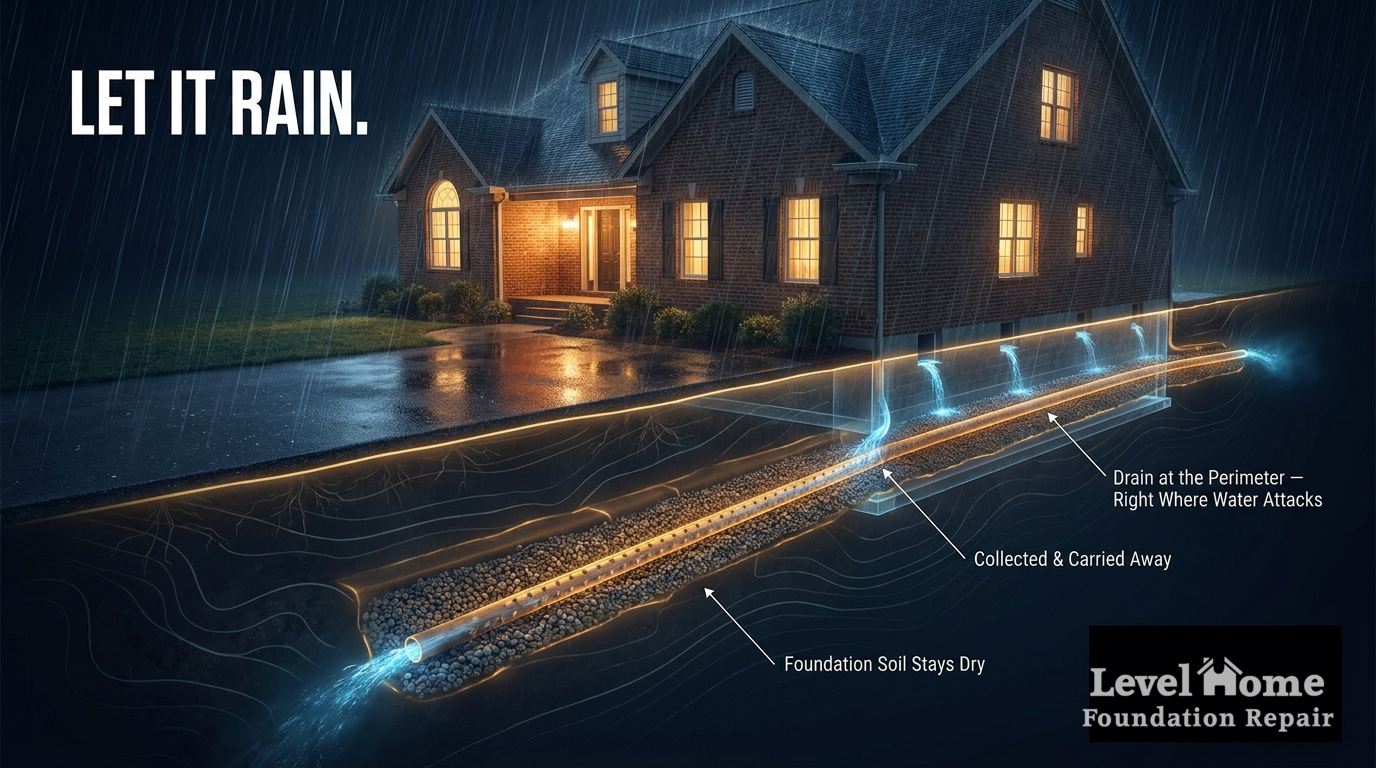
A perimeter drain intercepts water before it reaches the soil immediately around your foundation. The concept is straightforward: a trench filled with gravel and a perforated pipe is installed along the foundation’s edge. Rainwater and subsurface moisture flow into the gravel bed, enter the pipe, and are carried to a discharge point away from the home.
What makes this effective is location. The drain sits right where water attacks — at the perimeter of the foundation. Instead of allowing rainfall to saturate the clay soil against the foundation wall, the drain collects it and routes it away. The foundation soil stays significantly drier and more stable, which reduces the intensity of the shrink-swell cycle.
The result is not that your foundation never moves. All foundations on clay soil experience some movement. The result is that the moisture level in the surrounding soil stays more consistent, which means the movement stays within a range the structure can tolerate without cracking or settling.
Why Tulsa Properties Are Especially Vulnerable Without Drainage
Several factors specific to the Tulsa metro make drainage more critical here than in many other markets.
Clay content. Northeast Oklahoma sits on some of the most expansive clay soil in the country. The USDA classifies much of Tulsa County’s residential soil as having high shrink-swell potential, meaning even moderate changes in moisture can produce significant ground movement.
Storm intensity. Oklahoma does not distribute its rainfall evenly. A large portion of annual precipitation falls in concentrated bursts during spring and early summer. That rapid saturation overwhelms soil that may have been bone-dry just days earlier, creating the exact conditions that stress foundations most.
Flat lot grading. Many Tulsa neighborhoods — particularly older ones — were built on relatively flat lots without aggressive grading away from the foundation. Water has no natural path to leave the perimeter zone, so it sits and soaks in.
Aging gutter systems. Homes built in the 1960s through 1990s often have short downspouts that discharge water within a few feet of the foundation. That concentrated discharge saturates a small area repeatedly, creating localized settlement or upheaval that is more damaging than broad, even saturation.
What a Properly Installed System Looks Like
Not all drainage installations are equal. A system that actually protects a Tulsa foundation needs several things done correctly.
Correct depth and slope. The trench needs to reach below the footing level and maintain a consistent slope toward the discharge point. If the slope is too shallow, water sits in the pipe instead of flowing out.
Clean gravel backfill. Washed gravel — not crusher run or fill dirt — surrounds the pipe. This allows water to enter freely. Dirt-contaminated gravel clogs over time and defeats the purpose of the system.
Filter fabric. A geotextile fabric wraps the gravel bed to prevent fine soil particles from migrating into the gravel and clogging the system. In clay soil, this is non-negotiable. Without it, the system’s lifespan drops significantly.
Proper discharge. The collected water has to go somewhere productive — a pop-up emitter in the yard, a tie-in to the storm system, or a daylight outlet at a lower elevation. Dumping it two feet from where it was collected does nothing.
If you are unsure whether your drainage system was installed correctly, or whether your home needs one at all, a free inspection is the fastest way to find out. Understanding the difference between French drains and surface drains can also help you ask the right questions when evaluating options.
Drainage as Prevention, Not Just a Fix
Most homeowners contact a foundation drainage professional after they notice damage — cracks in the walls, doors that will not close, or water appearing in the crawl space. At that point, drainage is part of the repair plan. But it does not have to get there.
Installing a perimeter drainage system before damage occurs is one of the most cost-effective investments a homeowner can make. The cost of a drainage system is a fraction of the cost of crawl space structural repair or pier installation. And unlike those repairs, drainage addresses the root cause rather than the symptom.
If your home is showing early warning signs — minor cracks, slight floor slopes, or soil that stays wet days after rain — addressing drainage now can prevent those signs from becoming structural problems later.
Schedule a Free Drainage and Foundation Inspection
Level Home Foundation Repair provides free inspections for Tulsa-area homeowners concerned about water, drainage, or foundation movement. There is no pressure, no obligation, and no cost. If a drainage system makes sense for your property, we will explain exactly what is needed and why. If it does not, we will tell you that too.
Call or text (918) 361-7787 to schedule, or request your free inspection online.