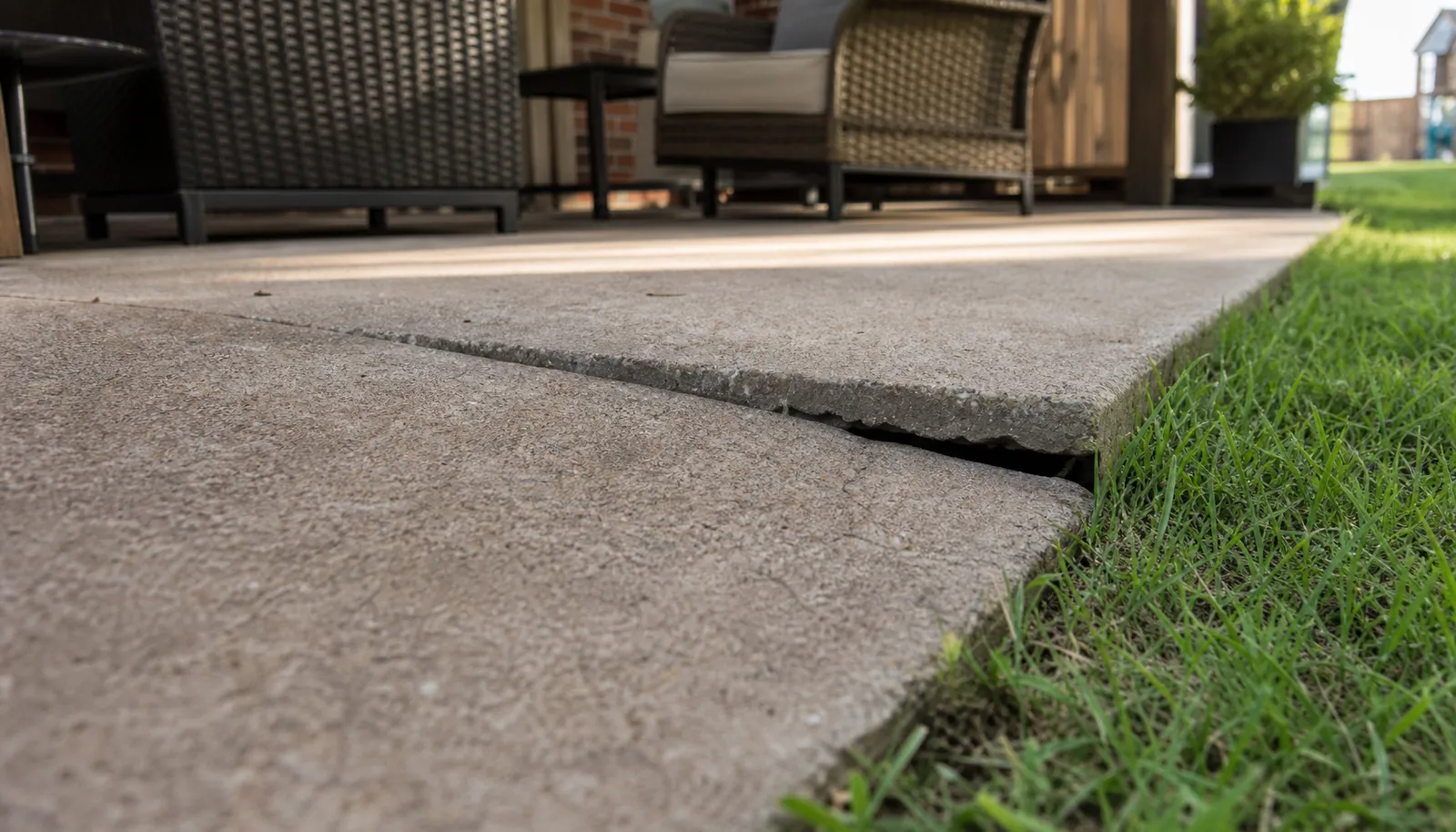
That uneven patio slab isn’t just ugly — it’s a lawsuit waiting to happen. Every time someone trips on that raised edge or stumbles where the concrete has dropped two inches, you’re one bad step away from a broken wrist and a homeowner’s insurance claim.
But here’s what most Tulsa homeowners don’t realize: you almost certainly don’t need to tear out and replace that patio. Concrete patio leveling can restore a sunken slab to its original position in a few hours, at a fraction of the cost of replacement.
Why Concrete Patios Sink in Oklahoma
Your patio slab didn’t crack or fail. The ground under it did.
Oklahoma’s clay soil is the primary culprit. During wet seasons, the clay swells and pushes upward. During dry months — and Tulsa gets plenty of 95-degree weeks between June and September — the clay shrinks and compacts. After years of these wet-dry cycles, voids form beneath the concrete. The slab, which was poured on compacted soil that no longer exists, drops into those voids.
Other common causes include:
- Washout from poor drainage — water channeling under the slab carries soil particles with it, hollowing out the base
- Tree root decomposition — when a tree is removed and roots decay beneath the slab, they leave gaps that cause settlement
- Original compaction failure — the fill soil under the patio was never properly compacted during construction
- Gutter runoff — downspouts dumping water directly next to the patio erode the subgrade over time
How Concrete Patio Leveling Works
Modern concrete leveling uses polyurethane foam injection — a process that’s faster, lighter, and more precise than the old mudjacking method your neighbor might remember from the 1990s.
Here’s the process:
- Drill small ports. Penny-sized holes (about 5/8 inch) are drilled through the sunken slab in a strategic pattern.
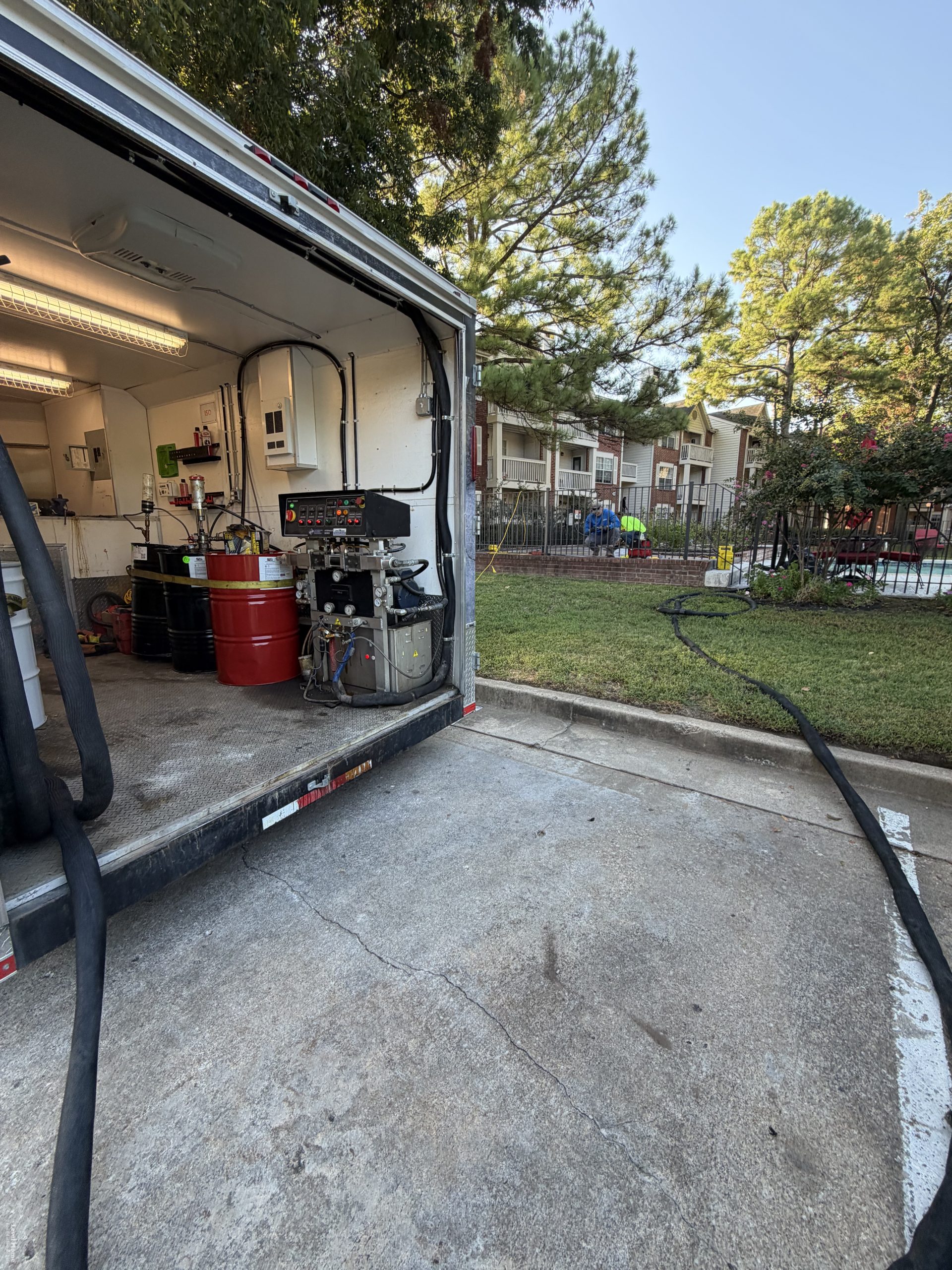
- Inject expanding foam. High-density polyurethane foam is pumped through the ports into the void beneath the concrete. The foam expands to fill the space and generates lift pressure.
- Level the slab. As the foam expands, the slab rises back to its original elevation. The technician monitors the lift in real time using laser levels and stops when the surface is flush with the surrounding concrete.
- Seal and finish. The drill holes are patched and the slab is ready for use — typically within 15 to 30 minutes after the work is complete.
The entire process for a standard backyard patio takes two to four hours. There’s no excavation, no heavy equipment tearing up your yard, and no curing time like you’d get with a full replacement.
Foam Leveling vs. Patio Replacement: The Cost Comparison
This is where the math gets interesting — and where most homeowners realize they’ve been overthinking the problem.
- Concrete patio replacement (demolition + disposal + new pour + curing): $8 – $16 per square foot. A 300 sq ft patio runs $2,400 – $4,800, plus you can’t use it for 3–7 days while it cures.
- Polyurethane foam leveling: $3 – $8 per square foot. That same 300 sq ft patio costs $900 – $2,400, and you’re using it the same afternoon.
That’s a 50–70% savings. And the foam doesn’t add significant weight to the already-compromised soil — it weighs about 2 pounds per cubic foot compared to the 100+ pounds per cubic foot that mudjacking slurry adds.
When Leveling Won’t Work (And You Actually Need Replacement)
Foam leveling isn’t a miracle cure for every situation. Here’s when replacement is the better call:
- The slab is severely cracked or broken into multiple pieces. Leveling lifts the slab, but it doesn’t repair structural fractures. If the concrete is crumbling or split into several sections, it needs to come out.
- The concrete surface is badly deteriorated. Spalling, scaling, or widespread surface damage means the slab’s useful life is over regardless of whether it’s level.
- The settlement exceeds 4–6 inches. Extreme settlement usually indicates a deeper soil problem that needs to be addressed before any slab work makes sense.
For the vast majority of sunken patios in the Tulsa area — where settlement ranges from half an inch to three inches — foam leveling is the right solution.
How to Prevent Your Patio From Sinking Again
Once you’ve leveled the patio, these steps keep it that way:
- Fix your drainage. Extend downspouts at least 4 feet away from the patio. Make sure the grade around the slab slopes away from the concrete, not toward it.
- Seal the control joints. Water infiltrating through cracks and joints is the fastest path to subgrade erosion. A good polyurethane caulk keeps water on top of the slab where it belongs.
- Manage your trees. Large trees within 15 feet of the patio will compete for soil moisture and accelerate the shrink-swell cycles. Root barriers can help if removal isn’t practical.
- Water consistently during droughts. This sounds counterintuitive, but keeping the soil moisture consistent — not soaked, not bone dry — reduces the extreme volume changes that cause settlement.
The Bottom Line
A sunken patio is a solvable problem. Polyurethane foam leveling restores the surface in hours instead of days, costs half to a third of replacement, and doesn’t add heavy material to soil that’s already proven it can’t hold weight.
If your Tulsa-area patio has settled, cracked at the joints, or created a trip hazard that makes you hold your breath every time someone walks across it — get it inspected before the next freeze-thaw cycle makes the gap wider. The fix is simpler than you think.