It’s 11 PM. You’re lying in bed, but you can’t sleep. Earlier today you noticed a crack running along your living room wall — one you swear wasn’t there last month. So you grabbed your phone and Googled “foundation crack Tulsa” and now you’re deep in a rabbit hole of horror stories about $30,000 repairs and houses that “can’t be saved.”
Take a deep breath. Most of the time, a foundation crack doesn’t mean your home is falling apart. But it does mean you need answers — and the first step to getting real answers is a professional foundation inspection in Tulsa.
This guide walks you through exactly what happens during a foundation inspection, what it should cost (or whether it should be free), how to make sure you’re getting an honest assessment, and what common problems Tulsa inspectors find in Oklahoma homes built on our notoriously unpredictable clay soil.
When Do You Need a Foundation Inspection in Tulsa?
Not every crack means crisis — but there are specific situations where scheduling a foundation inspection isn’t optional. Here’s when Tulsa homeowners should call:
1. You’re Buying or Selling a Home
This is the most common trigger. Oklahoma doesn’t require a separate foundation inspection during real estate transactions, but any experienced Tulsa realtor will tell you: skip this step at your own risk. Standard home inspections touch on the foundation, but they don’t go deep enough. A dedicated foundation inspection catches issues that general inspectors miss — especially in older homes in neighborhoods like Midtown, Maple Ridge, or Brookside where 80-year-old foundations are common.
2. You’ve Spotted Warning Signs
These are the red flags that should prompt a call:
- Cracks in drywall, especially diagonal cracks near door and window frames
- Doors or windows that suddenly stick or won’t close properly
- Visible cracks in the exterior brick or foundation wall
- Uneven or sloping floors
- Gaps between walls and ceiling or walls and floor
- Basement water intrusion after rain
3. After Severe Oklahoma Weather
Tulsa’s weather punishes foundations. Our extreme drought-to-flood cycles cause the expansive clay soil to shrink and swell dramatically — sometimes shifting several inches in a single season. After a prolonged drought (like the summers of 2022 and 2023) or major flooding, scheduling an inspection is smart preventive maintenance.
4. Before Major Renovations
Planning a kitchen remodel, room addition, or second-story build? A foundation inspection before you start ensures the existing structure can support the changes. Finding foundation problems mid-renovation is exponentially more expensive to fix.
5. Routine Annual or Biannual Check
If your home is older than 20 years and sits on Tulsa’s clay soil, a periodic check-up every 2-3 years is a smart investment. Most reputable foundation repair Tulsa companies offer these inspections at no cost. Learn more about our helical piers services.
What Happens During a Foundation Inspection in Tulsa
A thorough foundation inspection isn’t a 10-minute walkthrough. Here’s what a qualified inspector should be examining — and what you should expect if you’re standing there watching:
Exterior Examination (20-30 minutes)
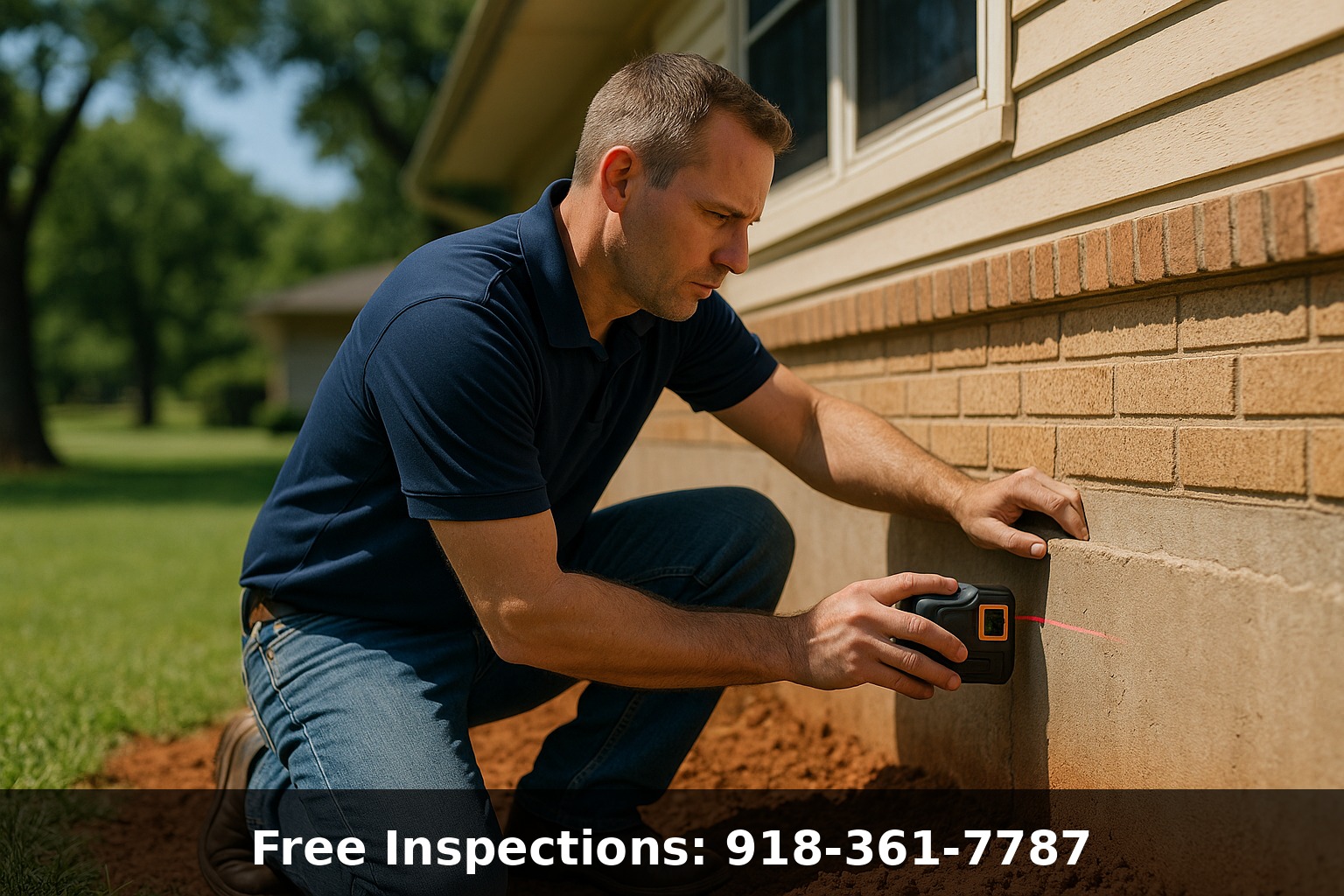
The inspector starts outside, walking the full perimeter of your home. They’re looking at:
- Foundation walls — checking for cracks, spalling, efflorescence (white mineral deposits), and bowing
- Grading and drainage — does the soil slope away from your foundation? Standing water near the foundation is the #1 preventable cause of foundation problems in Tulsa
- Gutters and downspouts — are they directing water at least 4-6 feet away from the home?
- Exterior brick and siding — stair-step cracks in brick mortar joints are a classic sign of differential settlement
- Vegetation — large trees within 15 feet of the foundation can extract massive amounts of moisture from the clay soil, causing localized shrinkage
Interior Examination (20-30 minutes)
Inside, the inspector examines every room, checking:
- Drywall cracks and their patterns (horizontal, vertical, diagonal — each tells a different story)
- Door and window alignment — do they open and close smoothly?
- Floor levelness — using a laser level or digital inclinometer, they measure slopes across rooms
- Gaps at baseboards, crown molding, and where walls meet ceilings
- Signs of previous repairs or patching that might indicate recurring movement
Crawl Space or Slab Assessment
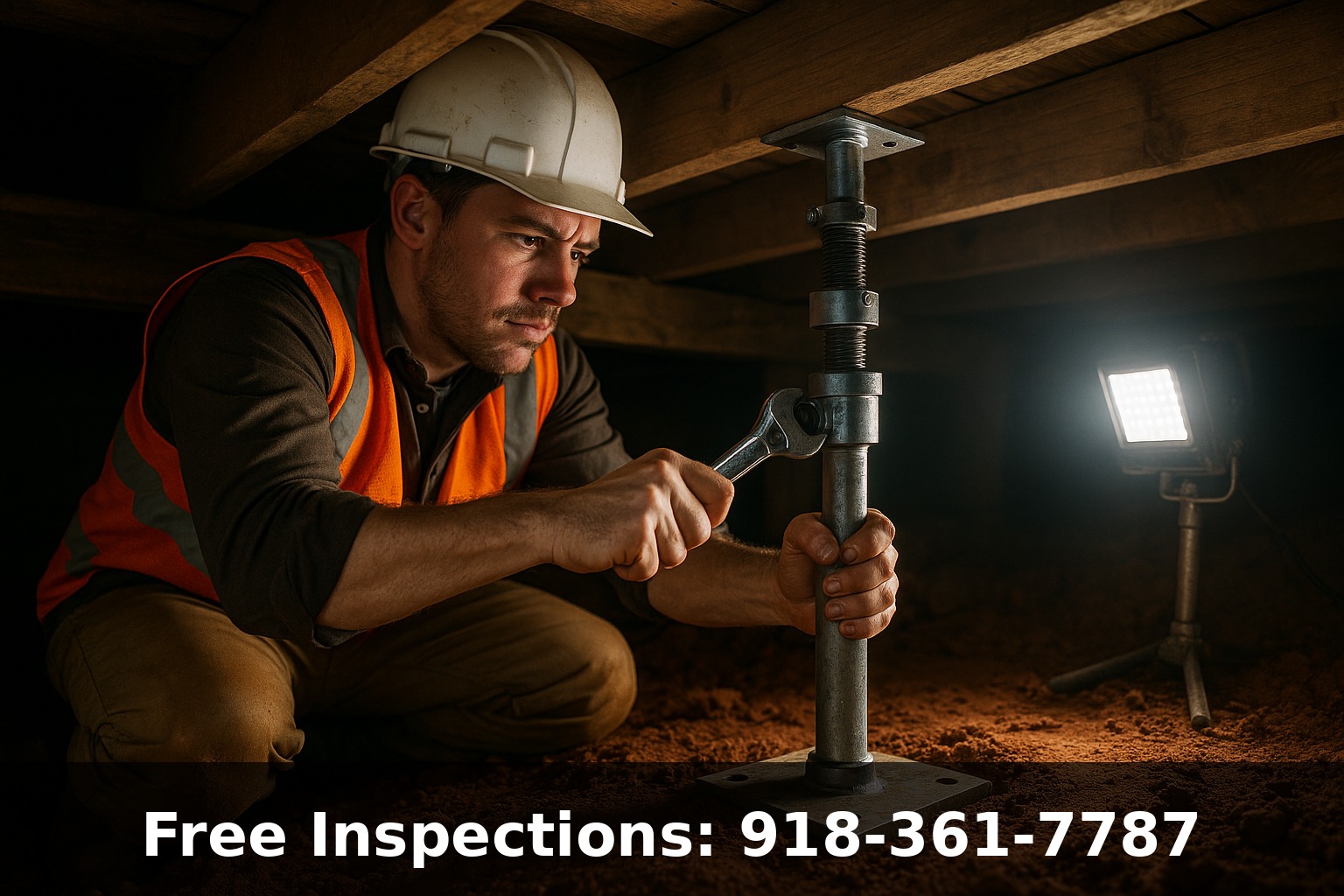
For homes with crawl spaces, the inspector should physically enter the crawl space (yes, actually crawl under there) to check:
- Support beams and floor joists for sagging, rot, or insect damage
- Moisture levels and standing water
- Vapor barrier condition
- Pier and post connections
For slab foundations (the most common type in Tulsa), the inspector uses elevation measurements across the slab to map any settlement or heaving patterns. A Zip Level or manometer system can detect differences as small as 1/8 of an inch.
Tools a Professional Inspector Uses
Be cautious of anyone who shows up with nothing but a flashlight. A proper foundation inspection in Tulsa should involve:
- Laser level or Zip Level — for precise elevation measurements
- Crack monitors or calipers — to measure crack widths accurately
- Moisture meter — to detect hidden water issues
- Digital inclinometer — to measure wall or floor slopes
- Camera — every finding should be documented with photos
Free Inspections vs. Paid Structural Engineer Reports
This is where Tulsa homeowners get confused — and where some companies take advantage. Let’s break it down honestly:
When a Free Inspection Is Enough
Most reputable foundation repair companies in Tulsa offer free inspections. These are conducted by experienced field inspectors who can identify common problems, recommend repair methods, and provide a detailed quote. A free inspection is typically sufficient when:
- You’ve noticed warning signs and want a professional opinion
- You’re getting a second opinion on work another company recommended
- You need a repair quote for budgeting purposes
- Routine maintenance check on an aging home
At Level Home Foundation Repair, our free inspections take 45-60 minutes and include a written report with photos and measurements. We believe in honest assessments — if your home doesn’t need repair, we’ll tell you. We’d rather earn your trust than push unnecessary work.
When You Need a Paid Structural Engineer Report ($300-$600)
A licensed Professional Engineer (PE) report is a formal, stamped document that carries legal weight. You’ll typically need one when:
- Real estate transactions require it — some lenders (especially FHA and VA loans) require a PE letter
- Insurance claims — your insurance company wants independent documentation
- Legal disputes — construction defect cases, neighbor disputes, or builder warranty claims
- Complex or unusual situations — significant structural movement, multiple competing diagnoses, or commercial properties
In the Tulsa area, a structural engineer’s foundation evaluation typically costs $300 to $600, depending on home size and complexity. Some engineers charge more for detailed reports with repair specifications.
🚩 Red Flags to Watch For
Be wary of any company that:
- Refuses to provide a written report after their “free” inspection
- Uses extreme scare tactics — “Your house could collapse!”
- Pressures you to sign a contract on the spot with a “today only” discount
- Won’t explain why they’re recommending specific repairs
- Recommends work without taking any measurements
How Much Does a Foundation Inspection Cost in Tulsa?
Here’s the straightforward breakdown Tulsa homeowners need:
| Inspection Type | Cost | What You Get |
|---|---|---|
| Foundation Repair Company Inspection | FREE | Visual assessment, measurements, written report, repair recommendations, and quote |
| Structural Engineer (PE) Report | $300 – $600 | Stamped engineering report, detailed analysis, repair specifications, legal documentation |
| Home Inspector (General) | $300 – $500 | Whole-house inspection with basic foundation observations (not specialized) |
Pro tip: Always get at least two foundation company inspections before committing to repair. Reputable companies welcome second opinions — it’s the pushy ones who don’t want you comparing.
What Your Foundation Inspection Report Should Include
Whether you’re getting a free company inspection or a paid PE report, the documentation should include these elements. If it doesn’t, ask why — or find someone more thorough.
1. Elevation Measurements
This is the most important data point. A grid of elevation readings across your slab or crawl space floor shows exactly where (and how much) your foundation has moved. Look for measurements at regular intervals — every 6-8 feet — documented on a floor plan diagram.
2. Crack Documentation
Every crack should be photographed, measured (width and length), and mapped. The report should note the crack pattern — this tells an experienced inspector whether you’re dealing with settlement, heaving, lateral pressure, or thermal movement.
3. Moisture and Drainage Assessment
In Tulsa, moisture is almost always part of the story. Your report should note the condition of drainage systems, grading around the home, gutter performance, and any signs of water intrusion.
4. Clear Recommendations
The report should plainly state one of three things:
- No repair needed — the foundation is performing normally
- Monitor and recheck — minor movement detected, recheck in 6-12 months
- Repair recommended — with specific methods, locations, and estimated costs
5. Photo Documentation
Every finding should be backed up with dated photographs. This creates a baseline you can compare against in future inspections.
Common Foundation Problems Found During Tulsa Inspections
After 15+ years and over 1,000 homes inspected in the Tulsa metro area, these are the problems we encounter most frequently:
Foundation Settlement
The most common issue. Tulsa’s clay soil loses moisture during droughts and compacts, causing sections of the foundation to sink. We frequently see 1-3 inches of differential settlement in homes throughout Broken Arrow, Owasso, Bixby, Jenks, and south Tulsa. Steel piers driven to stable bedrock are the permanent solution.
Foundation Heaving
The opposite of settlement — when clay soil absorbs excessive moisture and swells, it pushes the foundation upward. This is especially common after plumbing leaks under slab foundations. Heaving is trickier to repair than settlement because you can’t simply push the foundation back down.
Crawl Space Moisture and Structural Damage
Many older Tulsa homes (especially in Midtown, Kendall-Whittier, and Florence Park) have pier-and-beam foundations with crawl spaces. Oklahoma’s humidity combined with poor ventilation creates a perfect environment for wood rot, mold, and structural deterioration of support beams.
Poor Drainage Causing Ongoing Damage
Many Tulsa homes have drainage issues that cause foundation problems rather than being a symptom. Improper grading, clogged French drains, short downspout extensions, and even over-watering flowerbeds next to the foundation — all of these pump water into the clay soil and create the expansion that moves your foundation.
Foundation Cracks
Not all cracks are equal. Hairline cracks less than 1/16″ wide are often just normal concrete curing. But cracks wider than 1/4″, horizontal cracks in basement walls, or stair-step cracks in brick all warrant professional evaluation — and often repair.
Foundation Inspection in Tulsa FAQ
How long does a foundation inspection take?
A thorough foundation inspection typically takes 45 minutes to 1.5 hours, depending on home size and complexity. Be skeptical of anyone who finishes in 15 minutes — they’re not being thorough enough to give you reliable answers.
Should I be present during the inspection?
Absolutely yes. Being present allows you to ask questions in real time, see exactly what the inspector is finding, and get immediate explanations. A trustworthy inspector welcomes your presence and questions — they have nothing to hide.
Should I get a second opinion before agreeing to repairs?
Yes — especially if the recommended repairs exceed $5,000. Getting 2-3 inspections from different companies is standard practice and any reputable company will encourage it. If a company pressures you not to get a second opinion, that’s a major red flag.
What if the inspection finds problems I wasn’t expecting?
Don’t panic. Many foundation issues are repairable and more common than you think — especially in Tulsa’s challenging soil conditions. Get the full report, ask for a detailed repair plan with costs, and take time to make an informed decision. Honest companies won’t rush you.
How often should I have my foundation inspected?
For homes older than 20 years on clay soil, every 2-3 years is a good rhythm. For newer homes or homes that have already had foundation repair, an annual visual check with a professional inspection every 3-5 years is typically sufficient.
Get a Free, Honest Foundation Inspection in Tulsa
If you’ve made it this far, you’re clearly someone who does their homework before making a decision — and that’s exactly the kind of homeowner we love working with.
At Level Home Foundation Repair, we’ve built our reputation on something radical in this industry: honesty. We don’t sell fear. We don’t recommend repairs you don’t need. With 15+ years of experience and over 1,000 Tulsa-area homes inspected, we give you a straight answer — even when that answer is “your foundation is fine.”
Our free inspections include a detailed written report with elevation measurements, photos, and clear recommendations. We back our repair work with a warranty (terms vary by service), and we treat every home like it belongs to a neighbor — because in Tulsa, it probably does.
Schedule your free foundation repair Tulsa inspection today:
- 📞 Call or text: (918) 361-7787
- 🌐 Visit: www.levelhomefoundationrepair.com
- 📍 Serving: Tulsa, Broken Arrow, Owasso, Bixby, Jenks, Sand Springs, Sapulpa, and all of northeastern Oklahoma
As seen on PRLog — Level Home Foundation Repair is Tulsa’s trusted name in honest foundation assessments.