Level Home Foundation Repair — Realtor Resources
Foundation Warning Signs: The Real Estate Professional’s Complete Guide
You’re walking a home with your clients. They spot a crack in the wall and their eyes go wide. As a real estate professional, what you say in the next 30 seconds can either save the deal or kill it. This guide gives you the knowledge to tell the difference between normal settling and a real structural concern — and how to turn foundation issues into closed deals instead of lost ones.

and cost under $5,000 to fix
by Level Home Foundation Repair
a transferable lifetime warranty
Why Realtors Need to Understand Foundation Issues
Foundation problems are the #1 deal killer in residential real estate — but they don’t have to be. According to the American Society of Home Inspectors, roughly 25% of U.S. homes will experience some form of structural distress during their lifetime. In Oklahoma, with our expansive clay soils, that number is even higher.
The problem isn’t usually the foundation itself — it’s the fear of the unknown. Buyers hear “foundation issue” and imagine the worst. Sellers panic and over-discount. Deals fall apart over repairs that might cost less than a bathroom renovation.
Here’s the reality: most foundation issues are completely repairable, often in just 1–3 days, with warranties that transfer to the new owner. As a realtor, understanding this puts you in a position to:
- Reassure buyers with facts, not guesses
- Help sellers price appropriately instead of panic-discounting
- Keep deals together that other agents would lose
- Build a reputation as the agent who knows houses inside and out
The Foundation Severity Scale: Know What You’re Looking At
Not all cracks are created equal. Use this three-tier system to quickly assess what you’re seeing during a walkthrough:
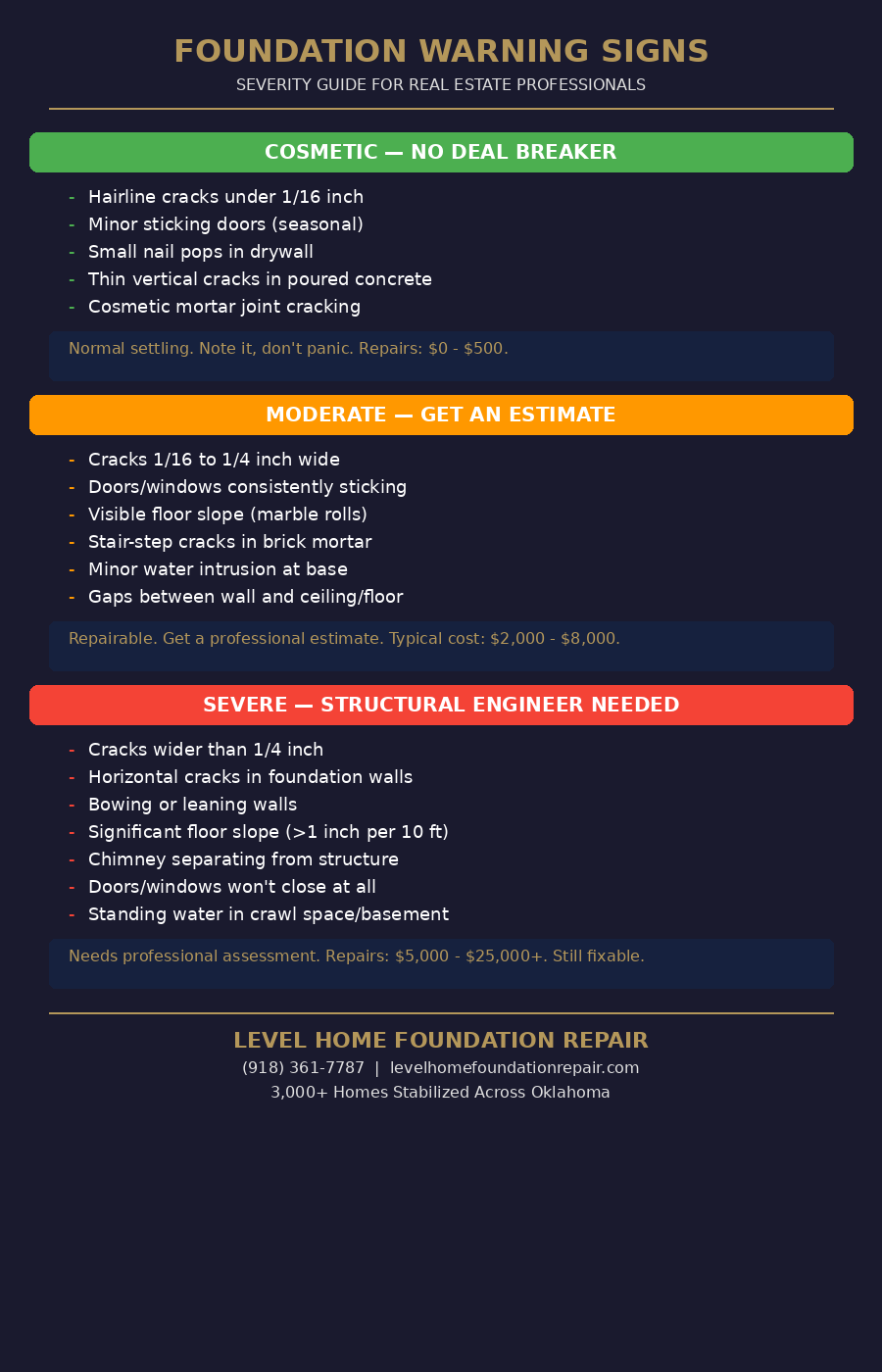
🟢 Cosmetic (No Deal Breaker)
These are signs of normal house settling and happen in virtually every home. They do not indicate structural failure.
- Hairline cracks under 1/16″ — nearly every home develops these within the first 2–5 years
- Minor door sticking — especially seasonal (humidity causes wood swelling)
- Small nail pops in drywall — caused by wood shrinkage, not foundation movement
- Thin vertical cracks in poured concrete — shrinkage cracks from curing
- Minor mortar joint cracking — purely cosmetic in most cases
What to tell your client: “This is completely normal settling. Every house does this. It’s cosmetic and doesn’t affect the structure at all.”
Estimated repair: $0 – $500 (often just caulk and paint)
🟡 Moderate (Get a Professional Estimate)
These signs indicate active movement that should be evaluated, but they’re typically very repairable.
- Cracks 1/16″ to 1/4″ wide — indicates some differential settling
- Doors and windows consistently sticking — not just seasonal; frame has shifted
- Visible floor slope — the “marble test” (a marble rolls across the floor)
- Stair-step cracks in brick mortar — classic sign of foundation settlement
- Minor water intrusion at the foundation base — may indicate drainage issues
- Gaps between wall and ceiling or floor — walls pulling away from structure
What to tell your client: “This shows some settling beyond normal. The good news? This is very common in Oklahoma and completely fixable. Let’s get an expert estimate so we know exactly what we’re dealing with.”
Estimated repair: $2,000 – $8,000 (typically helical piers or steel piers)
🔴 Severe (Structural Engineer Recommended)
These signs indicate significant structural movement that needs professional assessment — but even these are almost always repairable.
- Cracks wider than 1/4″ — significant differential movement
- Horizontal cracks in foundation walls — indicates lateral pressure (highest concern)
- Bowing or leaning walls — soil pressure or severe settlement
- Significant floor slope — more than 1″ per 10 feet
- Chimney separating from the house — indicates deep settlement
- Doors and windows that won’t close at all — severe frame distortion
- Standing water in crawl space or basement — active water intrusion
What to tell your client: “This needs a professional evaluation, and I wouldn’t recommend moving forward without one. But I’ve seen issues like this repaired many times — it’s rarely as bad as it looks. Let me connect you with a foundation specialist.”
Estimated repair: $5,000 – $25,000+ (helical piers, crawl space repair, or drainage systems)
The Realtor’s Walkthrough Checklist
Use this checklist at every showing. Most of these checks take less than 5 minutes and can save you from surprises at inspection.
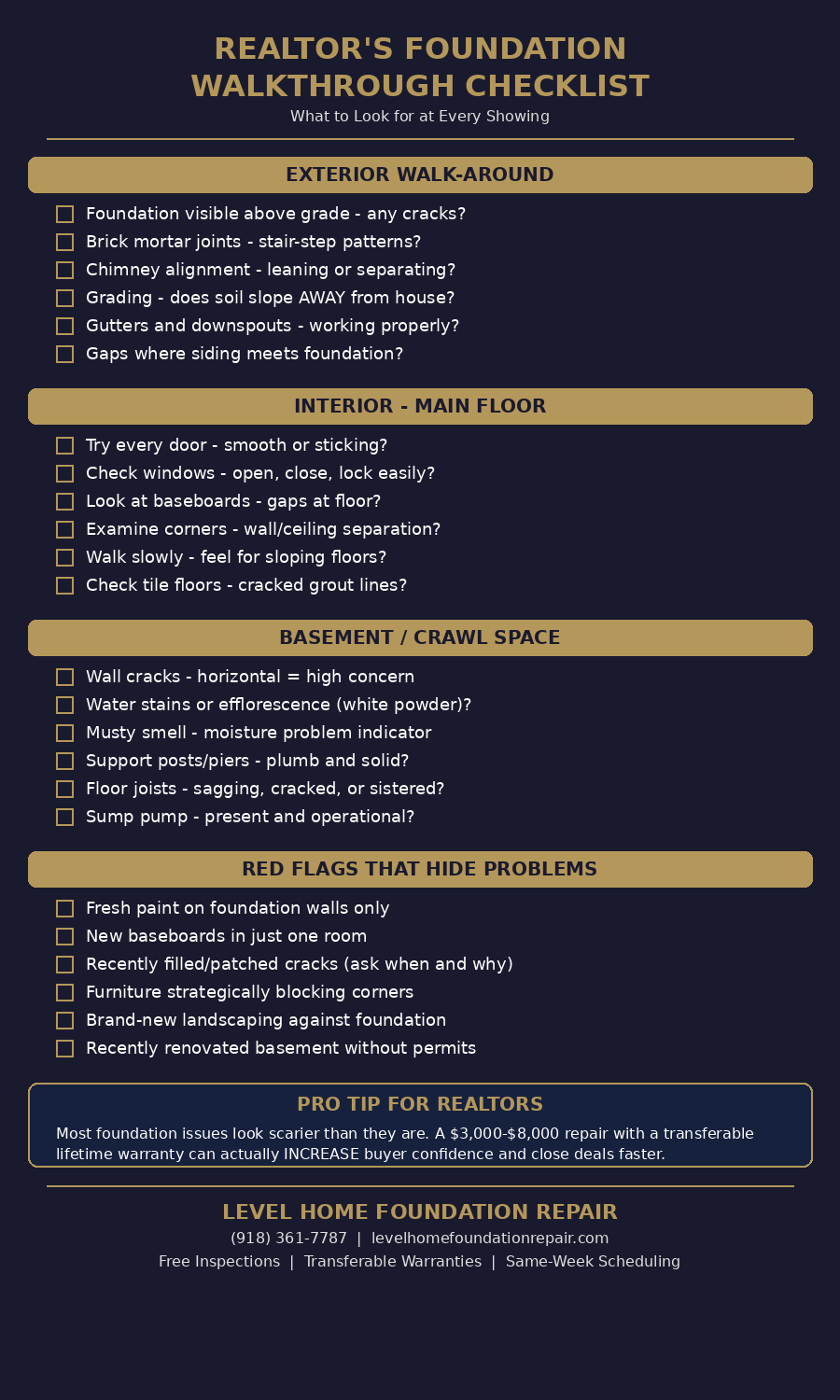
Exterior Walk-Around (2 Minutes)
| Check | What to Look For | What It Means |
|---|---|---|
| Foundation walls | Cracks, gaps, or displacement visible above grade | Vertical = usually OK. Horizontal = concern. Stair-step = settling. |
| Brick mortar | Stair-step cracking patterns in mortar joints | Classic settlement indicator. Width determines severity. |
| Chimney | Leaning, separating from main structure, or cracked | Heavy chimneys settle faster on weak soil. Often the first visible sign. |
| Grading | Does the soil slope AWAY from the house? | Water pooling at foundation = #1 cause of foundation problems in Oklahoma. |
| Gutters | Present, intact, with downspout extensions? | Missing or broken gutters concentrate water at the foundation. |
Interior Check (3 Minutes)
| Check | What to Look For | What It Means |
|---|---|---|
| Doors | Open and close every interior door | Sticking = possible frame shift from foundation movement. |
| Windows | Open, close, and lock each window | Difficult operation = frame distortion. Look for gaps at corners. |
| Baseboards | Gaps between baseboard and floor | Indicates floor has dropped away from walls. |
| Corners | Wall-to-ceiling and wall-to-wall joints | Separation at joints = differential settlement between sections. |
| Floors | Walk slowly — feel for slopes or bouncing | Slope toward center = settling. Bouncing = weakened support. |
| Tile | Cracked tiles or grout lines | Tile is rigid — even small foundation shifts crack it. |
Red Flags That May Hide Problems
Be especially alert when you see:
- Fresh paint on foundation walls only — why just there?
- New baseboards in a single room — may cover gap between wall and floor
- Recently patched cracks — ask when, why, and who did the work
- Furniture strategically blocking corners — look behind it
- Brand-new landscaping against the foundation — may be hiding exterior cracks
- “Recently renovated” basement without permits — cosmetic cover-up risk
The “Oklahoma Factor”: Why Our Soil Matters
Oklahoma sits on some of the most expansive clay soil in the country. This soil swells when wet and shrinks when dry, creating a constant push-pull cycle on foundations. This is why foundation issues are more common here than in most states — and why they’re rarely a surprise to experienced foundation professionals.
Key facts for your clients:
- Oklahoma’s soil can exert up to 15,000 pounds per square foot of swelling pressure
- Seasonal cycles (wet spring → dry summer) cause the most movement
- Poor drainage is the #1 controllable factor — proper grading and gutters prevent most issues
- Age doesn’t determine risk — newer homes on improperly prepared soil can have worse issues than 50-year-old homes
How Foundation Repairs Actually Work
Demystifying the repair process helps your clients make confident decisions:
| Repair Method | How It Works | Best For | Timeline |
|---|---|---|---|
| Helical Piers | Steel shafts screwed deep into stable soil/bedrock beneath the foundation | Most residential foundation settlement, new construction | 1–3 days |
| Steel Push Piers | Steel tubes hydraulically driven to load-bearing strata | Heavier structures, deeper bedrock situations | 1–3 days |
| Concrete Leveling | Polyurethane foam injected beneath sunken slabs to lift and stabilize | Driveways, patios, garage floors, pool decks | Same day |
| Crawl Space Repair | Structural supports, encapsulation, and moisture control | Sagging floors, moisture damage, weakened joists | 1–3 days |
| Drainage Systems | French drains, surface grading, and waterproofing | Water intrusion, poor grading, basement moisture | 1–2 days |
The key point for your clients: foundation repair is not a demolition project. Most repairs are completed in 1–3 days with minimal disruption — families often stay in the home during the work.
How a Transferable Warranty Changes the Conversation
This is your secret weapon as a realtor. Every Level Home foundation repair comes with a transferable lifetime warranty. Here’s why that matters for your transactions:
- For buyers: A repaired foundation with a warranty is better than an unrepaired one. The issue has been professionally addressed and guaranteed.
- For sellers: Having a repair completed before listing — with warranty documentation — often results in higher offers than discounting the price and leaving it for the buyer.
- For you: A transferable warranty is a negotiation tool. It converts a feared liability into a documented asset.
Frequently Asked Questions from Real Estate Professionals
Q: My buyer is panicking about a crack they found. What do I say?
A: Context is everything. First, assess the crack using the severity scale above. If it’s hairline (under 1/16″), reassure them that virtually every home in Oklahoma develops these. If it’s wider, recommend a free professional inspection. Say: “Let’s get the facts before we make any decisions. I know a foundation company that does free inspections and will give us a written report.”
Q: Should the seller repair before listing or offer a credit?
A: In most cases, repairing before listing is the stronger strategy. A completed repair with transferable warranty documentation shows buyers the issue is handled. A credit forces the buyer to deal with it, which feels risky — and many lenders won’t finance homes with known structural issues. A $5,000 repair is almost always better than a $15,000 price reduction.
Q: Will a foundation repair show up as a red flag on future inspections?
A: A professionally repaired foundation with warranty documentation is actually a positive indicator to experienced inspectors. It shows the issue was identified and properly addressed. Inspectors note the repair and warranty, which gives future buyers confidence.
Q: Can buyers get financing on a home with foundation issues?
A: It depends on the lender and severity. FHA and VA loans typically require structural issues to be repaired before closing. Conventional loans vary. This is another reason to recommend the seller repair before listing — it eliminates a financing obstacle.
Q: How long does a foundation inspection take?
A: A thorough inspection takes 45–90 minutes for a typical home. At Level Home, inspections are free and include a written report with photos, measurements, and recommended solutions with pricing. We can typically schedule within a few days.
Q: What if the home inspection reveals issues the seller didn’t disclose?
A: Oklahoma requires sellers to disclose known material defects. If issues are discovered at inspection, it becomes a negotiation point. Having a professional estimate in hand gives you concrete numbers to negotiate with, rather than guessing. Many deals that seem dead over foundation concerns close successfully once both sides have real numbers.
Q: Is it true that some foundation companies over-sell repairs?
A: Unfortunately, yes — some companies recommend more piers than necessary or push unnecessary repairs. Always get at least two estimates. A reputable company will explain exactly what’s happening, why, and give you options. At Level Home, we show you the data and let you decide — no pressure, no scare tactics.
Q: How should I handle foundation concerns in my listing description?
A: If repairs have been completed, lead with the warranty: “Foundation professionally stabilized with transferable lifetime warranty.” This actually builds confidence. If issues are known but unrepaired, work with your seller to get them addressed before listing — or price accordingly with full disclosure.
Quick Reference: Repair Costs at a Glance
Use these Oklahoma-specific ranges when advising your clients. For an exact estimate, visit our interactive pricing guide or contact us for a free inspection.
| Repair Type | Typical Range | Average in Oklahoma |
|---|---|---|
| Cosmetic crack repair | $200 – $800 | $400 |
| Concrete leveling (per area) | $500 – $2,500 | $1,200 |
| Pier installation (4–8 piers) | $3,000 – $10,000 | $5,500 |
| Major stabilization (8–15 piers) | $8,000 – $20,000 | $12,000 |
| Crawl space repair | $3,000 – $15,000 | $6,500 |
| Drainage systems | $2,000 – $8,000 | $4,000 |
For detailed cost breakdowns by repair type, see our comprehensive guides: Oklahoma Foundation Repair Cost Guide and Tulsa Foundation Repair Costs.
Partner with Level Home: Your Foundation Expert on Speed Dial
Real estate professionals across Oklahoma trust Level Home Foundation Repair as their go-to resource for foundation questions. Here’s what you get when you partner with us:
- Free inspections for your listed properties — scheduled within days
- Written reports with photos and measurements you can share with buyers
- Priority scheduling — we understand your timelines and closing dates
- Transferable lifetime warranties on all structural repairs
- Direct access — call or text us at (918) 361-7787 anytime
- 2,500+ homes stabilized across Oklahoma — experience you can count on
Need a Foundation Inspection for Your Listing?
We offer free inspections with written reports for real estate professionals. Most appointments available within 48 hours.
Level Home Foundation Repair serves Tulsa, Broken Arrow, Owasso, Jenks, Bixby, Sand Springs, Sapulpa, Claremore, Catoosa, Glenpool, Coweta, and the greater Oklahoma region. Licensed, insured, and trusted by 2,500+ Oklahoma homeowners.