The garage is almost always the first slab to settle
If you own a home in Tulsa, Broken Arrow, Bixby, or anywhere in the metro, there is a good chance your garage floor has a crack running through it or a noticeable dip near the door. Most homeowners assume every concrete crack is a foundation problem. Sometimes it is. More often with garage floors, the cause is simpler than that, and so is the fix.
Garage slabs in Oklahoma settle before the rest of your home for a few specific reasons that come down to how they are built and what sits underneath them.
Why garage slabs are different from your home’s foundation
Most Tulsa homes built after the 1970s sit on a post-tension or conventionally reinforced slab foundation. The foundation slab has a perimeter beam, interior grade beams, and reinforcement designed to carry the weight of the structure above it. Engineering goes into that slab.
Your garage floor is a different story. In most residential construction, the garage slab is a floating slab — a 4-inch-thick pad of concrete poured directly over compacted fill dirt. It has no perimeter beam tying it into the foundation. It is not designed to carry structural loads. It is designed to park cars on.
That distinction matters because when the fill dirt underneath the garage compresses, shifts, or washes out, the garage floor moves independently of the rest of your home. The house stays put. The garage floor drops.
Oklahoma soil makes it worse
Tulsa sits on expansive clay soil that swells when it absorbs water and shrinks when it dries. During a wet spring, that clay can expand 5 to 8 percent by volume. During a dry July, it contracts just as aggressively. This cycle repeats every year.
Under your home’s foundation, the soil is somewhat protected from extreme moisture swings by the structure above it. Under your garage, the slab is thinner, the fill is shallower, and water migration at the garage door opening creates a moisture gradient that accelerates the shrink-swell cycle right at the slab edge.
The result is predictable. The leading edge of the garage floor — the section closest to the door — drops first. You see it as a gap forming under the garage door seal, or as water pooling just inside the threshold after a rain.
The most common crack patterns and what they mean
Not every garage floor crack signals a major problem. Here is what we typically see during evaluations in the Tulsa metro:
Hairline shrinkage cracks
These appear within the first year or two after the concrete is poured. They follow no particular pattern and are usually less than 1/16 inch wide. They are cosmetic. The concrete contracted slightly as it cured, and the surface cracked where it was weakest. No repair needed.
Single crack running corner to corner
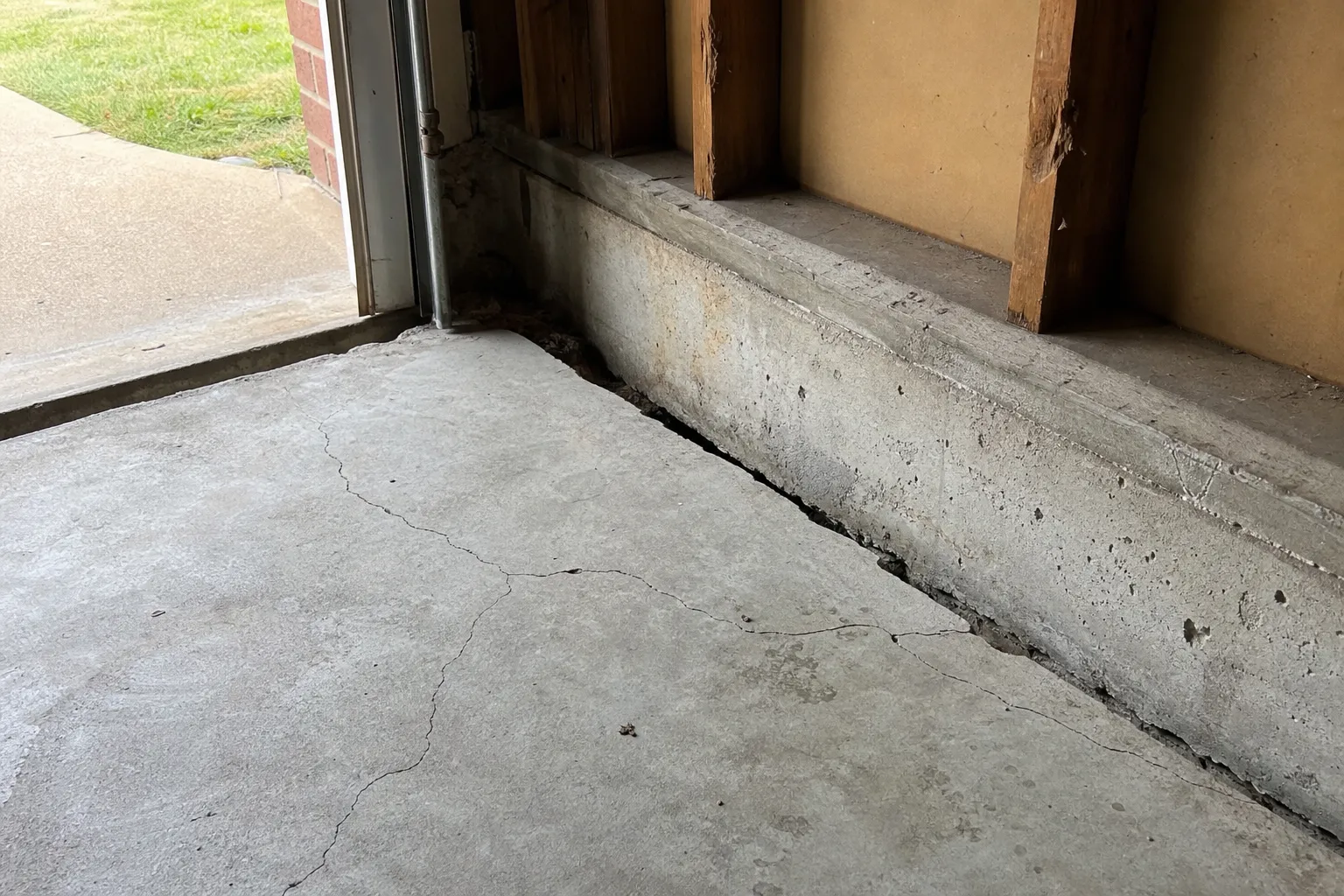
A diagonal crack from one corner of the garage to the opposite corner usually indicates the fill settled unevenly underneath. One side of the slab is sitting lower than the other. If the offset is less than a quarter inch and is not actively growing, it may be stable. If the gap is widening or the slab is noticeably tilted, the fill has not finished moving.
Crack at the joint where the garage meets the house
This is the most common pattern we see across Tulsa, Owasso, and Jenks. A separation forms right where the garage slab meets the home’s foundation stem wall. It happens because the two slabs were never structurally connected — the garage slab was poured up against the foundation but not tied into it. When the fill underneath the garage compresses, the garage floor drops while the house stays in place, and the joint opens up.
Multiple cracks with a sunken center section
When you see several cracks radiating from a central depression, the fill underneath that area has either washed out or compressed significantly. This sometimes happens when a plumbing leak under the garage goes undetected for months. The water saturates the clay fill, it loses bearing capacity, and the slab above it settles into the void.
When garage floor settling affects the rest of your home
A sinking garage floor is usually not a structural threat to your home’s foundation. The two slabs are independent. However, there are situations where garage floor movement signals a broader problem:
- If the stem wall between the garage and the living space is cracking, the soil movement affecting the garage may be extending under the home’s foundation perimeter.
- If interior doors near the garage are sticking, the foundation beam adjacent to the garage may be responding to the same soil conditions.
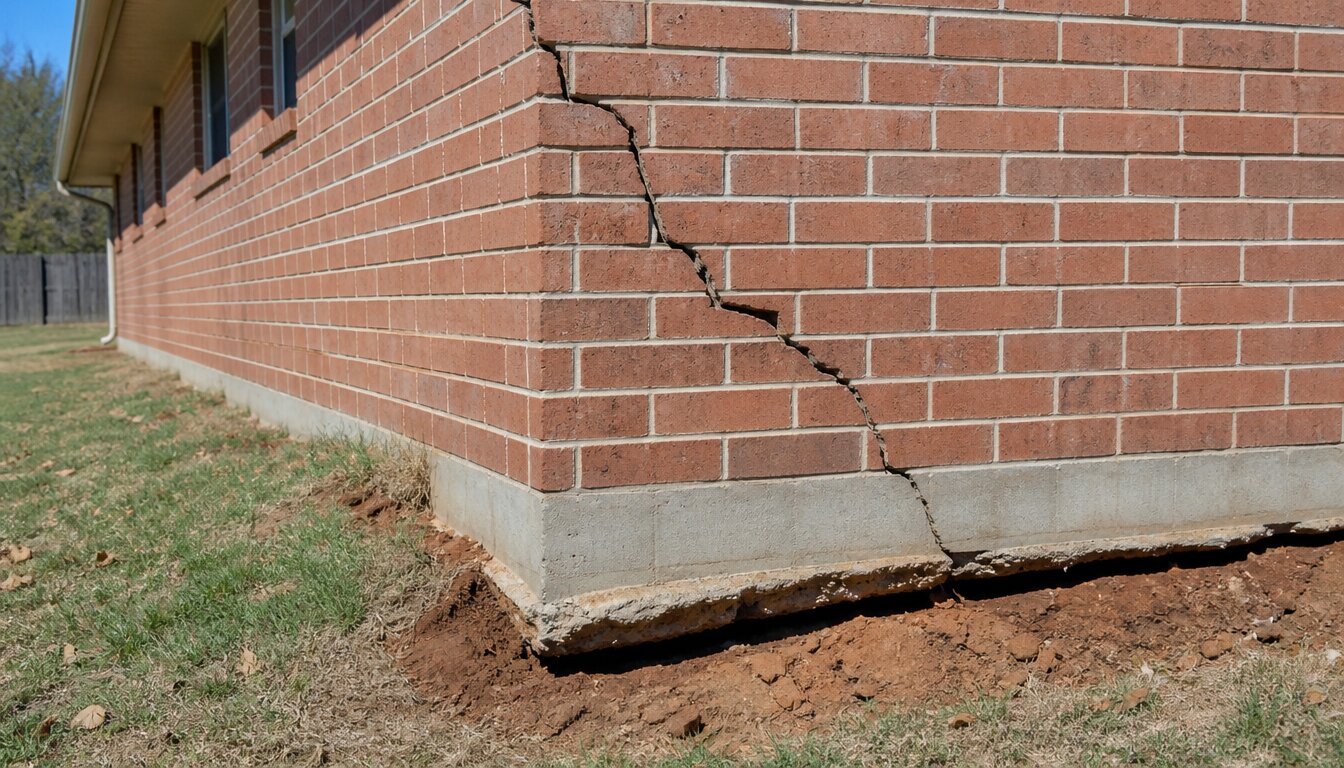
- If you see stair-step cracks in the brick veneer above the garage, the movement is no longer limited to the floating slab — it is affecting the structure.
In those cases, we evaluate the entire foundation, not just the garage floor.
How garage floor repair works in Oklahoma
For a garage slab that has settled but is otherwise intact, the standard fix is polyurethane foam injection. Small holes are drilled through the slab at strategic points, and expanding polyurethane foam is injected underneath. The foam fills voids, compresses loose fill, and lifts the slab back to grade.
The process takes a few hours for a typical two-car garage. The foam cures in minutes, and you can park on the slab the same day. It works well for settlement up to about 2 inches. Beyond that, or if the slab is badly broken into multiple pieces, replacement may make more sense than lifting.
For situations where the garage floor settling is connected to broader foundation movement, we may recommend steel push piers or helical piers along the adjacent foundation beam before addressing the garage slab itself. Lifting the slab without stabilizing the foundation would be treating the symptom, not the cause.
What a garage floor evaluation includes
When we come out to look at a settling garage floor in Tulsa, we check:
- Elevation readings across the garage slab using a zip level or manometer
- The width, depth, and direction of all cracks
- The joint between the garage slab and the home’s foundation
- The stem wall and brick veneer above and adjacent to the garage
- Drainage patterns around the garage door opening and along the driveway apron
- Any evidence of plumbing leaks that could be saturating the subgrade
If the issue is isolated to the garage slab, the fix is usually straightforward and affordable. If we see signs that the movement extends into the home’s foundation, we tell you that directly and explain what the full repair would involve.
The bottom line for Tulsa homeowners
Your garage floor is built differently from your foundation, sits on shallower fill, and is more exposed to Oklahoma’s moisture extremes. That is why it settles first. Most of the time, it is a standalone slab issue that foam injection handles cleanly. Occasionally, it is an early warning that the soil conditions under your home are shifting.
If your garage floor has dropped, cracked, or separated from the house, a concrete leveling evaluation will tell you exactly what is going on and whether the fix is a half-day foam job or something that needs deeper attention.
Call (918) 361-7787 for a free evaluation. We will measure it, explain what we find, and give you a straight answer on what it needs.